Free Weights Explained: Master Your Home Gym Setup
If you have hit a plateau with bodyweight exercises or are tired of navigating crowded gym floors, it is time to rethink your strength strategy. The beauty of a home gym lies in its efficiency, but bulky machines can quickly eat up your floor space and budget.
That is where free weights come in. Versatile, space-saving, and incredibly effective for building functional strength, they are the cornerstone of any serious training setup. In this guide, we will help you navigate the essential gear, plan your layout, and maximize your workouts.
Key Takeaways
- Free weights require more stabilization than machines, leading to better functional strength and core engagement.
- Adjustable dumbbells are the most space-efficient starting point for garage and apartment gyms.
- Proper flooring (at least 3/8-inch rubber) is non-negotiable to protect your foundation and equipment.
- Mastering how to use free weights safely requires starting light and prioritizing form over load.
Choosing the Right Setup for Your Space
Building a home gym in North America usually means working within the confines of a two-car garage, a basement, or a spare bedroom. Your equipment choices need to reflect your square footage.
Dumbbells, Kettlebells, or Barbells?
If you are in an apartment or tight bedroom setup, adjustable dumbbells are your best friend. They replace an entire rack of fixed weights in a footprint no larger than a shoebox. For garage gyms with at least 100 square feet of dedicated space, a barbell and bumper plate setup becomes viable. Kettlebells offer a fantastic middle ground, perfect for ballistic movements and easily tucked away in a corner.
Protecting Your Floors
Do not just drop iron on bare concrete or hardwood. You need high-density rubber flooring. Horse stall mats (typically 4x6 feet and 3/4-inch thick) are a home gym staple that will absorb the shock of dropped weights and deaden the noise.
Mastering the Basics: Form and Function
The biggest advantage of unrestricted movement is also its biggest challenge. Without a machine guiding your path, your stabilizing muscles have to work overtime.
Learning How to Use Free Weights
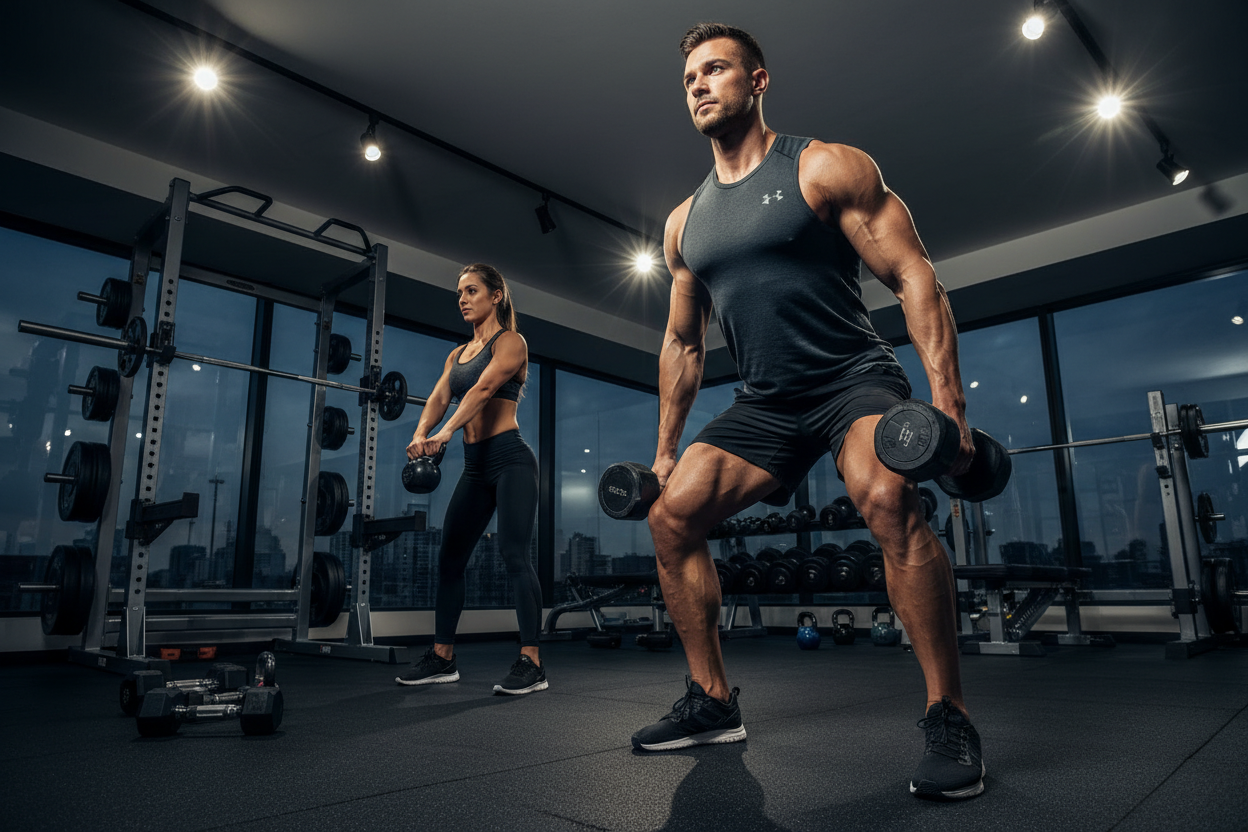
If you are wondering how to use free weights effectively, the secret is tempo and control. Start with compound movements like goblet squats, overhead presses, and Romanian deadlifts. Keep your core braced, control the eccentric (lowering) portion of the lift, and never sacrifice your spinal alignment for an extra rep.
Gym vs. Home Training
Many people ask how to use free weights at gym environments versus a home setup. At a commercial facility, you have the luxury of endless fixed-weight increments, specialized benches, and heavy-duty racks. At home, you need to be creative. Utilize tempo variations, pause reps, and unilateral (single-arm or single-leg) exercises to make lighter weights feel heavier and push your muscles to failure without needing a massive rack of heavy iron.
From Our Gym: Honest Take
Over the last four years, I have tested dozens of setups in my own 12x12 basement gym. While I love the classic feel of cast-iron hex dumbbells, I eventually swapped them for a premium set of adjustable dumbbells. The space savings were undeniable.
However, here is my honest caveat: adjustable dumbbells can feel slightly clunky during explosive movements like snatches, and you absolutely cannot drop them without risking the internal mechanisms. For heavy deadlifts and presses, I still rely on a standard Olympic barbell. The knurling on a quality bar provides a chalked grip that no adjustable handle can match. If you have the budget, get the adjustables for accessory work and a barbell for your heavy compounds.
Frequently Asked Questions
Are free weights better than machines?
For most home gym owners, yes. They recruit more stabilizer muscles, mimic natural human movement patterns, and offer vastly superior space-to-versatility ratios compared to single-station machines.
How much weight should a beginner buy?
A beginner should look for an adjustable dumbbell set that goes up to at least 50 lbs per hand. If buying a barbell, a standard 300 lb weight set (including the 45 lb bar) will provide plenty of room to grow for squats and deadlifts.
Do I need a bench to use them effectively?
While not strictly mandatory—you can do floor presses instead of bench presses—a flat or adjustable weight bench exponentially increases the number of exercises you can perform, making it a highly recommended early investment.