
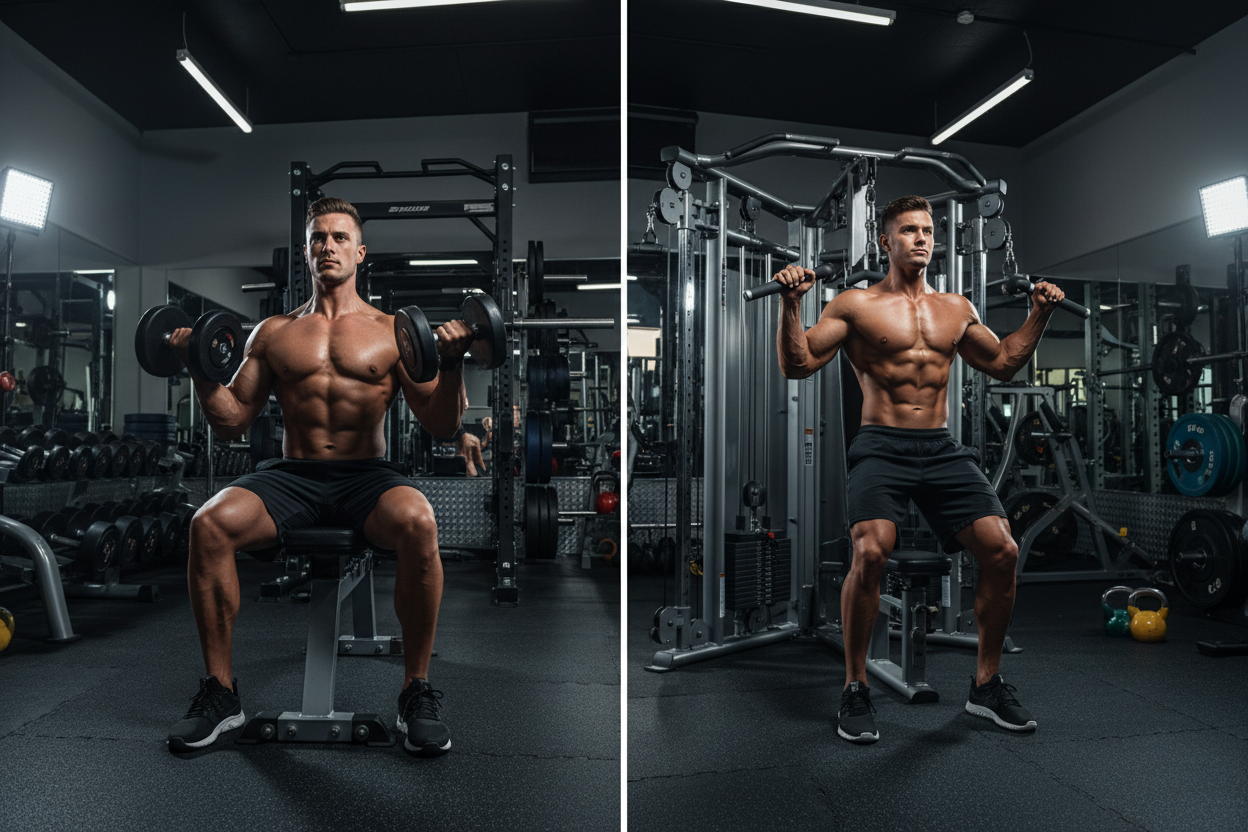
Free weight bench press vs machine: Which Builds a Better Chest?
Building the ultimate chest setup in your home gym usually brings up one massive debate. When you are mapping out your floor plan, balancing your budget, and chasing those upper-body gains, the free weight bench press vs machine dilemma is guaranteed to surface.
Both options have die-hard fans. Free weights offer raw, functional strength, while machines provide targeted, stabilized muscle isolation. But when you are outfitting a basement or garage gym where every square foot matters, you cannot afford to make the wrong choice. In this guide, we will break down exactly which setup makes the most sense for your space, training style, and budget.
Key Takeaways
- Free weights require high stabilizer muscle engagement, making them ideal for overall functional strength.
- Machines isolate the pectorals safely without a spotter, perfect for training to absolute failure.
- A free weight setup (rack, bench, barbell) offers more versatility for a smaller footprint compared to single-station machines.
- When comparing a chest press machine vs dumbbell press, dumbbells allow for a deeper, more natural range of motion.
Training Application: Muscle Activation & Growth
The Raw Power of Free Weights
There is a reason the traditional bench press is the gold standard for upper body strength. When you look at a machine vs barbell bench press, the barbell forces your rotator cuffs, lats, and core to work in overdrive just to keep the weight stable. This translates to greater overall neurological adaptation and raw power. Plus, swapping the barbell for dumbbells allows you to correct muscular imbalances and achieve a deeper stretch at the bottom of the movement.
The Isolation of Machines
Machines, such as selectorized chest presses or plate-loaded leverage machines, remove the stabilization factor. While functional purists might scoff, this is actually a massive advantage for hypertrophy (muscle growth). Because you do not have to balance the weight, you can push your chest to absolute mechanical failure safely without a spotter. If you are comparing a chest press machine vs dumbbell press for pure chest isolation, the machine wins by letting you focus 100% of your energy on contracting the pecs.
Space Planning for North American Home Gyms
Garage vs. Spare Bedroom Setups
Space is the ultimate currency in a home gym. A standard Olympic barbell is 86.6 inches long. To comfortably load plates and execute a bench press, you need a minimum width clearance of 10 feet. If you are setting up in a tight spare bedroom, a free weight bench press might feel claustrophobic. However, a power rack and adjustable bench combo is a multi-tool—you can squat, press, and row in one footprint.
Conversely, a dedicated chest press machine usually requires a footprint of around 4 feet by 5 feet. It is more compact in width but is a "unitasker." If you have a sprawling two-car garage gym, adding a dedicated machine is a luxury that makes sense. If you are in a 10x10 room, versatility must win.
Value & Budget: What Makes Sense for You?
Long-Term Investment Analysis
From a financial standpoint, a high-quality adjustable bench and a set of adjustable dumbbells or a barbell setup provides the best price-to-performance ratio. You are unlocking dozens of exercises for the price of one setup. Commercial-grade chest press machines, while incredibly durable and smooth, often cost upwards of $1,500 just to train one or two movement patterns. For most home gym owners, free weights are the smarter initial investment, while machines make great secondary additions once the basics are covered.
From Our Gym: Honest Take
When we were outfitting our own garage gym facility last year, we debated this exact topic. We initially brought in a beautiful, plate-loaded chest press machine. The movement was buttery smooth, and the chest pump was undeniable. However, we quickly realized a major drawback: the footprint.
At 6'2", I found the machine's fixed path slightly restricted my natural pressing angle, causing mild front delt flare. We ended up swapping it for a heavy-duty 3x3 power rack, an adjustable FID bench, and a barbell with aggressive volcano knurling. The knurling on the bar held my chalked grip solid through heavy sets of 315 lbs, and the safety straps in the rack allowed me to train to failure just as safely as I did on the machine. Ultimately, the free weight setup gave us way more bang for our buck, though I still miss the machine for burnout sets.
Frequently Asked Questions
Is a chest press machine safer than a free weight bench press?
Generally, yes. Machines lock you into a fixed range of motion and have built-in safety stops. If you fail a rep, the weight simply returns to the starting position. With a free weight barbell press, failing without a spotter or safety catch arms can be dangerous.
How much space do I need for a barbell bench press setup?
You need an absolute minimum of 10 feet in width to comfortably load and unload an Olympic barbell (which is over 7 feet long itself). Depth-wise, plan for at least 6 to 8 feet to accommodate the bench and your stance.
Can I build a big chest with just a machine?
Absolutely. Because machines allow you to train close to muscular failure with high stability, they provide an excellent stimulus for hypertrophy. However, you may miss out on some of the functional stabilizer strength that free weights provide.


