Forget the Bench: Why a Barbell Hip Thrust Floor Setup Saves Your Back
We have all been there. You are trying to set up for heavy thrusts, but the bench keeps sliding across the stall mats, or worse, you feel that sharp pinch in your lumbar the second you hit the top. I spent years chasing a 'bigger' range of motion on the bench only to realize I was just arching my back like a suspension bridge. The barbell hip thrust floor setup isn't a shortcut; it is a mechanical correction that forces you to move correctly.
Quick Takeaways
- Floor contact physically stops lumbar hyperextension at the top.
- Easier setup for home gyms with limited equipment or sliding benches.
- Peak glute contraction happens at the top, which the floor version preserves perfectly.
- Bumper plates are non-negotiable for rolling the bar into position without a struggle.
The Real Reason Your Lower Back Screams on Glute Day
Bench-based thrusts are great on paper, but they are technically demanding. When your mid-back is pivoted on a bench, it is incredibly easy to flare your ribs and let your lower back do the heavy lifting. I have seen guys at my local warehouse gym load up 405 lbs just to wiggle their hips and crunch their vertebrae. It is not a glute workout at that point; it is a spine-crushing contest.
The bench also introduces 'sliding bench syndrome.' Unless you have a heavy-duty rack or a wall to brace against, that bench is going to move. This shifting base makes it impossible to maintain the 90-degree shin angle you need to keep the tension off your quads and on your glutes.
Why the Barbell Hip Thrust Floor Setup Changes Everything
By performing a barbell hip thrust from floor (technically a heavy glute bridge), you create a hard physical stop. Your butt hits the ground, and your spine stays neutral because there is no room to sag at the bottom or over-arch at the top. The floor acts as a tactile cue for your pelvis.
If you find that even this version feels off, or if you are dealing with a nagging injury that makes heavy bilateral loading a pain, you might want to try a 1 leg hip thrust. This helps fix any side-to-side imbalances before you go back to the heavy bar. The floor setup essentially acts as your coach, physically preventing that dangerous overextension that sends people to the chiropractor.
How to Nail the Barbell Hip Thrust From Floor Form
Lie flat on your back with your knees bent at roughly 90 degrees. Tuck your chin—this is the most important part. If you look at the ceiling, you will arch your back. Keep your eyes on the wall in front of you. Drive through your heels and squeeze like you are trying to crush a walnut between your cheeks.
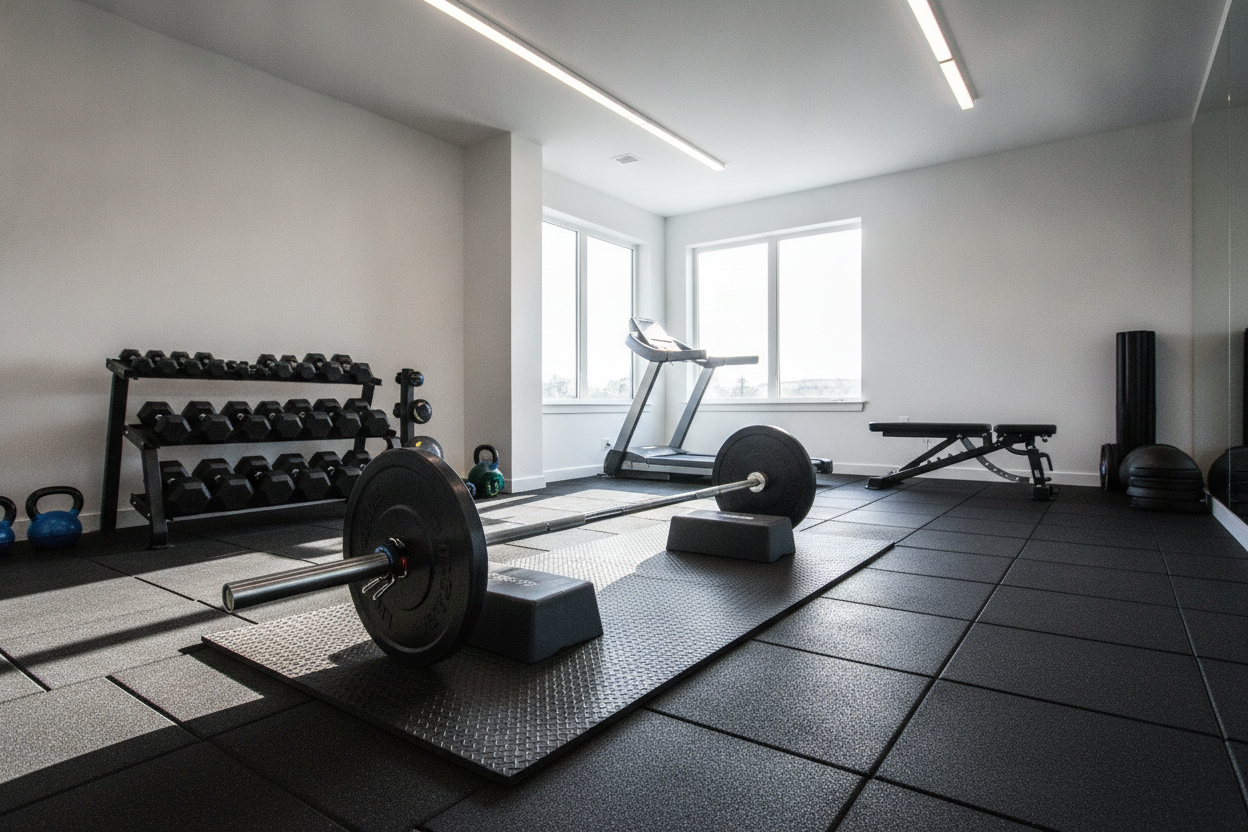
To keep things from sliding, make sure you have a bulletproof barbell hip thrust station where your shoulders are not sliding on slick hardwood or thin carpet. A decent set of rubber stall mats or a high-grip yoga mat under your upper back makes a massive difference in stability.
The Bumper Plate Hack for Easy Loading
Do not even try this with 10-lb iron plates. You will be pinned to the floor like a trapped bug. Using a full-diameter barbell bumper plate set gives you the 8.5 to 9 inches of clearance needed to actually roll the bar over your thighs and into the crook of your hips. If you are using iron 45s, that is fine, but anything smaller requires a bar jack or a lot of unnecessary swearing.
Is Reduced Range of Motion Actually a Bad Thing?
Critics say you lose the 'stretch' at the bottom when you ditch the bench. Sure, you lose maybe 4-6 inches of travel. But muscle EMG data shows glutes are most active at short muscle lengths—meaning, the lockout. You are not losing the 'meat' of the movement; you are just cutting out the part where most people's form breaks down anyway. I would rather have 100% quality reps with a shorter range than 50% quality reps that ruin my discs.
Personal Experience
I used to be a range-of-motion snob. I would stack plates under my feet and use a high bench, thinking deeper was better. My reward? A week of popping Ibuprofen and a lower back that felt like it was made of glass. Switching to the floor forced me to actually use my glutes. I had to drop the weight by about 50 lbs initially, which bruised my ego, but my hips have never felt more powerful and my back pain vanished within two weeks.
FAQ
Does the floor version work the same muscles?
Yes, it targets the gluteus maximus, hamstrings, and core. You just lose a small amount of hamstring stretch at the bottom.
Should I use a bar pad?
Absolutely. A heavy steel bar on your hip bones is a recipe for nasty bruising and will make you cut the set short. Use a dedicated thick foam hip thrust pad.
Can I do this with dumbbells?
You can, but a barbell allows for much more progressive overload. Once you can do 100 lbs, balancing a heavy dumbbell on your pelvis becomes a logistical nightmare compared to a stable bar.