Flooring for Weightlifting: What to Know Before You Build
Nothing shatters the dream of a perfect home gym faster than the sound of a loaded barbell cracking your garage's concrete foundation. Whether you are battling limited space, trying to muffle the noise of early morning deadlifts so you don't wake the kids, or just tired of your bench sliding around, your foundation dictates your performance.
Investing in proper flooring for weightlifting isn't just an aesthetic choice—it is a mandatory insurance policy for your equipment, your joints, and your home's structural integrity. In this guide, we will break down exactly what you need to build a safe, durable lifting platform without overspending.
Key Takeaways
- Material is king: High-density vulcanized rubber is the only viable option for heavy lifting; avoid EVA foam entirely.
- Thickness dictates protection: A minimum of 3/4-inch thickness is required if you plan on dropping barbells.
- The stall mat hack: 4x6 foot horse stall mats offer the best price-to-performance ratio for garage setups.
- Subfloors matter: Heavy Olympic lifting over concrete often requires a plywood subfloor underneath the rubber to disperse force.
Material Matters: Rubber vs. Foam
When shopping for weight training flooring, you will encounter a massive variance in materials. Making the wrong choice here will cost you thousands in damaged gear.
High-Density Rubber (The Gold Standard)
Vulcanized or recycled high-density rubber is non-negotiable for strength athletes. It absorbs shock, rebounds predictably, and withstands the localized impact of cast iron or bumper plates. It also provides the necessary grip for your lifting shoes during heavy squats.
Why EVA Foam Fails for Heavy Lifting
Those cheap, interlocking puzzle mats sold at big-box sporting goods stores are made of EVA foam. While fine for yoga or light dumbbell work, foam compresses under heavy loads. If you squat on foam, your feet will sink, destroying your stability and power transfer. Worse, a dropped deadlift will punch right through it.
Thickness Guide: How Much Do You Actually Need?
Not all rubber is created equal. Your training style dictates the thickness of your flooring.
3/8-Inch to 1/2-Inch (General Fitness)
If your routine consists of machine work, dumbbell exercises, and controlled barbell movements where the weight is never dropped (like bench presses or rack pulls inside a power rack), 3/8-inch to 1/2-inch rubber rolls or tiles will suffice. It protects the floor from scuffs and provides great traction.
3/4-Inch (Heavy Deadlifts & Olympic Lifts)
If you are pulling heavy deadlifts, performing cleans, or bailing on squats, 3/4-inch rubber is the absolute minimum. This thickness absorbs the violent kinetic energy of a dropped barbell, protecting the plates from warping and the concrete from micro-fractures.
Space Planning for North American Garage Gyms
Most two-car garages in North America have a slight slope toward the door for drainage. When laying out your weight training flooring, you need to account for this gradient. If you are building an 8x8 foot deadlift platform, placing it perpendicular to the slope can cause the barbell to roll away from you mid-set.
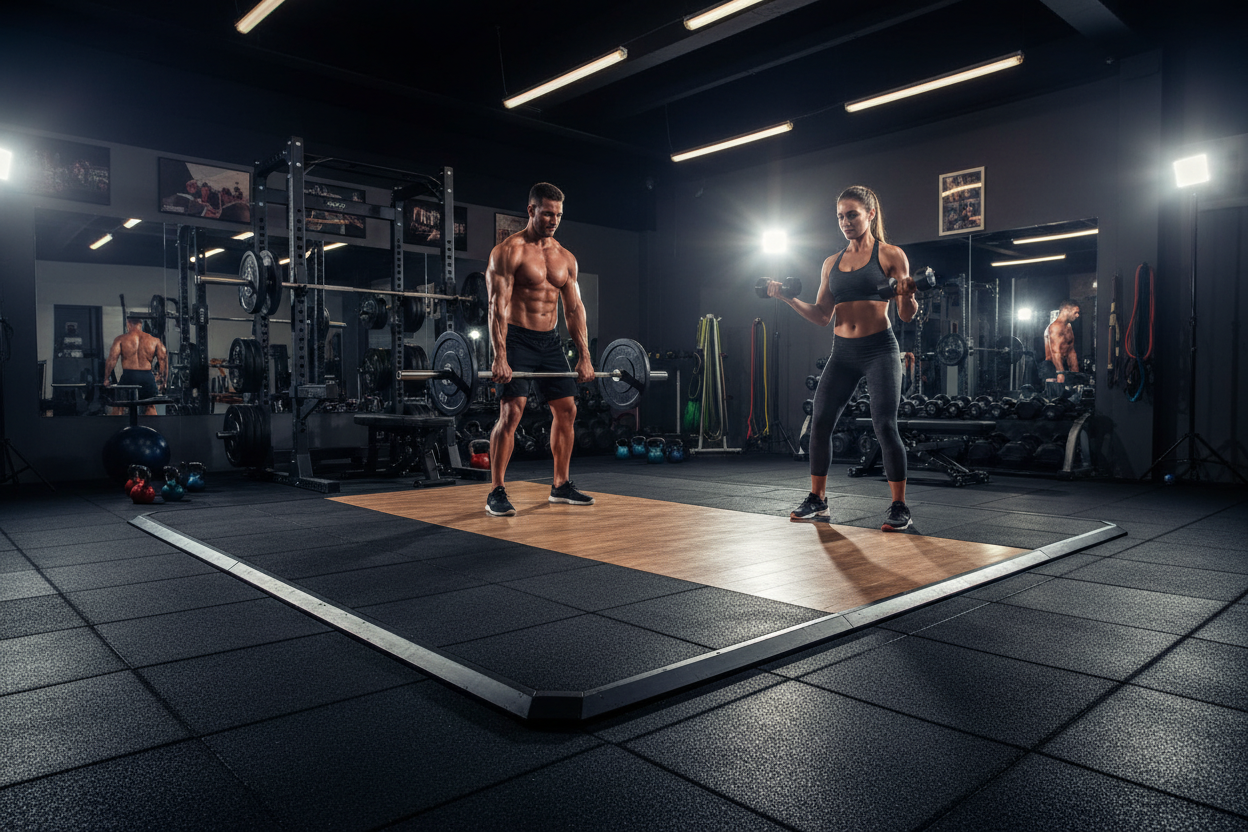
For a standard power rack setup, a 6x8 foot footprint (using three 4x6 stall mats turned sideways) provides enough clearance for the rack, a bench, and a comfortable lifting zone outside the uprights.
From Our Gym: Honest Take
When I first built out my basement gym, I thought I could get away with 1/2-inch commercial rolled rubber directly over the concrete. It looked incredibly sleek. But after a few months of heavy deadlifts, I noticed the concrete underneath was starting to powder and pit. I immediately had to retrofit the space.
I switched to 3/4-inch horse stall mats placed over a layer of 5/8-inch OSB plywood. The difference in shock absorption was night and day, and the barbell stopped bouncing erratically. The one honest caveat? Fresh stall mats smell terribly of off-gassing sulfur. I had to leave them in the driveway in the summer sun for two weeks, scrubbing them twice with a heavy-duty degreaser, before the odor was manageable indoors. It is a hassle, but for the durability and cost savings, it is 100% worth the effort.
Frequently Asked Questions
Do I need plywood under my gym flooring?
If you are dropping heavy weights (over 315 lbs) directly onto a concrete floor, yes. Even 3/4-inch rubber won't disperse all the energy. A layer of 5/8-inch or 3/4-inch plywood acts as a force dissipater, spreading the impact over a wider surface area to protect the concrete beneath.
Are horse stall mats good for a home gym?
They are arguably the best budget-friendly option for home gyms. At 3/4-inch thick, they are designed to withstand a 1,500-pound animal, making them virtually indestructible for human weightlifting. Just be prepared to deal with their initial rubber odor.
How do I stop gym mats from sliding?
If your mats are shifting, you can use heavy-duty double-sided carpet tape along the perimeters. Alternatively, framing the lifting area with 2x4 wood borders or simply using the weight of your power rack to anchor the mats will keep them firmly in place.