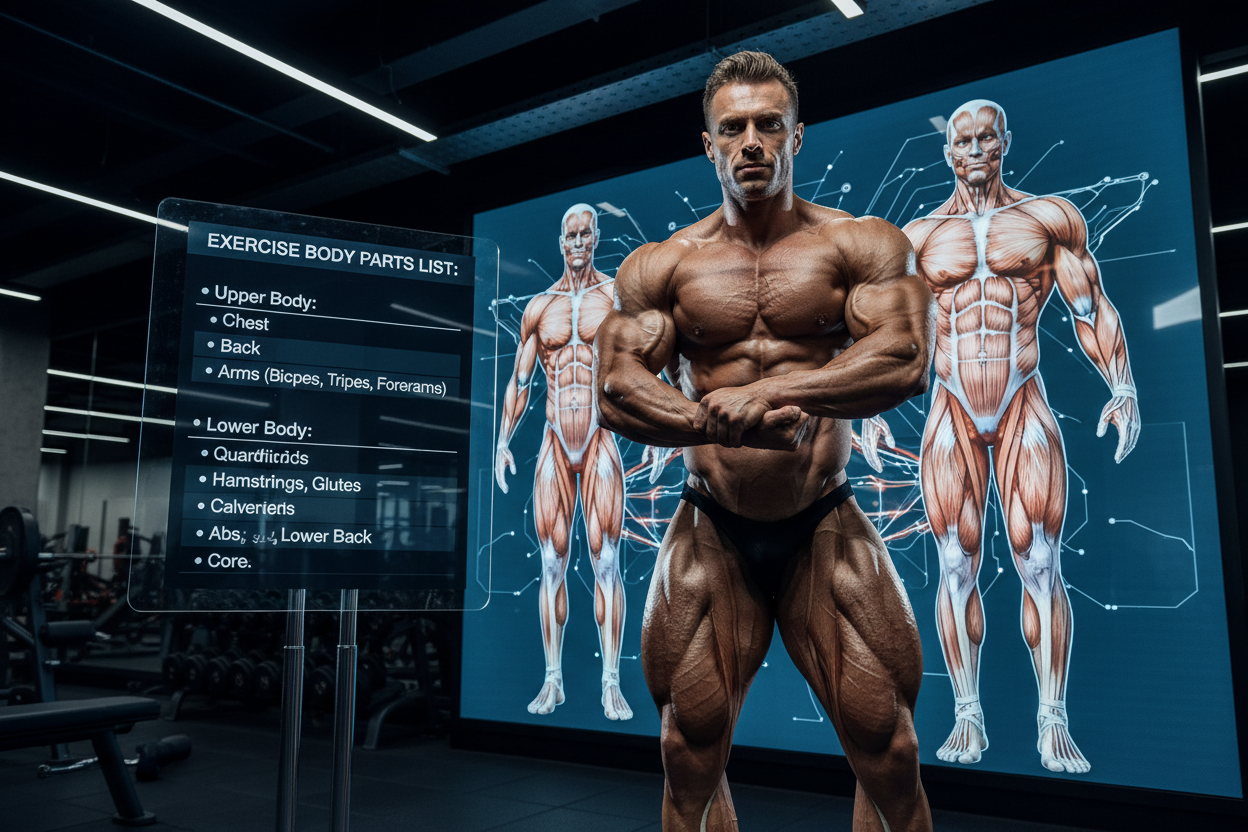
Exercise Body Parts List: The Definitive Guide for Hypertrophy
Walking into the gym without a plan is the fastest way to stall your progress. You grab a dumbbell, do a few curls, maybe hit the bench press, and call it a day. But without a structured exercise body parts list, you are likely neglecting critical stabilizers or overtraining your mirror muscles (chest and biceps).
Understanding anatomy isn't just for medical students; it is the blueprint for building a balanced physique. If you don't know what you are trying to target, you can't establish the mind-muscle connection required for growth.
Key Takeaways: The Core Muscle Groups
If you are looking for a quick reference to structure your training split, here is the essential hierarchy of muscle groups you need to hit weekly.
- Chest (Pectorals): Major and minor; responsible for pushing movements.
- Back (Posterior Chain): Lats, traps, and rhomboids; responsible for pulling.
- Legs (Lower Body): Quads, hamstrings, glutes, and calves.
- Shoulders (Deltoids): Front, side, and rear heads.
- Arms: Biceps, triceps, and forearms.
- Core: Rectus abdominis, obliques, and transverse abdominis.
The Major Groups: A Detailed Breakdown
To build a physique that functions as well as it looks, we need to go beyond the basics. Here is a comprehensive list of body parts to workout, categorized by how they actually move.
1. The Torso (Push and Pull)
Your torso houses the largest muscle groups in the upper body. Training these releases the most anabolic hormones and burns the most calories.
- Pectorals (Chest): Don't just bench press. You need to hit the upper chest (clavicular head) with inclines to avoid that "droopy" look.
- Latissimus Dorsi (Lats): The "wings" of your back. Vertical pulling (pull-ups) builds width, while horizontal rowing builds thickness.
- Trapezius (Traps): These run from your neck down to the middle of your back. Most people ignore the lower traps, which leads to poor posture.
2. The Legs (The Foundation)
Skipping leg day is a meme for a reason. Your legs house the largest muscles in the body.
- Quadriceps: The front of the thigh. Essential for knee extension.
- Hamstrings: The back of the thigh. Crucial for knee flexion and hip stability.
- Glutes: The engine of your body. Weak glutes often cause lower back pain.
3. The Extremities (Shoulders and Arms)
This is the list of muscles to workout if you want aesthetic appeal, but they also serve vital functional roles.
- Deltoids: The shoulder has three heads. The side delt gives you width, but the rear delt is what keeps your shoulders healthy.
- Triceps: These make up two-thirds of your arm mass. If you want big arms, stop curling and start pressing.
Structuring Your Split
Knowing the parts is step one. Grouping them is step two. You shouldn't train every body part every day unless you are doing a specific full-body routine with managed intensity.
The Push/Pull/Legs Logic:
The most effective way to use this list is to group muscles that work together. Chest, shoulders, and triceps are "Push" muscles. Back and biceps are "Pull" muscles. This prevents you from training a sore muscle two days in a row.
My Training Log: Real Talk
I used to think I had a complete routine until I started suffering from nagging shoulder impingement. I looked at my training log and realized my "exercise body parts list" was basically just "things I can see in the mirror."
I remember specifically the first time I truly isolated my rear delts. I was doing face pulls, and instead of just yanking the rope, I focused on external rotation. The burn wasn't a deep muscular ache like a squat; it was a sharp, localized heat right behind the shoulder joint that felt almost like cramping. It was uncomfortable and humbling because I had to drop the weight to practically nothing—the stack was so light the plates barely made a sound when they touched.
But the biggest reality check? The "click" in my shoulder during bench press disappeared after three weeks of prioritizing that tiny, invisible muscle. Sometimes the body parts you hate training are the ones keeping you in the game.
Conclusion
Building a body isn't about guessing. It is about systematically checking off every item on this list. Start with the large compound movements for the big groups (Legs, Back, Chest) and finish with isolation work for the smaller details (Arms, Calves, Rear Delts). Consistency with the right structure always beats intensity with the wrong plan.
Frequently Asked Questions
What is the most neglected body part to workout?
The rear deltoids and the hamstrings are frequently skipped. Most lifters are "quad-dominant" and "anterior-dominant" (front of the body), which leads to rounded shoulders and knee issues over time.
Can I train all body parts in one session?
Yes, full-body workouts are excellent for beginners or those with limited time. However, you must manage your volume. You cannot do 5 exercises per body part in a single session without risking burnout.
How many exercises should I do per muscle group?
For large groups like legs and back, aim for 3 to 4 exercises per session. For smaller groups like biceps or calves, 2 exercises are usually sufficient to stimulate growth without overtraining.