
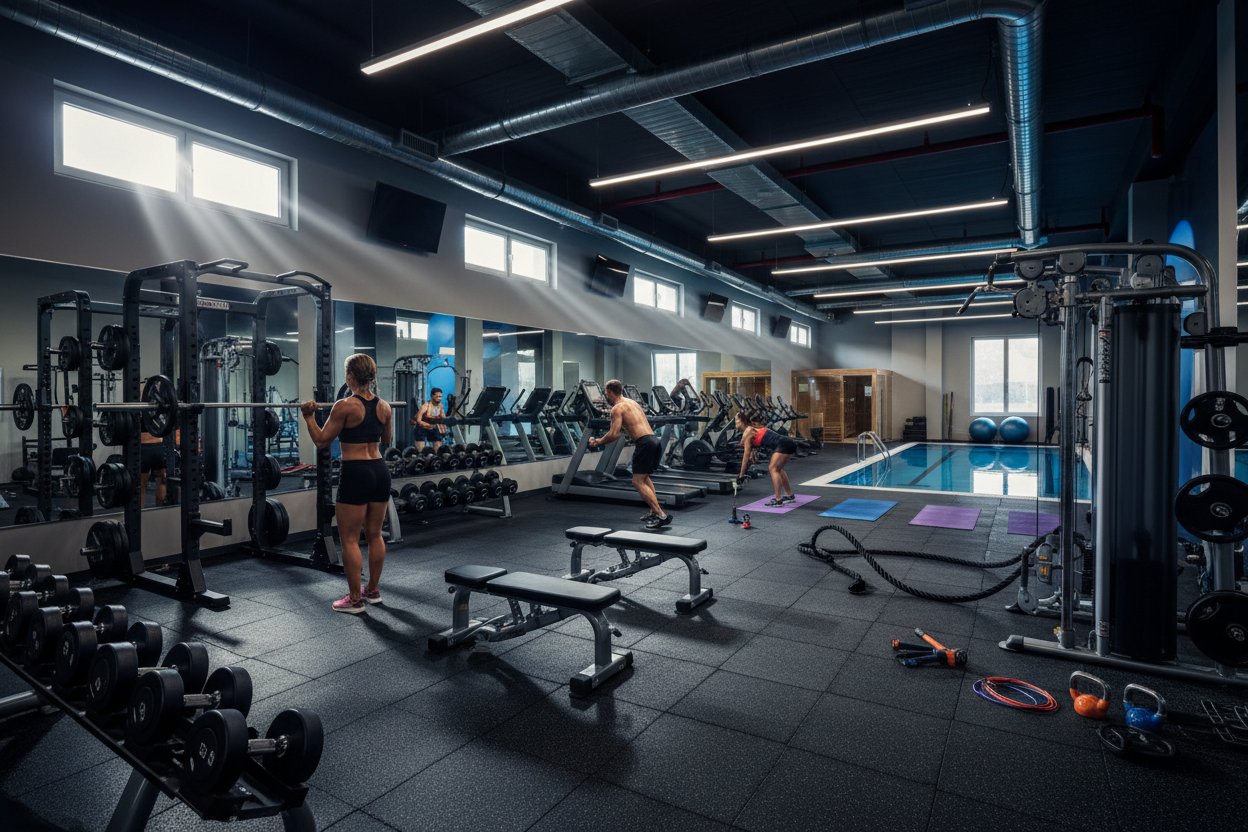
Equipment and Facilities in Gym: The Ultimate Navigation Guide
Walking into a fitness center for the first time can feel like stepping onto an alien planet. You hear the clanking of iron, the hum of motors, and see people contorting themselves on contraptions that look like medieval torture devices. If you feel overwhelmed, you aren't alone. Understanding the vast array of equipment and facilities in gym settings is the first step to conquering that anxiety and actually getting a good workout.
We aren't just going to list items here. We are going to break down the specific zones of a gym, why they exist, and how to navigate them without looking like a deer in the headlights.
Quick Summary: What to Expect
If you are looking for a quick breakdown of standard gym zones, here is what you need to know:
- Cardio Theater: Includes treadmills, ellipticals, and rowers primarily for heart health and calorie expenditure.
- Free Weight Section: The area containing dumbbells, barbells, and benches for compound strength movements.
- Resistance Machines: Pin-loaded or plate-loaded devices designed to isolate specific muscle groups safely.
- Functional Training Area: Open turf or mat space with kettlebells, medicine balls, and TRX straps for mobility and stability.
- Recovery & Amenities: The non-training facilities found in gym environments, such as saunas, steam rooms, and locker areas.
The Cardio Zone: More Than Just Running
Most gyms position this section right at the entrance. It serves as a warm-up area and a conditioning hub. You will usually find treadmills, stair climbers, and stationary bikes here.
The science here is straightforward: steady-state movement increases your heart rate and body temperature. However, a common mistake is spending your entire session here because it feels "safe." Use this equipment to prime your central nervous system for 5-10 minutes before moving to the weights, or for dedicated endurance sessions.
The Resistance Machines: Isolation and Safety
If you walk past the cardio, you typically hit the machine sector. These are fixed-path motion devices. You sit down, adjust a pin to select weight, and push or pull.
Pin-Loaded vs. Plate-Loaded
You will encounter two main types. Pin-loaded machines use a weight stack with a selector pin. They are excellent for beginners because the stability is built into the machine. Plate-loaded machines (often Hammer Strength brand) require you to manually load round iron plates onto the machine. These generally mimic natural movement curves better but require more setup time.
The Free Weight Section: The Iron Paradise
This is often the most intimidating area, but it yields the highest return on investment for strength. This area is defined by equipment that is not bolted to the floor or guided by cables.
Dumbbells and Barbells
Dumbbells require you to stabilize the weight in three dimensions. This recruits more muscle fibers than machines because your body has to fight gravity and lateral movement simultaneously. Barbells allow for heavier loading on compound movements like squats and deadlifts.
Squat Racks and Platforms
You will see large metal cages (power racks). These are vital gym facilities list staples. They allow you to perform heavy lifts with safety bars that catch the weight if you fail a rep. Do not use these for bicep curls if other equipment is available; it is a major breach of gym etiquette.
Functional Training and Turf
Modern gyms have shifted toward "functional fitness." Look for a strip of artificial turf. This area is for sled pushes, lunges, and plyometrics. It is where you train movement patterns rather than just individual muscles.
Here you will find kettlebells (cannonballs with handles) and medicine balls. The goal here is athleticism—teaching your body to move as a cohesive unit.
General Facilities Found in Gym Environments
Beyond the workout floor, the quality of a gym is often judged by its support infrastructure. This includes locker rooms, hydration stations, and recovery zones.
High-end commercial gyms often include saunas or steam rooms. These aren't just for relaxation; heat exposure post-workout can aid in blood flow and muscle relaxation. However, hygiene here is non-negotiable. Always sit on a towel.
My Personal Experience with equipment and facilities in gym
I’ve trained in everything from rusted garage dungeons to pristine, air-conditioned athletic clubs, and I need to be honest about the reality of gym gear. It’s rarely as smooth as the brochures look.
I remember distinctly the first time I used a "high-end" cable crossover machine at a commercial chain. On paper, it was state-of-the-art. In reality, one of the pulleys had a slight hitch—a gritty friction point right at the bottom of the movement. Every time I did a fly, I felt a 'clunk-stutter' that threw off my mind-muscle connection. It taught me that the newest equipment isn't always the best; sometimes the old, well-oiled iron plates that rattle when you lift them offer a smoother, albeit louder, experience.
Another thing nobody tells you about is the "gym smell" in the functional area. There is a specific scent of rubber flooring mixed with disinfectant and stale sweat that lingers on your hands after doing pushups on the turf. No amount of hand sanitizer immediately removes it. It’s a badge of honor, really. It means you actually did the work rather than just sitting on a phone in the locker room.
Conclusion
Mastering the equipment and facilities in gym environments takes time. You don't need to use every machine on your first day. Start with the basics, respect the equipment, and wipe down your station when you are done. The gym is a tool for your body; once you know how to operate the machinery, you can build whatever you want.
Frequently Asked Questions
What is the most essential equipment for beginners?
For beginners, a mix of pin-loaded resistance machines and dumbbells is best. Machines teach you the movement path safely, while dumbbells help build the necessary stabilizer muscles without overloading your joints.
Are the saunas and steam rooms safe to use?
Generally, yes, as long as you stay hydrated and limit your time to 15-20 minutes. However, always check the cleanliness. If the facility smells like mildew rather than cedar or eucalyptus, it is best to skip it to avoid respiratory issues.
What is the difference between a Smith Machine and a Squat Rack?
A Squat Rack allows for free movement of the barbell, requiring you to balance the weight. A Smith Machine has the barbell attached to vertical rails. While the Smith Machine is safer for solo training, it does not train your stabilizing muscles as effectively as a free-weight squat rack.


