Dumbbells vs Resistance Bands: Which Actually Builds Muscle?
Walk into any commercial gym, and you see the divide. On one side, the iron addicts clanging heavy metal. On the other, the functional crowd stretching colorful latex. It’s the classic debate of dumbbells vs resistance bands, and frankly, there is too much misinformation floating around about which tool reigns supreme.
If you are trying to decide whether to invest in a rack of iron or a set of tubes, or if you are wondering if you can really swap heavy lifting for elastic tension, you need the biomechanical facts, not marketing fluff. Let’s break down the physics, the physiology, and the practical application of both.
Key Takeaways: The Verdict
- Resistance Profile: Dumbbells provide constant resistance (gravity), while bands provide linear variable resistance (getting heavier as they stretch).
- Hypertrophy (Muscle Growth): Dumbbells are superior for tracking progressive overload, a key driver of growth. However, bands create higher peak tension at the top of the movement.
- Safety: Resistance bands are generally safer for joints and allow for natural movement patterns, whereas dumbbells require strict form to avoid injury.
- The Winner: For raw size, dumbbells win. For functional strength, rehabilitation, and peak contraction, bands win. The best program uses both.
The Science: Gravity vs. Elastic Tension
To understand the battle of exercise bands vs weights, you have to look at the physics. Your muscles do not have eyes. They don't know if you are holding a generic iron hex dumbbell or a fancy latex loop. They only detect tension.
Dumbbells rely on gravity. A 20lb dumbbell is 20lbs at the bottom of a curl and 20lbs at the top. This is constant resistance. However, because of leverage, the weight often feels lighter at certain points in the range of motion (like the top of a chest fly).
Resistance bands operate on Linear Variable Resistance (LVR). The more you stretch the band, the heavier it gets. This matches your body's natural strength curve for many movements. You are strongest near the lockout of a press, which is exactly where the band exerts the most force. When asking "are resistance bands better than weights," the answer depends on where in the rep you want the challenge.
Dumbbells: The King of Progressive Overload
If your primary goal is resistance bands vs free weights bodybuilding, free weights usually have the edge for one specific reason: Quantifiable Progressive Overload.
To build muscle, you need to systematically increase the stress placed on the body. With dumbbells, moving from 30lbs to 35lbs is a clear, measurable step. You know exactly how much stronger you are getting.
The Pros of Dumbbells
- Stabilization: Unlike machines, dumbbells force you to stabilize the weight, recruiting more muscle fibers.
- Range of Motion: You can often get a deeper stretch with dumbbells than with a barbell or certain band setups.
- Ease of Use: There is no setup time. You just pick them up and lift.
Resistance Bands: The Peak Contraction Specialist
So, are exercise bands as good as weights? In some specific contexts, they are actually better. The issue with free weights is momentum. It is easy to swing a dumbbell up, bypassing the muscle work. With resistance bands, you cannot cheat momentum because the elastic energy pulls back instantly.
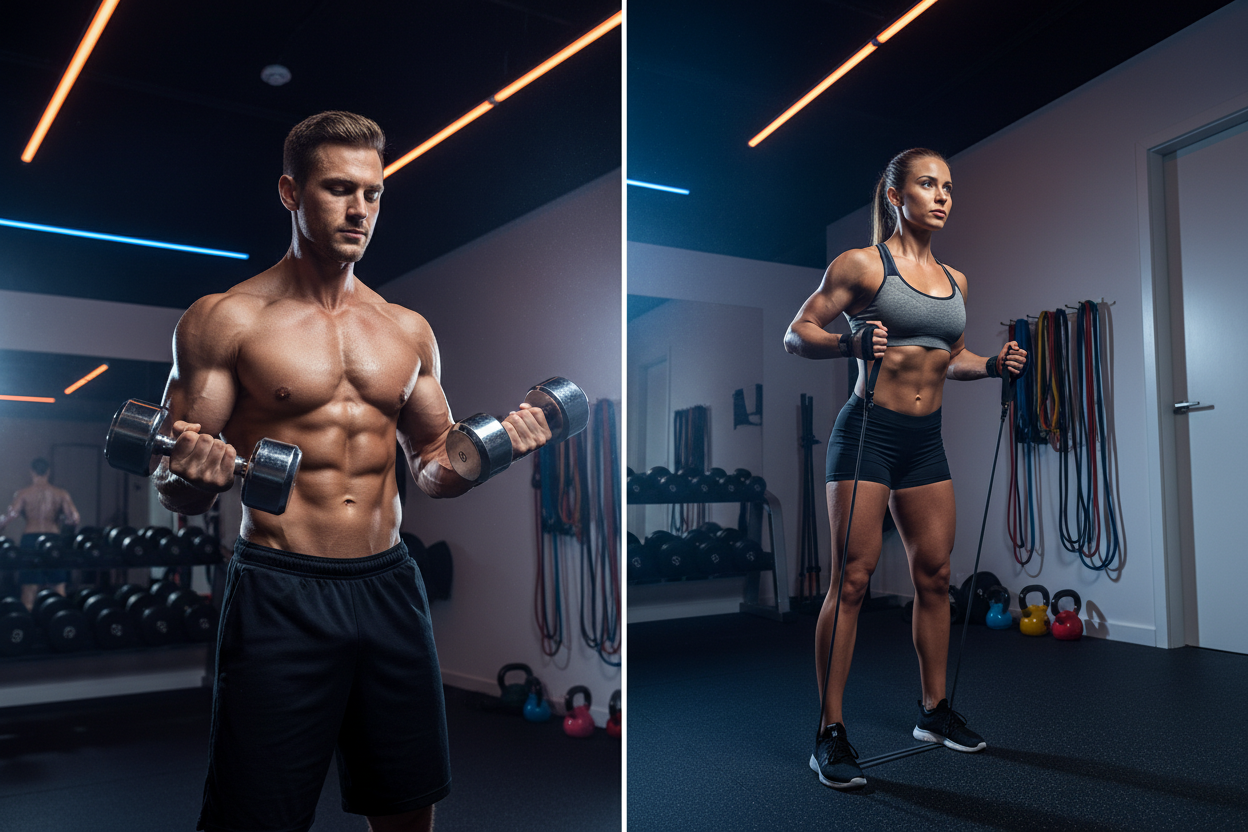
When looking at resistance bands vs weight training, bands force a harder contraction at the peak of the movement. Think about a lateral raise. With a dumbbell, there is almost no tension on your deltoid at the bottom. With a band, you can maintain tension through the entire rep.
Why Choose Bands?
- Joint Friendly: Elastic weights are not dead weight. They don't compress your joints the same way gravity does, making them ideal for high-volume work or rehab.
- Portability: You can't fit a dumbbell rack in your suitcase.
- Versatility: You can change the angle of resistance (horizontal, vertical, diagonal) easily, which is impossible with free weights without a pulley system.
Head-to-Head Comparison
1. For Building Muscle
Can you use resistance bands instead of weights for hypertrophy? Yes, but it is harder to track. Research shows that if volume and fatigue are equated, bands can build muscle similar to weights. However, keeping track of "Blue Band + Red Band" is harder than logging "50lbs." For pure bodybuilding, dumbbells vs resistance bands usually ends with dumbbells taking the gold, but bands are a fantastic finisher to pump blood into the muscle.
2. For Weight Loss
When discussing resistance bands vs weights for weight loss, the tool matters less than the intensity. Dumbbells might allow for heavier compound lifts (squats, deadlifts) which burn more calories during the session. However, bands are excellent for metabolic circuits and high-rep burnout sets that keep your heart rate elevated.
3. Safety Profile
Are resistance bands safer than weights? Generally, yes. If you drop a resistance band, it just snaps back to the anchor. If you drop a dumbbell, you might break a toe. Furthermore, resistance tube vs weights comparisons show that tubes put less shear force on the spine during movements like squats.
The Hybrid Approach: Weights with Resistance Bands
The smartest athletes don't choose. They combine. This is often called "accommodating resistance." You can wrap a band around a heavy dumbbell or barbell. As you lift the weight, the band stretches, making the load heavier at the top. This forces you to accelerate through the entire movement, building explosive power that neither tool can achieve alone.
My Training Log: Real Talk
I’ve spent years grinding under heavy iron, but I’ve also spent months traveling with nothing but a bag of loop bands. Here is the honest truth about the experience.
There is a specific, gritty satisfaction to dumbbells. The knurling digging into your palm creates a neurological connection that says "it's go time." You feel the dead weight immediately. But my ego took a massive hit the first time I swapped heavy dumbbell bench press for heavy band presses.
With dumbbells, I could lock out my elbows and rest for a split second at the top. With bands, that "rest" point is actually the hardest part of the rep. The band is trying to violently throw your hands back down. The shake/wobble I felt in my stabilizers was humbling. I also noticed that with bands, the soreness (DOMS) felt different—less deep tissue bruising, more of a surface-level muscle burn. Now, I refuse to do bicep curls without bands because the peak contraction cramping sensation is something I just can't replicate with iron.
Conclusion
So, is resistance band better than weights? No. Is it worse? Also no. They are different tools for different jobs. If you want to track numbers and build maximum mass, prioritize dumbbells. If you want joint longevity, portability, and peak contraction, prioritize bands.
Don't fall into the trap of thinking you have to be in one camp. Use dumbbells for your heavy compound lifts and resistance bands for your isolation and burnout work. That is how you build a physique that is as functional as it is aesthetic.
Frequently Asked Questions
Can I really build muscle with just resistance bands?
Yes. Your muscles respond to mechanical tension and metabolic stress. As long as you are close to failure and progressively using thicker bands or more reps, you will stimulate hypertrophy. It is harder to measure than free weights, but physiologically effective.
Are resistance bands better than weights for beginners?
Often, yes. Resistance bands vs free weights for beginners is a common debate, but bands are generally more forgiving. They prevent you from using momentum to cheat the weight up, teaching you to control the movement pattern before you graduate to heavy iron.
How do I replicate heavy squats with bands?
This is the hardest lift to replicate. You can stand on the band and hold it at shoulder height (front squat style), or use a heavy loop band across your shoulders and under your feet. However, for lower body raw strength, free weights vs resistance bands usually favors weights due to the sheer load required for legs.