Dumbbell Squats for Women: The Definitive Guide for 2025
Walking into the free weight section can feel like entering a gladiator arena. The squat racks are often occupied, and the idea of loading a heavy barbell onto your back might feel daunting or simply unsafe without a spotter. Here is the truth: you don't need a barbell to build powerful glutes and toned quads. Dumbbell squats for women are arguably the most versatile tool in your training arsenal.
Whether you are training in a crowded commercial gym or a compact living room, dumbbells offer a unique range of motion and safety profile that barbells cannot match. This guide cuts through the noise to show you exactly how to execute this movement for maximum hypertrophy and strength.
Key Takeaways
- Safety First: Dumbbells allow you to safely "bail" on a lift if you reach failure, making them safer for solo training than back squats.
- Core Engagement: Front-loaded variations (like Goblet squats) force higher core activation to maintain an upright torso.
- Imbalance Correction: Using separate weights for each hand helps identify and fix strength asymmetries between your left and right legs.
- Accessibility: You can perform effective squats with weights female lifters need with minimal equipment and space.
Why Choose Dumbbells Over the Barbell?
Many lifters assume that to get strong, the bar must bend. That is a misconception. While barbells are excellent for maximal load, dumbbells provide superior mechanics for many female lifters.
Biomechanics and Center of Gravity
When you place a barbell on your back, the load is behind your center of gravity. This often forces the torso to lean forward to compensate. With women's squats with weights held at the sides or chest, the weight is closer to your center of mass. This allows for a more upright torso, deeper hip flexion, and significantly less shear force on the lumbar spine.
Grip and Stability
Holding weights challenges your stability. Your stabilizer muscles work overtime to prevent the weights from swinging. This creates a systemic tension that builds functional strength, not just aesthetic muscle.
Mastering the Form: Variations That Work
Not all squats are created equal. Depending on how you hold the weight, you change the stimulus.
The Goblet Squat (Beginner to Intermediate)
This is the gold standard for learning proper mechanics. Hold one dumbbell vertically against your chest, cupping the top end with both hands.
Keep your elbows tucked in. As you descend, your elbows should track inside your knees. This tactile feedback prevents your knees from caving in (valgus collapse), a common issue in squats for women with weights.
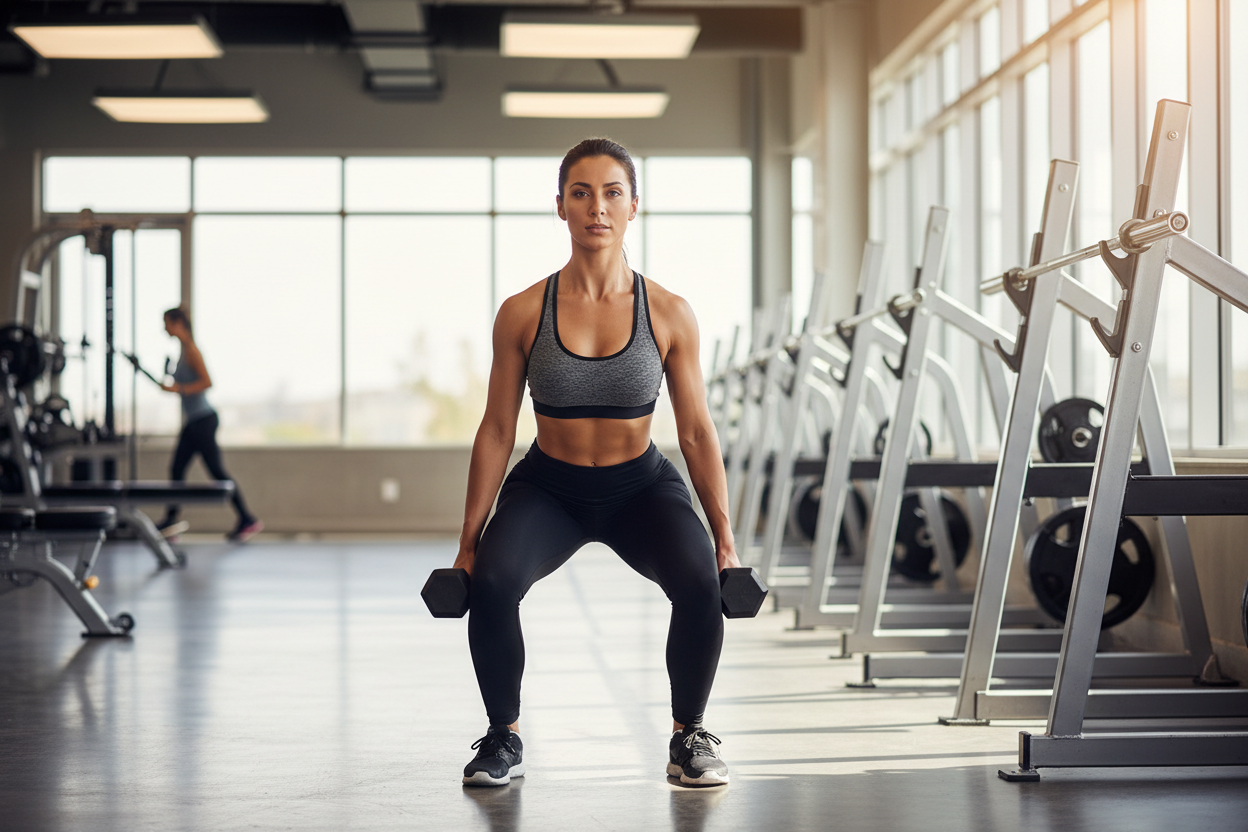
The Dual Dumbbell Squat (Intermediate to Advanced)
Once you max out the heaviest dumbbell for goblet squats, switch to holding two dumbbells at your sides (suitcase style) or racked on your shoulders. The suitcase hold challenges your grip strength and traps, while the shoulder rack emphasizes the quads and core.
Common Mistakes Killing Your Gains
Even with lighter weights, form breakdown reduces efficacy and invites injury.
The "Stripper" Squat
This happens when your hips shoot up faster than your chest coming out of the hole. It shifts the load entirely to your lower back. To fix this, drive your upper back into the imaginary wall behind you as you stand up.
Knee Valgus
If your knees buckle inward as you push up, you are losing glute engagement. Think about "spreading the floor" with your feet to keep the knees tracking over the toes.
My Training Log: Real Talk
I want to be honest about the reality of switching to high-volume dumbbell work. A few years ago, I injured my lower back and had to abandon the barbell for three months. I switched exclusively to heavy dumbbell squats.
The first thing I noticed wasn't leg fatigue—it was my forearms screaming. When you are holding 50lb dumbbells in a front-rack position, the knurling (the rough grip pattern) digs into your palms, and your upper back feels like it's on fire before your legs even hit failure. I remember having to use wrist straps just so my grip wouldn't be the limiting factor. Also, getting heavy dumbbells into the starting position is a workout in itself. I learned to kick the weights up with my knees to get them to shoulder height. It’s unpolished and gritty, but the definition I saw in my quads after eight weeks was something the barbell never gave me.
Conclusion
You do not need a 300-pound back squat to have impressive legs. By focusing on time under tension, depth, and proper mechanics, dumbbell squats can serve as the cornerstone of your lower body training. Grab the weights, check your ego at the door, and focus on the quality of every rep.
Frequently Asked Questions
Will dumbbell squats make my legs bulky?
No. Building significant bulk requires a massive calorie surplus and high levels of testosterone. Dumbbell squats will build lean muscle tissue, giving your legs shape and firmness, not excessive bulk.
How heavy should I go?
Select a weight where the last 2-3 reps feel difficult to complete with perfect form. If you can easily chat while squatting, the weight is too light. If your form breaks down immediately, it is too heavy.
Can I replace barbell squats entirely with dumbbells?
Yes, for most general fitness and aesthetic goals. Unless you are a powerlifter competing in the squat, dumbbells provide enough resistance to build strength and muscle for the vast majority of women.