Don't Skip Leg Day: How to Build Big Legs Even With Bad Knees
Few things are more demoralizing in the gym than gearing up for a heavy squat session only to feel that familiar sharp twinge in your patella. Knee pain is the great equalizer in fitness, affecting everyone from seasoned powerlifters to weekend warriors. If you are dealing with this, your first instinct might be to rest indefinitely. You might find yourself asking, should i skip leg day if my knee hurts?
The short answer is no, you usually shouldn't skip it entirely, provided the pain isn't from an acute, fresh injury like a tear. Completely avoiding movement often leads to atrophy in the quadriceps and hamstrings, the very muscles responsible for stabilizing your knee joint. The solution isn't cessation; it's modification. You can absolutely learn how to build big legs with bad knees by shifting your focus from heavy load to mechanical tension and selecting the right movements. You don't have to sacrifice size for comfort.
Understanding the Mechanics of Knee-Friendly Training
When you look at standard leg workouts, they are often quad-dominant and involve significant forward knee travel (think sissy squats or forward lunges). For healthy joints, this is fine. For sensitive joints, this shear force is a nightmare. To train legs with bad knees effectively, you need to prioritize the posterior chain—your glutes and hamstrings. These muscles extend the hip without placing excessive torque on the knee joint.
Furthermore, maintaining a vertical shin angle during compound movements is crucial. When your shin stays perpendicular to the floor, the load shifts back into your hips. This allows you to perform weightlifting with bad knees without feeling like you are grinding your cartilage into dust.
The Best Compound Movements for Weak Knees
If you want to know what are the best leg exercises for bad knees that still pack on mass, look no further than the Romanian Deadlift (RDL). Unlike a standard deadlift or squat, the RDL involves almost no knee flexion. It is a pure hip hinge. You can load this movement heavily to stimulate the hamstrings and glutes, contributing to overall leg size without aggravating the knee joint.
Another staple for your routine should be the Box Squat. This is widely considered one of the best leg exercises knee pain sufferers can utilize. By sitting back onto a box, you break the eccentric portion of the lift, eliminating the bounce at the bottom where knee stress is highest. It forces you to use your hips to drive up. This is exactly how to do leg day with bad knees while still moving respectable weight.
Isolating the Quads Without the Pain
The trickiest part of leg day for knee pain is hitting the quadriceps. Most quad exercises, like the leg extension machine, place high shear force on the knee. So, how to strengthen thigh muscles without hurting knees becomes a game of angles.
Terminal Knee Extensions (TKEs) are a lifesaver here. Using a resistance band anchored to a rack and looped behind your knee, you simply straighten your leg against the tension. This pumps blood into the vastus medialis (the teardrop muscle) without heavy impact. It is arguably one of the most effective leg workouts for weak knees because it serves as both a warm-up and a rehabilitation tool.
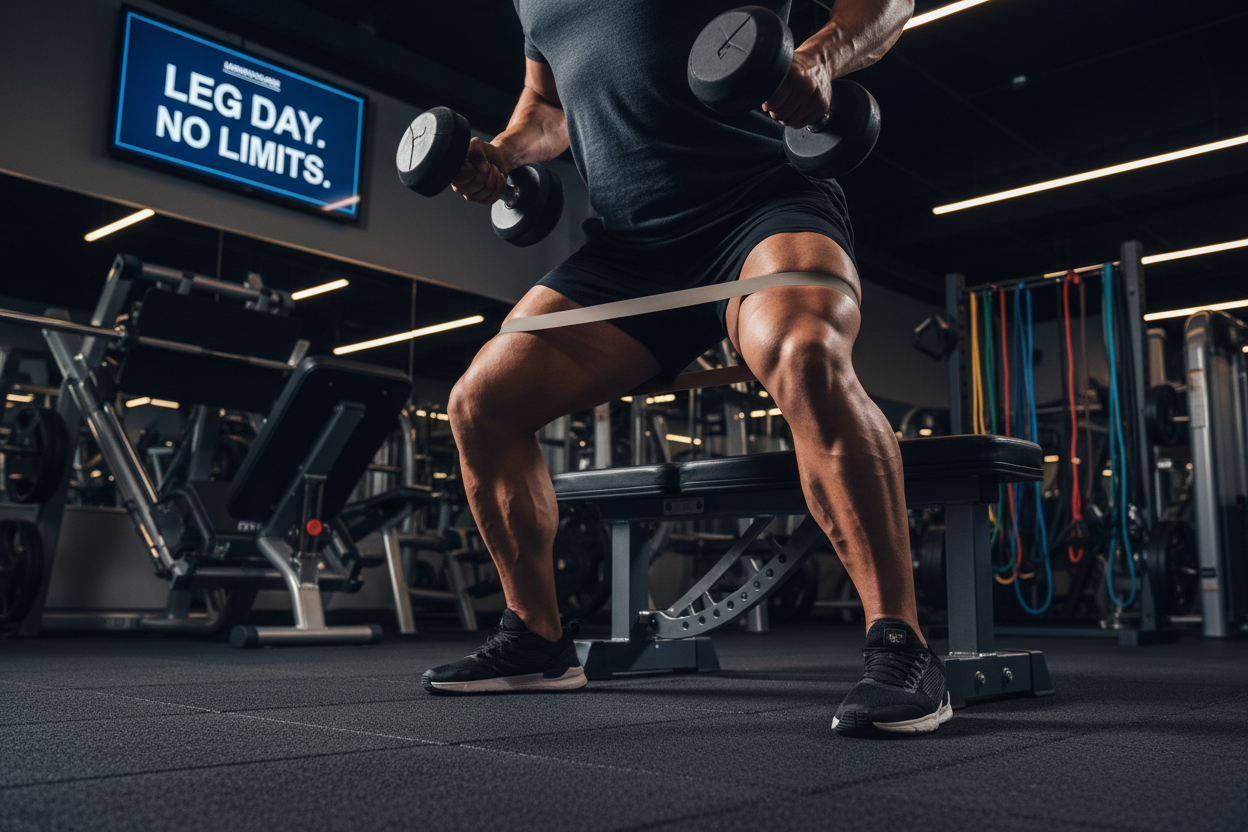
For those looking for thigh strengthening exercises with bad knees that mimic a squat, try the Spanish Squat. This involves using a heavy resistance band looped around the back of your knees while you perform a squat pattern. The band supports the joint and keeps the shins vertical, allowing you to load the quads heavily with significantly reduced pain.
My Personal Battle with Knee Injuries
I learned these lessons the hard way. A few years ago, I developed a nagging case of patellar tendonitis—often called Jumper's Knee—from going too heavy on front squats too frequently. Every time I tried to push through a leg workout with injured knee issues, I ended up limping for two days. I thought my days of building size were over.
I had to completely overhaul my approach. I swapped forward lunges for reverse lunges, which are far superior leg exercises with low knee impact because the backward step keeps the front shin vertical. I stopped back squatting and started doing heavy sled pushes and trap bar deadlifts. Surprisingly, my legs actually grew faster during this period. I realized that how to get bigger legs with bad knees wasn't about the amount of weight on the bar, but the quality of the contraction and the volume I could sustain without injury. Pain kills consistency, and consistency is what builds muscle.
Building Legs at Home
You don't need a leg press or a hack squat machine to see results. There are plenty of at home leg exercises for bad knees that are highly effective. The key is increasing time under tension.
Wall sits are deceptive. They look easy, but holding a perfect 90-degree angle for 60 seconds will set your quads on fire with zero impact. This is a staple among leg exercises for bad knees at home. Combine this with glute bridges performed with a single leg. Lying on your back and driving your hips up using one leg isolates the posterior chain intensely.
If you have a slippery floor, you can perform hamstring curls using a towel or sliders. Lie on your back, lift your hips, and slide your heels out and back in. This is one of those leg exercises that won't hurt your knees but will leave your hamstrings cramping in the best way possible.
Programming Your Leg Day
When structuring a leg day bad knees routine, the order of exercises matters. Pre-exhaustion is a valid strategy. Start with hamstring curls or glute bridges to get blood into the area and tire the legs out slightly. This means you won't need as much heavy weight for your compound movements later, which saves your joints.
Here is a sample structure for workouts for guys with bad knees (or anyone wanting mass):
- Warm-up: TKEs (3 sets of 20 reps per leg)
- Primary Compound: Box Squats or Trap Bar Deadlifts (3 sets of 8-10 reps)
- Secondary Compound: Reverse Lunges or Step-Ups (3 sets of 10-12 reps)
- Accessory: Romanian Deadlifts (3 sets of 12-15 reps)
- Finisher: Wall Sits or Sled Pushes
This approach covers all bases: leg exercise knee pain management, hypertrophy, and strength. If you are wondering how to get big legs with bad knees, the secret lies in the 8-15 rep range. Heavy singles and doubles place immense stress on connective tissue. Moderate weight with slow, controlled eccentrics (lowering phase) builds muscle just as effectively and keeps you safe.
Final Thoughts on Training Through Pain
Experiencing knee pain when working out legs is a signal, not a stop sign. It tells you that your mechanics are off or your tissue tolerance is low. By utilizing exercise for legs and knees that prioritize hip dominance and vertical shins, you can continue to progress.
Whether you are doing leg exercises knee focused rehab or trying to build mass, listen to your body. If a movement hurts, swap it. There is always a variation that will work for your anatomy. You can build legs with bad knees; you just have to train smarter, not necessarily harder.
Frequently Asked Questions
Can I still squat if I have bad knees?
Yes, but you likely need to modify the variation. Box squats or Spanish squats are excellent alternatives because they reduce the torque on the knee joint while still working the thigh muscles. Avoid deep ATG (ass-to-grass) squats until your knee strength improves.
What cardio is best for leg day with bad knees?
Low-impact options are best to avoid aggravating the joint. Walking on an incline treadmill, using a stationary bike (cycling), or swimming are ideal choices that increase blood flow to the legs without the repetitive pounding of running on pavement.
How often should I train legs if my knees hurt?
Frequency should depend on recovery. If your knees are sore for days after a session, reduce the volume or frequency to once a week. However, for most people, training legs twice a week with lower volume per session is actually better for joint health than one massive, painful workout.