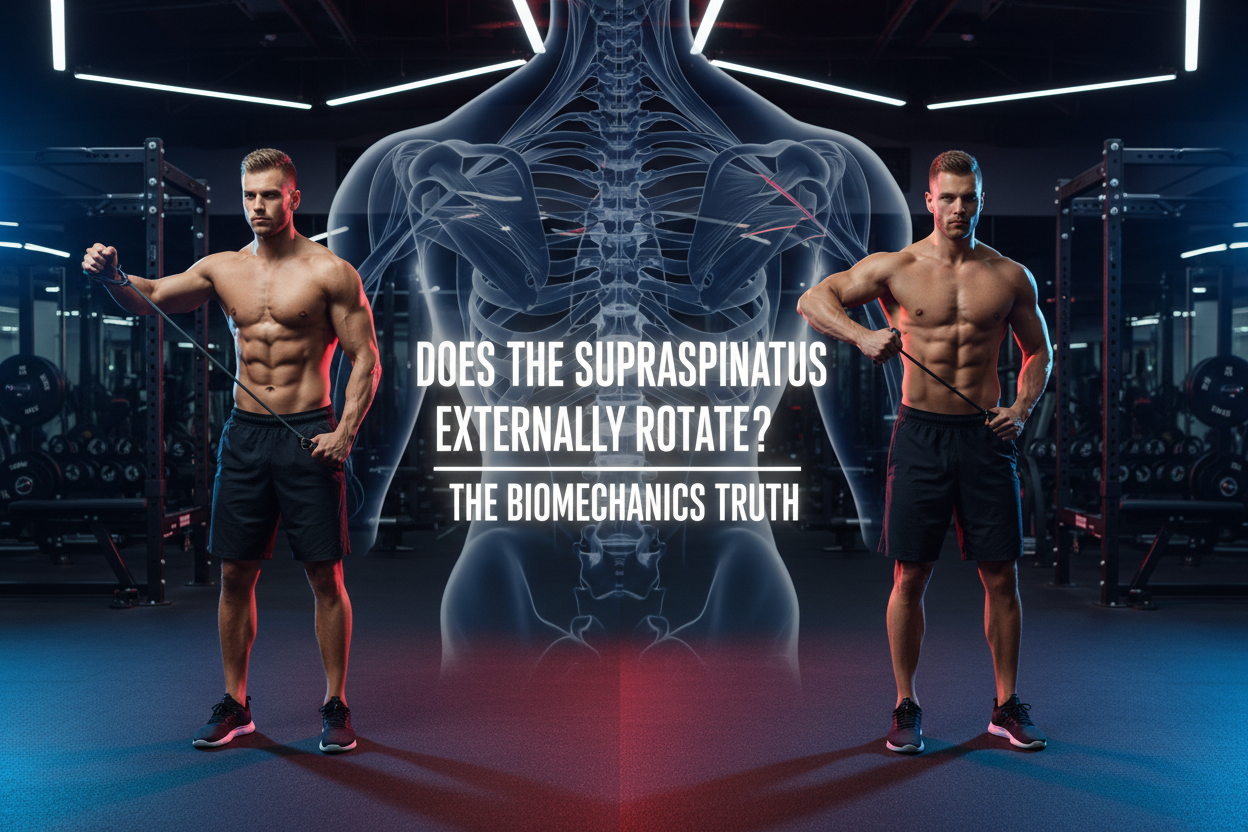
Does the Supraspinatus Externally Rotate? The Biomechanics Truth
Shoulder anatomy is rarely black and white, but few muscles cause as much confusion in the gym and the clinic as the supraspinatus. If you are trying to rehab a shoulder or optimize your overhead press, understanding the role of supraspinatus external rotation is critical to avoiding injury.
Many athletes assume that because it is part of the rotator cuff, its main job is rotation. That assumption often leads to poor exercise selection and the dreaded shoulder impingement. Let’s clear up the biomechanics so you can train smarter.
Key Takeaways: The Supraspinatus Cheat Sheet
- Primary Function: The supraspinatus is primarily a shoulder abductor (lifting the arm away from the side), specifically initiating the first 15–30 degrees of movement.
- Rotation Role: It acts as a weak assistant in external rotation, but it is not the primary mover for this action (that belongs to the infraspinatus and teres minor).
- Stability is King: Its most vital job is compressing the humeral head into the socket to prevent the deltoid from pulling the arm bone upward.
- The Myth: The supraspinatus does not perform internal rotation.
The Anatomy: What Does This Muscle Actually Do?
To understand movement, you have to look at the wiring. The supraspinatus sits on top of the shoulder blade (scapula) and runs under the bony roof of the shoulder (acromion) to attach to the top of the arm bone (humerus).
Because of this horizontal line of pull, its mechanical advantage is best suited for abduction. Think of it as the starter motor for your shoulder. It gets the arm moving sideways before the big deltoid muscle takes over the heavy lifting.
Solving the Debate: Does Supraspinatus Externally Rotate?
This is the million-dollar question for biomechanics nerds and physical therapists.
The Short Answer
Technically, yes, but barely. When the arm is hanging by your side, the supraspinatus can contribute a small amount of torque to external rotation. However, relying on it to rotate your arm is like using a putter to drive a golf ball. It can do it, but it’s not designed for it.
The "Does Supraspinatus Externally Rotate" Context
Research suggests that while the muscle fibers are oriented in a way that could produce rotation, the supraspinatus functions more like a dynamic ligament. As you externally rotate your arm using other muscles, the supraspinatus fires to keep the ball of the joint centered. If it didn't, the rotation would likely cause the bone to slide around loosely in the socket.
The "Supraspinatus Internal Rotation" Myth
Let’s put this one to bed immediately. There is often confusion regarding supraspinatus internal rotation. The supraspinatus does not internally rotate the shoulder.
Internal rotation is handled by the powerhouse muscles: the subscapularis, pectoralis major, and latissimus dorsi. If you are feeling strain in the top of your shoulder during internal rotation (like reaching behind your back), it’s usually not the supraspinatus contracting, but rather the tendon being stretched or pinched (impinged) under the acromion.
Stop Doing "Empty Cans" (Do This Instead)
For years, the "Empty Can" exercise (lifting arms to the side with thumbs pointed down) was the gold standard for isolating this muscle. The logic was that internal rotation isolated the supraspinatus.
We now know this is a bad idea for most people.
Doing lateral raises with your thumbs down (internal rotation) reduces the space in the shoulder joint. This grinds the supraspinatus tendon against the bone. Instead, use the "Full Can" position. Lift your arms with your thumbs pointing up (external rotation). This clears the acromion, gives the tendon room to breathe, and still activates the muscle effectively.
My Training Log: Real Talk on Shoulder Rehab
I learned the hard way that textbook anatomy doesn't always match gym reality. A few years back, I was dealing with a nagging ache right on the top of my deltoid cap. I thought I needed to strengthen my rotators, so I grabbed a resistance band and started hammering away at what I thought was supraspinatus isolation.
I was doing those "Empty Can" raises I mentioned earlier. I remember the specific sensation vividly: a sharp, catching pinch—almost like a piece of gristle getting stuck between two molars—every time my arm passed parallel to the floor. It wasn't a muscular burn; it was mechanical block.
I switched to the "Full Can" raise (thumbs up) and the difference was night and day. The pinch vanished, replaced by a dull, deep fatigue inside the shoulder capsule rather than that sharp bite on the outside. It felt less like I was grinding bone and more like I was actually stabilizing the joint. If you feel that "gristle pinch," stop immediately. You're not training the muscle; you're sawing through the tendon.
Conclusion
While the supraspinatus can assist with external rotation, its main gig is abduction and stabilization. Don't get hung up on trying to make it a primary rotator. Focus on keeping the humeral head depressed and centered in the socket. Train with a "thumbs up" position to keep the joint open, and respect the delicate nature of this small but crucial muscle.
Frequently Asked Questions
Does the supraspinatus externally rotate the arm?
Yes, it assists in external rotation, especially when the arm is by the side. However, it is a weak rotator compared to the infraspinatus and teres minor. Its main function is abduction (lifting the arm).
Does the supraspinatus cause internal rotation?
No. The supraspinatus does not perform internal rotation. That function is primarily carried out by the subscapularis, lats, and pecs. Confusion often arises because internal rotation puts the supraspinatus tendon on a stretch.
What is the best exercise for the supraspinatus?
The "Full Can" exercise is widely considered the best and safest option. This involves lifting the arm in the scapular plane (about 30 degrees forward) with the thumb pointing up, which minimizes the risk of impingement.