Designing the Best Weight Room for Serious Strength
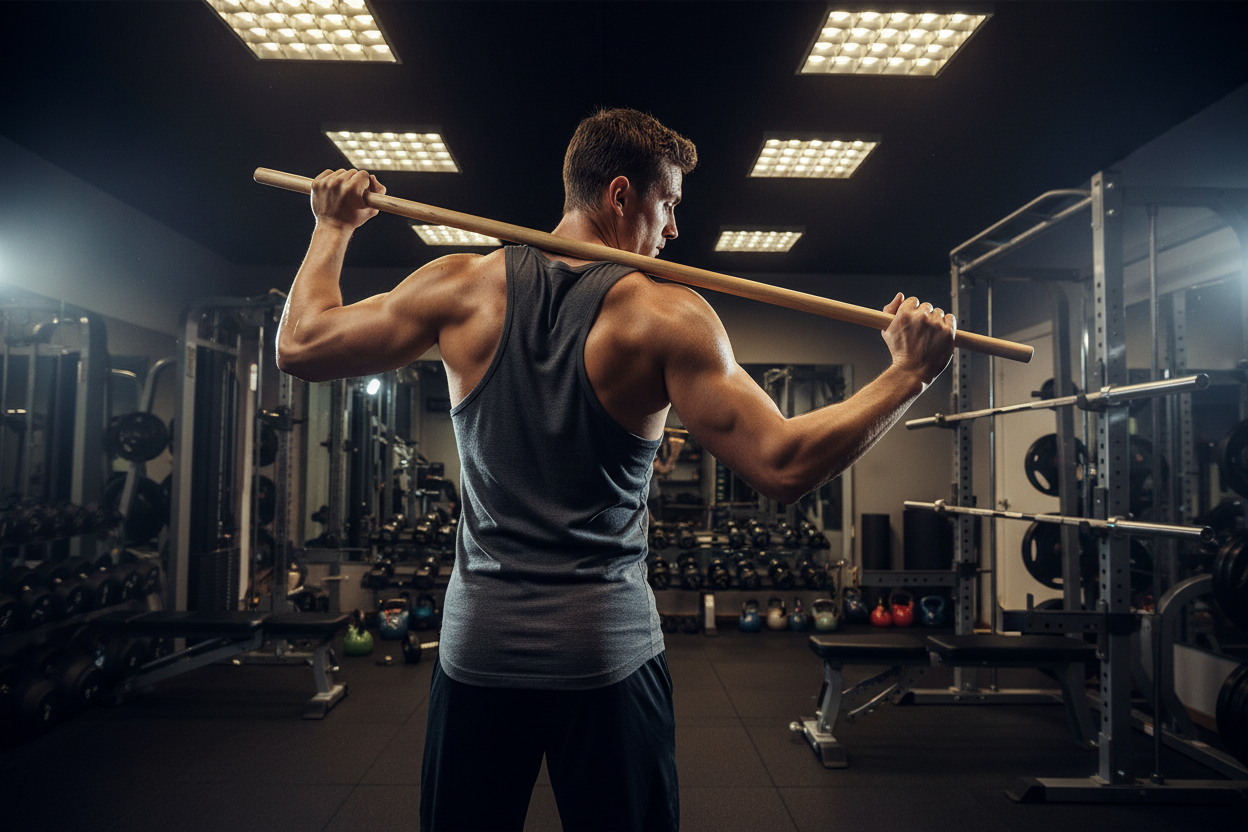
Your environment dictates your effort. If you are training in a cluttered, poorly lit, or unstable space, your numbers will plateau. Whether you are outfitting a garage gym or evaluating a commercial facility, identifying the best weight room requires looking past the shiny machines and focusing on the variables that actually drive performance.
Key Takeaways: What Makes a Weight Room Effective?
- Foundation First: The flooring must provide stability for static lifts and absorption for drops; high-density rubber is non-negotiable.
- Spatial Flow: Equipment needs a safety perimeter; crowded racks lead to compromised form and accidents.
- Atmosphere Engineering: Lighting temperature (Kelvin) and air circulation directly impact energy levels and perceived exertion.
- Essentialism: The best rooms prioritize a power rack, a stiff barbell, and a flat bench over isolation machines.
The Foundation: Why Flooring is More Than Aesthetic
Most people blow their budget on a rack and ignore the floor. This is a critical error. The floor is the interface between you and the earth. If it compresses, you lose force transfer.
In a high-performance setting, you need 3/4-inch vulcanized rubber or horse stall mats. Avoid those cheap puzzle-piece foam tiles sold at big-box stores. When you have 300+ pounds on your back, foam compresses unevenly, creating instability in your ankles and knees. You need a surface that is firm enough to push against but forgiving enough to protect your plates during a deadlift.
Equipment Selection: The "Big Three" Priority
A weight room is defined by its ability to handle compound movements. If the room is filled with Smith machines but lacks a dedicated platform, it fails the utility test.
The Power Rack
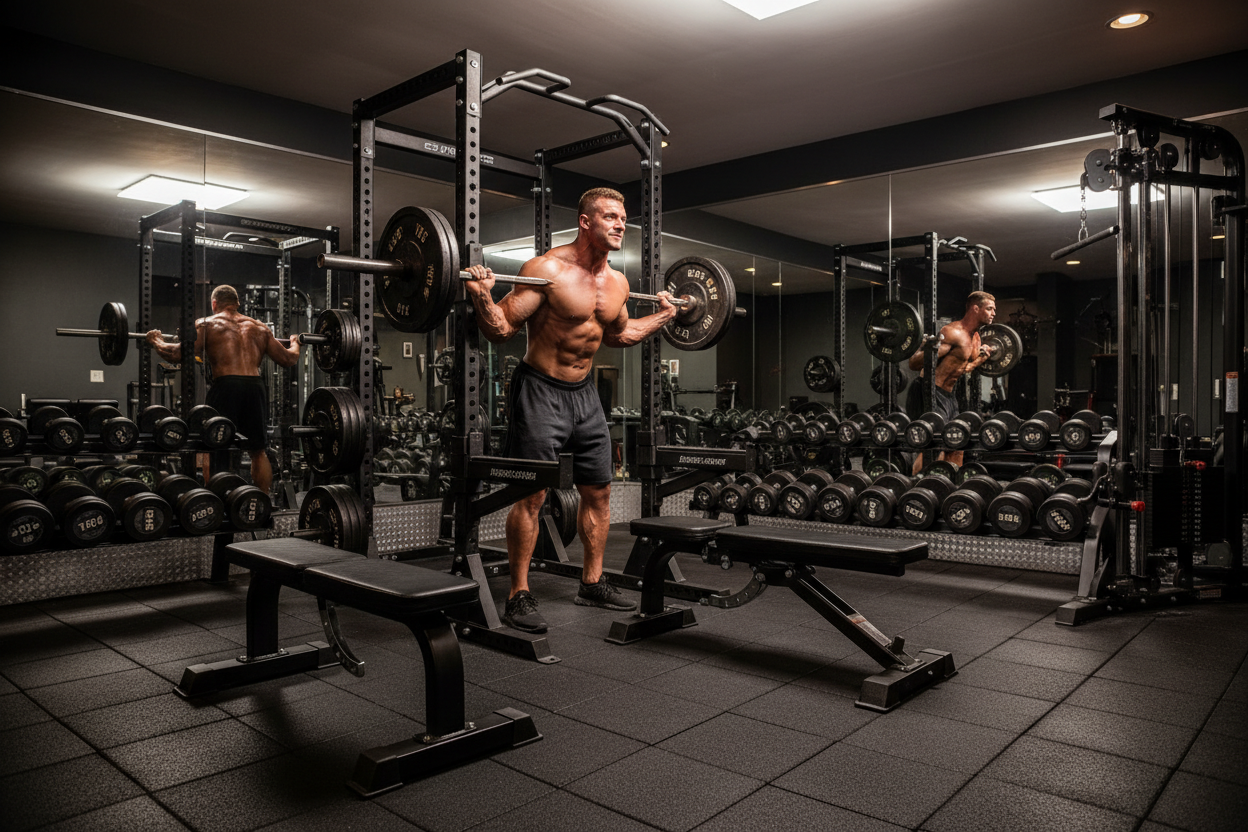
This is the centerpiece. Look for a 3x3 inch steel upright specification with 1-inch hardware. Why? Rigidity. When you re-rack a heavy squat, you want a dull thud, not a rattle. The hole spacing matters too; "Westside" spacing (1-inch holes) through the bench zone allows for precise safety pin placement that can save your life without ruining your range of motion.
The Barbell
The bar is the only piece of equipment you are in constant contact with. A generic "beater bar" usually has a thick, 30mm+ shaft and passive knurling. The optimal bar should have a 28mm to 29mm shaft with aggressive enough knurling to stick to your hands without tearing the skin. The spin mechanism (bushings vs. bearings) dictates how the weight moves; bushings are preferred for powerlifting stability, while bearings are needed for Olympic lifting turnover.
Lighting and Airflow: The Hidden Variables
Have you ever felt sluggish in a dim gym? That is biology, not laziness. The best weight room utilizes lighting in the 4000K to 5000K range (Cool White/Daylight). This spectrum suppresses melatonin and keeps alertness high.
Similarly, airflow is crucial for thermoregulation. Once your core temperature spikes too high, your body downregulates performance to protect itself. Industrial fans or proper HVAC aren't luxuries; they are performance enhancers that allow you to maintain intensity for longer durations.
My Training Log: Real Talk
I remember the first time I finally dialed in my own weight room setup after years of training in commercial boxes. I thought buying the expensive rogue rack was the game-changer, but it wasn't.
It was the humidity control. I live in a humid climate, and for the first month, my expensive iron plates started developing a thin film of surface rust, and the chalk on my hands would turn to paste within two sets. I bought a commercial dehumidifier, and the difference was visceral. The knurling on the bar felt sharper and "dryer" against my palm, allowing me to hook grip without slipping. That specific, gritty feeling of a bone-dry barbell—where the steel bites into the skin just right—is something you can't appreciate until you've tried deadlifting in a swamp. That detail turned a room with weights into a proper training facility.
Conclusion
Building or finding the best weight room isn't about spending the most money. It is about respecting the physics of lifting. Prioritize a stable floor, reliable steel, and an environment that keeps you alert. Once those variables are locked in, the only thing limiting your progress is your work ethic.
Frequently Asked Questions
How much space do I need for a functional weight room?
At a minimum, you need a 10x10 foot area. This accommodates a 7-foot Olympic bar (which requires roughly 8-9 feet of clearance for loading plates) and a power rack, while leaving enough room to move safely around the equipment.
Is it better to have mirrors in a weight room?
It depends on your training style. For bodybuilders, mirrors are essential for checking symmetry and contraction. However, for powerlifters and Olympic lifters, mirrors can sometimes be a distraction or cause you to rely on visual cues rather than proprioception (feeling where your body is in space).
What is the most underrated piece of equipment for a home weight room?
Adjustable dumbbells. They save a massive amount of floor space compared to a full rack of fixed dumbbells and allow for accessory work that barbells cannot provide. Look for a pair that goes up to at least 80-90 lbs to ensure you don't outgrow them quickly.