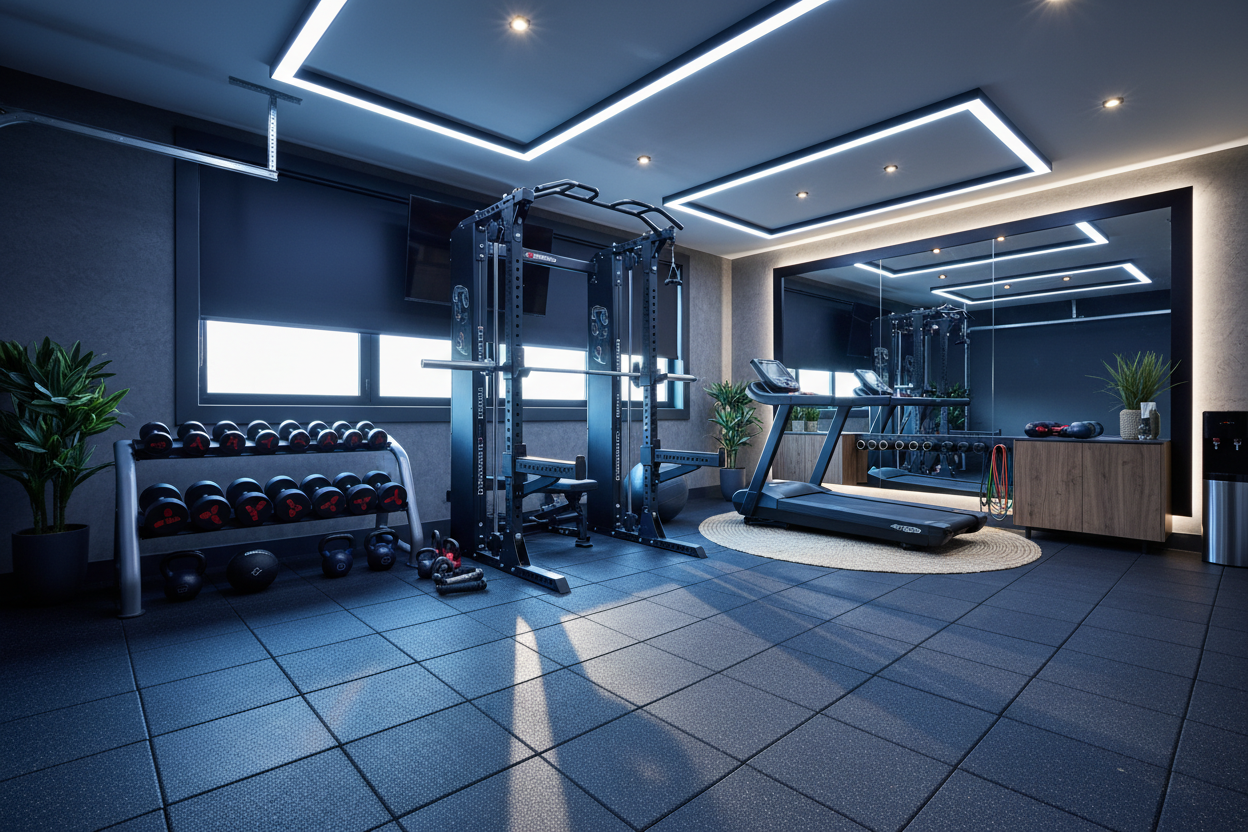
Designing a Home Fitness Room You Won't Quit Using
Most home gyms fail. Not because the equipment is bad, or the intentions aren't pure, but because the environment is hostile to progress. If your home fitness room ideas are limited to shoving a treadmill into a dark corner of the basement, you are setting yourself up for a very expensive clothes hanger.
As a coach, I see this constantly. Clients invest thousands in gear but zero thought into the atmosphere. The result is a space that feels like a storage unit, not a sanctuary. To build a habit, you need to build a space that pulls you in rather than pushes you away.
Key Takeaways
- Zoning is crucial: Even in a small gym in room scenario, separate your lifting area from your stretching area to improve workflow.
- Lighting dictates energy: Avoid clinical fluorescent lights; opt for dimmable LEDs (4000K-5000K) to mimic daylight and maintain focus.
- Flooring protects everything: 8mm rubber is the industry standard for a gym room in house to protect joints and subfloors.
- Air quality affects endurance: Dedicated ventilation or industrial fans are necessary to prevent the room from becoming a heat trap.
The Psychology of the Space
When setting up an exercise room at home, you are fighting against the comfort of your own house. The couch is usually just twenty feet away. Therefore, the room must signal "work" the moment you step across the threshold.
This starts with visual clutter. A fitness room at home shared with a home office or a laundry room often fails because the brain cannot switch modes. If you must share the space, use room dividers or distinct flooring changes to create a psychological boundary. You need to walk in and feel a shift in mindset.
Flooring: The Foundation of Performance
Do not train on carpet. It destabilizes your ankles during squats and absorbs sweat, which eventually leads to a permanent funk in your gym room at home. Conversely, concrete is too hard on the joints for plyometrics.
The sweet spot is high-density rubber flooring. For a standard setup, 8mm thick rolls or interlocking mats work well. If you are building a large home gym and plan on dropping heavy deadlifts, you need to upgrade to 3/4-inch horse stall mats or a dedicated lifting platform. This isn't just about protecting the floor; it's about the tactile feedback your feet get during a lift.
Lighting and Mirrors: More Than Vanity
Lighting in a gym in house is often an afterthought, but it dictates your energy levels. Warm, yellow lighting encourages relaxation—the opposite of what you want. You want cool, white light that mimics midday sun to keep your circadian rhythm alert.
Regarding mirrors: yes, they look cool, but their function is technical. In a solo gym room in house, you don't have a spotter to critique your depth on a squat. A large mirror is your feedback loop. It keeps your spine neutral and your form honest.
Layout and Flow
A common mistake is pushing all equipment against the walls to create a big open space in the middle. While this looks spacious, it's often inefficient. Functional design creates stations.
The Power Rack Position
If you have a rack, it is the centerpiece. It needs clearance. You need at least two feet of space on either side of the barbell sleeves. There is nothing more frustrating than clipping the wall mid-rep.
Dumbbell and Accessory Zones
Store your dumbbells near the bench. It sounds obvious, but I've seen layouts where the weights are across the room. In a fatigue state, walking ten feet to rack weights increases the chance you'll leave them on the floor. Good design minimizes friction.
My Personal Experience with Home Fitness Room Ideas
I learned the hard way that ventilation is the single most underrated aspect of a home gym. A few years ago, I converted a spare bedroom into a training space. I bought the best rack, Rogue plates, and nice mirrors.
But I ignored the airflow. It was a 10x10 room with one window. During a high-volume squat session in July, the humidity spiked so high that my chalk stopped working. It just turned to paste on my hands. The air felt heavy, almost suffocating, and I found myself cutting the workout short just to get out of the "sweat box."
I eventually installed a high-velocity industrial wall fan mounted in the corner. The noise is loud—a constant white noise drone—but that moving air changed everything. Now, when I'm grinding through a final set, that artificial breeze is the only thing keeping my core temperature manageable. Don't spend your budget on fancy lights if you haven't bought a good fan first.
Conclusion
Building the ultimate training space isn't about buying the most expensive equipment. It's about creating an ecosystem where training feels natural. Whether you have a massive basement or a compact gym in room setup, prioritize flooring, lighting, and airflow. Make the space respected, and the results will follow.
Frequently Asked Questions
What is the minimum size for a functional home gym?
You can build an effective gym room at home in as little as 100 square feet (10x10). This is enough space for a power rack, a bench, and bar clearance. For functional training or calisthenics, you need even less, but ceiling height becomes the limiting factor.
How do I soundproof my exercise room at home?
Soundproofing is difficult without construction, but you can dampen noise. Use thick rubber mats to absorb impact vibration. If you are in an upstairs apartment, use crash pads for dropping weights. Adding acoustic panels to the walls can also reduce the echo and clanking sounds.
Is a garage or a spare bedroom better for a gym?
A garage usually allows for a large home gym setup and heavy lifting without worrying about floor damage. However, climate control is the trade-off. A spare bedroom offers climate control but limits the weight you can drop and the ceiling height for overhead presses.