Decoding Exercise Programs Gym Veterans Use at Home
I remember staring at my phone at 10 PM in a cramped 10x10 spare bedroom. The commercial facility across town had just closed, and I had a client's spreadsheet open, trying to figure out how to do a seated cable row with nothing but a pair of 20-pound dumbbells. Translating the exercise programs gym regulars swear by into a living room routine feels like trying to read a foreign language at first.
But after building out dozens of garage and spare-room setups for my clients, I realized something important. The machines and heavy iron are just tools. The actual programming is based on human biomechanics. Once you understand the skeleton of a routine, you can execute it anywhere, using whatever gear you have on hand.
Quick Takeaways
- Focus on movement patterns (push, pull, hinge, squat) rather than specific machines.
- Use resistance bands to mimic the constant tension of cable stacks.
- Swap heavy bilateral leg presses for intense unilateral movements like Bulgarian split squats.
- Protect your home subfloor with high-density mats to safely handle dropped free weights.
- Track total volume and rest periods when heavy maximal loads aren't available.
The Core Elements of Effective Exercise Programs Gym Coaches Build
Progressive overload is king. A good gym training programme works because it forces adaptation over time. If you squat 135 lbs for 3 sets of 10 this week, you need 140 lbs or 11 reps next week. This principle doesn't care if you train in a massive commercial facility or your basement.
I teach my clients to look past the equipment and focus on planes of motion. A well-rounded routine requires horizontal pushing, vertical pulling, hip hinging, and squatting. When you strip away the chrome and the padded seats, every effective workout is just a variation of these fundamental human movements. Your nervous system doesn't know what a specialized machine is; it only understands mechanical tension and muscle fatigue. As long as you can safely load those movement patterns and recover adequately, your body will respond.
Analyzing the Movement Patterns Behind the Machines
When you look at a standard fitness gym program, it is usually packed with proprietary machines. You'll see a seated chest press, a lat pulldown, and a leg extension. But what are these really? The chest press is just a horizontal push. The lat pulldown is a vertical pull.
You don't need the exact machine; you just need to replicate the mechanics. Sometimes clients ask me about the best weight training machines to buy for their garage. I usually tell them to skip the single-use isolation stations. A functional trainer or a solid half-rack is worth the floor space, but a massive pec deck isn't. By identifying the underlying pull or push mechanic of a machine exercise, you instantly free yourself to swap in a dumbbell, kettlebell, or bodyweight alternative that accomplishes the exact same goal.
Substituting Commercial Gear for Home Equipment
Most commercial gym workout programs rely heavily on a mix of free weights and specialized selectorized machines. Translating this to a home environment requires a modular approach. You swap the bulky, expensive gear for versatile, space-saving alternatives that hit the exact same muscle fibers without cluttering your room.
Swapping Cable Stacks for Resistance Bands
Cable stacks provide constant tension, which is why bodybuilders love them for triceps pushdowns and lateral raises. To mimic this at home, I use heavy-duty resistance bands with a sturdy door anchor. A good set of loop bands offering 10 to 150 pounds of resistance can replicate almost any cable movement.
The resistance curve is slightly different—bands get harder as they stretch—but the isolation effect on the muscle is incredibly similar. I frequently program banded face pulls and triceps extensions for my remote clients, and the feedback on muscle activation is identical to what they report from the gym.
Replacing Leg Presses with Squat Variations
The leg press is the hardest machine to give up. You can load it with 400 pounds safely. At home, you likely don't have that kind of weight plates lying around. The solution is unilateral training.
Drop the bilateral leg press and switch to Bulgarian split squats or heavy dumbbell goblet squats. Holding a single 50-pound dumbbell and repping out split squats with your rear foot elevated will humble you faster than a heavy machine press, and it requires a fraction of the equipment. It also builds incredible core stability and fixes left-to-right strength imbalances.
Creating a Stable Base for Heavy Free Weights
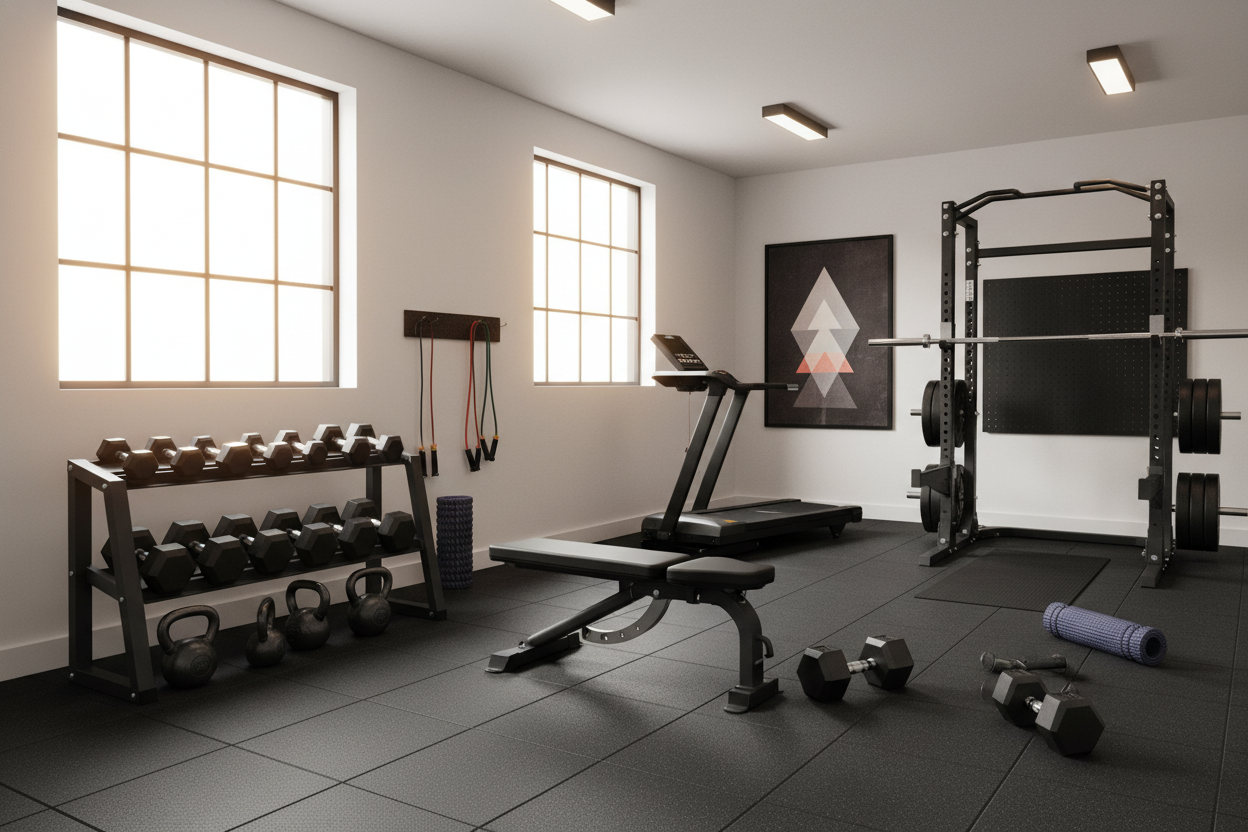
Most training programs for gym settings assume you are standing on impact-absorbing commercial rubber flooring. When you bring heavy dumbbells into a spare room with hardwood or carpet, things get risky. You need a stable, grippy base that protects your subfloor from dropped weights and prevents your bench from sliding.
I always have clients start with a large exercise mat as their foundation. It absorbs the shock of a 50-pound dumbbell slipping from your grip during a sweaty set of rows. Without it, you are one failed rep away from a cracked floorboard.
For most standard room setups, rolling out a 6x8ft exercise mat gives you the ideal footprint. It is wide enough for lateral lunges and long enough for walking planks without your hands or feet slipping off the edge. This commercial-grade surface area is what actually allows you to train with intensity at home safely.
Tracking Progress When Your Environment Changes
When you transition an established training program for the gym into a home routine, your raw numbers will probably drop. You aren't barbell back squatting 315 pounds in your living room. Instead of tracking sheer weight, you have to track your reps, your rest periods, and your time under tension.
If you did 4 sets of 12 goblet squats with a 60-pound dumbbell last week, aim for 4 sets of 15 this week. Progression is still happening, even if the load on the bar looks different. I have my clients keep a logbook specifically for their home workouts. We track how slow they can perform the eccentric (lowering) phase of a push-up, or how many strict pull-ups they can do. Changing the metric of success keeps you motivated when you don't have access to heavy iron.
Adjusting Volume and Intensity for Home Conditioning
Finally, modifying a fitness program for gym spaces to fit your home often means manipulating volume and intensity. If you max out your adjustable dumbbells at 52.5 pounds each, you have to make that weight feel heavier. Cut your rest periods from 90 seconds down to 45 seconds.
Add pause reps at the bottom of your squats, or slow down the eccentric phase of your dumbbell presses. This increases metabolic stress and forces muscle growth without requiring heavier weights. If you want to focus more on fat loss with this high-volume approach, check out this home gym training guide for conditioning routines that will leave you completely gassed.
My Experience Testing Modular Home Setups
I've personally tested dozens of setups, but my current go-to involves a pair of 5-52.5 lb adjustable dumbbells, a flat utility bench, and a set of heavy loop bands. I ran a standard push/pull/legs split for 12 weeks using only this gear on a high-density 7mm mat. The pump and muscle fatigue were identical to my commercial facility days.
The one honest downside? Resistance bands snap if they get micro-tears, and they don't offer the exact same smooth, uniform resistance curve as a perfectly lubricated cable pulley. You have to inspect them regularly, but for the space they save, it's a trade-off I gladly make.
FAQ
Can I build muscle without machines?
Absolutely. Muscle tissue only recognizes tension, not the logo on the equipment. Free weights and bodyweight exercises can provide all the stimulus needed for hypertrophy if you train close to failure.
How do I replicate a lat pulldown at home?
Anchor a heavy resistance band to the top of a sturdy door, kneel down, and perform the exact same pulling motion. Alternatively, install a doorway pull-up bar and work on pull-up negatives.
Do I need a bench for home chest workouts?
A bench allows for a greater range of motion, but floor presses are a highly effective alternative. Lying flat on your mat to press dumbbells also protects your shoulders from over-extension, making it a great variation for joint health.