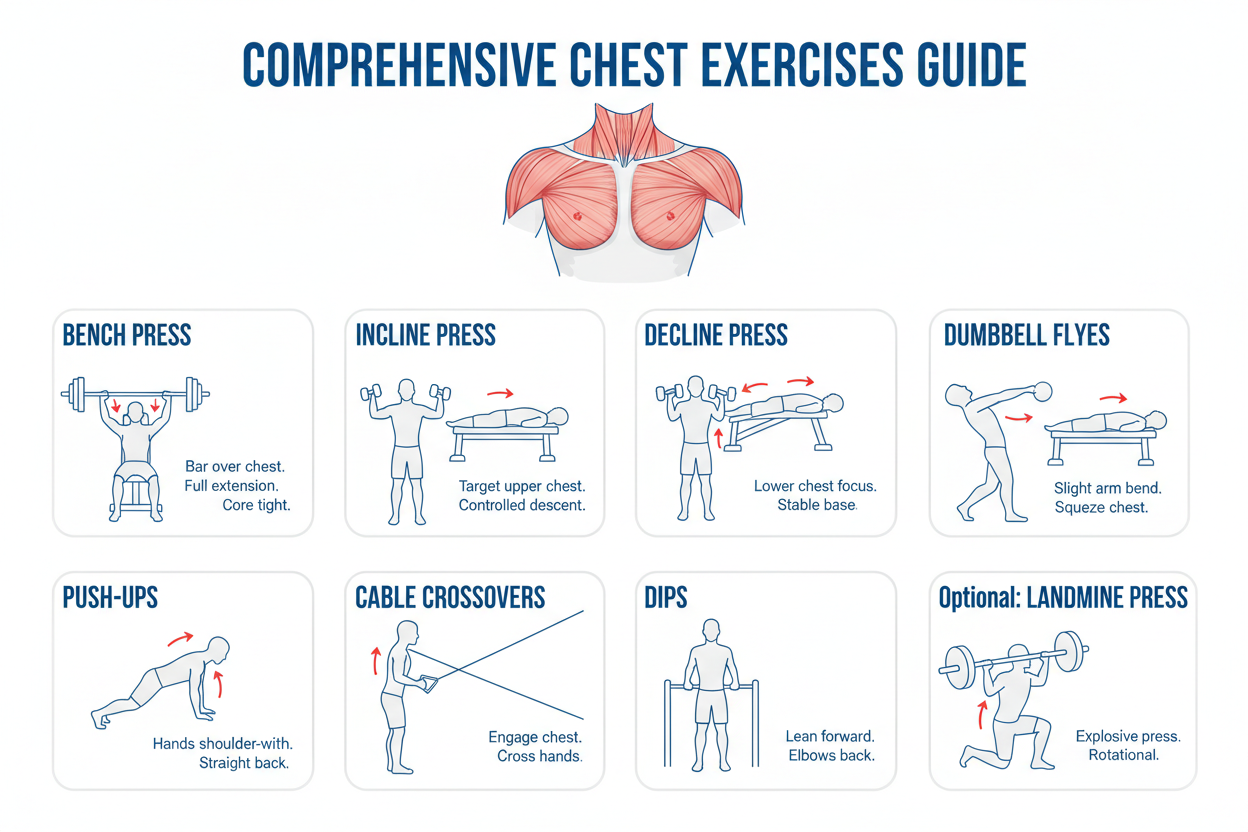
Chest Exercise Diagram Guide for Effective Workouts
Building a stronger chest requires a well-structured approach that combines knowledge of anatomy with proper workout diagrams. Understanding how different exercises target specific areas of your pectoral muscles can help you maximize results while minimizing injury risks. A chest exercise diagram or chest workout diagram offers a visual map of how each movement engages the muscles, which is especially useful for beginners and experienced lifters alike.
Understanding Chest Anatomy
The chest muscles, mainly the pectoralis major and pectoralis minor, serve as the primary movers during pressing and fly exercises. The pectoralis major consists of two parts: the clavicular head (upper chest) and the sternal head (lower chest). Effective training requires incorporating movements that target both sections for balanced strength and aesthetics.
Why Use a Chest Exercise Diagram
A diagram provides clarity on correct movement patterns, hand positioning, and grip. It visually identifies which angle to press or pull to emphasize different muscle fibers. For example, an incline press shifts focus to the upper chest, while a decline press works more on the lower portion. Diagrams also help in planning workout progressions by depicting proper form and range of motion.
Common Movements Featured in Diagrams
Most chest workout diagrams highlight fundamental exercises such as bench press, push-ups, chest flies, and cable crossovers. Some may also include variations like single-arm dumbbell presses or machine-based movements. These visuals serve as quick references, making them invaluable when building your own workout plan.
Structuring Your Chest Workout
To achieve balanced development, integrate both compound and isolation exercises. Compound lifts such as the flat and incline bench press recruit multiple muscle groups, promoting strength and size gains. Isolation moves like dumbbell flies allow for specific targeting of muscle fibers for better shape and definition.
Sample Chest Workout Diagram Flow
1. Warm-up: 5 minutes of light cardio and dynamic stretches.
2. Flat Bench Press – 4 sets of 8-10 reps.
3. Incline Dumbbell Press – 3 sets of 8-10 reps.
4. Cable Fly – 3 sets of 12-15 reps.
5. Push-Ups – 2 sets to failure.
Following such a structured pattern mirrors what you would typically see in comprehensive diagrams, where exercises progress from heavy compound lifts to lighter isolation work.
Safety Considerations
While diagrams help with planning, remember to maintain proper form. Incorrect posture can lead to shoulder strain or tendon injuries. Keep elbows at a comfortable angle during presses and avoid overextending during flies. Always use a weight that allows you to complete the movement with controlled motion.
Personal Experience with Using Workout Diagrams
When I began strength training, I was unsure which exercises truly worked my chest and often felt more shoulder engagement than desired. Once I started referencing detailed chest exercise diagrams, I learned to adjust the bench incline and wrist position, which significantly improved targeting. Over a few months, not only did my strength increase, but my chest muscle definition became more prominent, proving the value of visual guidance in training.
Tips for Maximizing Results
- Train your chest 1-2 times per week for recovery and growth.
- Change angles and grips periodically to avoid plateaus.
- Pair diagrams with real-time feedback from mirrors or training partners.
- Maintain progressive overload by gradually increasing weights.
Incorporating Diagrams into Home Workouts
Even without gym access, diagrams can help adapt exercises using resistance bands, bodyweight, or household objects. For example, a resistance band chest fly can mimic the motion shown in cable fly diagrams, allowing for effective training in small spaces.
Conclusion
Chest exercise diagrams are more than just visual aids—they represent a bridge between theoretical understanding and practical application. By studying and following clear chest workout diagrams, you can ensure proper form, effective targeting, and consistent progression whether training at home or in the gym.