Can One Muscle Exercise Machine Really Replace a Full Gym?
I remember the exact moment I hit my breaking point with my garage gym. I was tripping over a stray 45-pound plate while trying to navigate around a power rack that barely cleared the ceiling, all while my shins were taking a beating from a misplaced bench. I wanted my floor space back, and I started doom-scrolling at midnight, wondering if a single muscle exercise machine could actually do it all.
The promise is seductive: one footprint, one price tag, and every exercise you need. But after years of testing everything from $5,000 functional trainers to $400 scrap-metal specials, I’ve learned that the 'all-in-one' dream usually comes with some heavy fine print. You aren't just buying gear; you're buying a specific way of training, and if that machine doesn't align with your goals, it’s just a very expensive place to hang your wet towels.
- Footprint: Most high-end units require at least a 6x6 foot dedicated area plus clearance for movement.
- Resistance: Weight stacks are often capped at 200 lbs, which can be limiting for lower body work.
- Cable Ratios: A 2:1 ratio means 100 lbs on the stack feels like 50 lbs in your hand—know your math before buying.
- Versatility: If it doesn't have adjustable pulleys, you're locked into fixed planes of motion that might not fit your frame.
The All-In-One Dream vs. The Garage Gym Reality
We’ve all seen the ads where a guy with 4% body fat does twenty different exercises on a sleek, silver unit that looks like it belongs in a sci-fi movie. It’s tempting to think you can swap a cluttered room of mismatched dumbbells and rusty racks for a single muscle workout machine. In reality, the transition is about trade-offs. You trade the raw, heavy feel of iron for the smooth, consistent tension of cables.
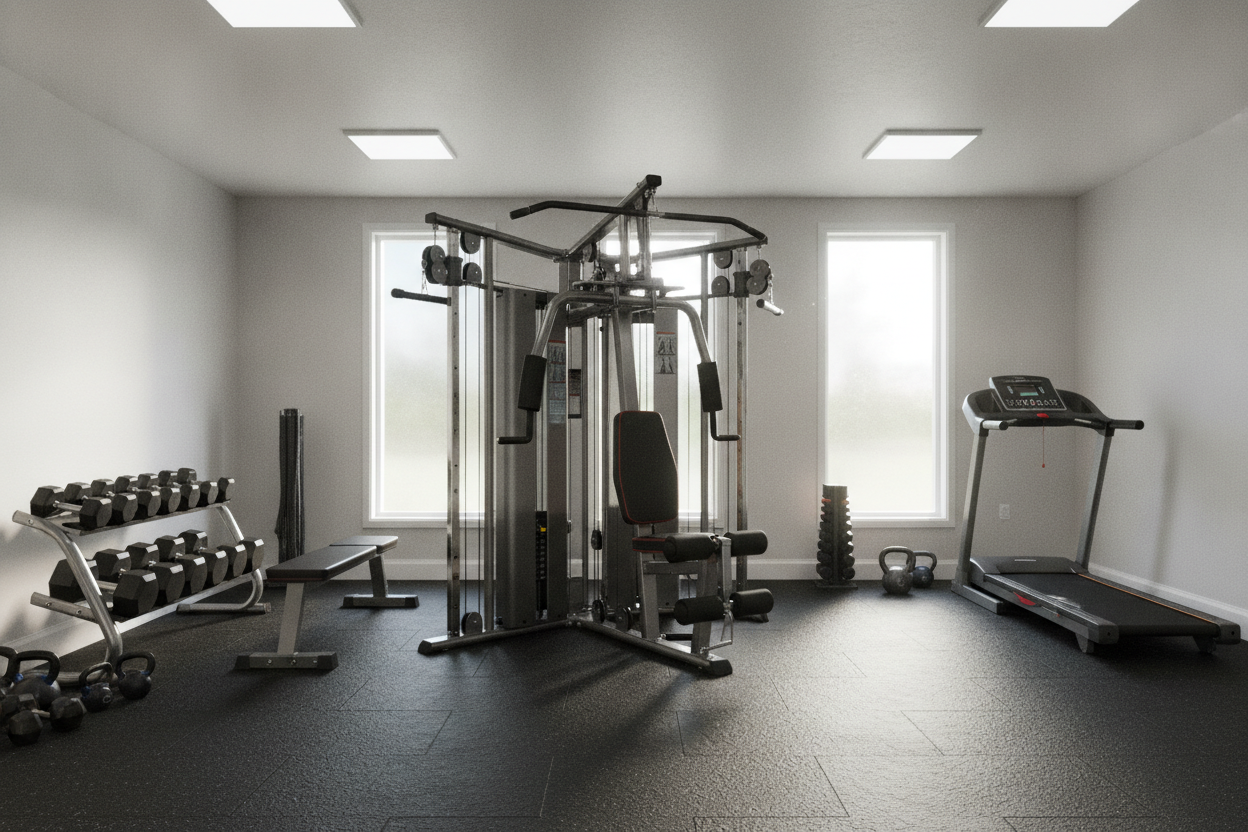
For most of us, space is the ultimate currency. A standard power rack with a barbell and a full set of plates needs about 100 square feet to be functional without feeling like a coffin. A well-designed multi-station can cut that in half. But don't be fooled by the 'compact' labels. I once bought a unit that claimed to fit in a corner, only to realize I couldn't actually perform a chest fly without hitting the drywall. Always measure your 'working' footprint, not just the base of the machine.
What Makes a Gym Muscle Machine Worth the Floor Space?
If you’re going to drop two or three grand on a gym muscle machine, the biomechanics better be flawless. I look for two things immediately: the pulley quality and the cable ratio. Cheap machines use plastic pulleys that drag and stutter, which ruins your mind-muscle connection. You want heavy-duty nylon or aluminum pulleys with high-quality bearings. If it doesn't glide like it's on ice, send it back.
Then there’s the weight stack. Most home units use a 2:1 ratio, which is great for functional movements and high-velocity work because the cable travels further and feels smoother. However, if you’re a strong lifter, a 160-lb stack with a 2:1 ratio only gives you 80 lbs of actual resistance. That’s barely a warm-up for a heavy row. I prefer machines that offer a 1:1 ratio option or at least a 300-lb stack so you don't outgrow the equipment in six months. Also, check the guide rods—if they aren't polished steel, the friction will make 100 lbs feel like 120 lbs on the way up and 80 lbs on the way down.
The Movements You Actually Lose (And How to Adapt)
Here is the hard truth: no cable-based machine can perfectly replicate the sheer mechanical load of a 400-pound barbell back squat or a heavy deadlift. The stabilization isn't the same, and the nervous system response is different. If your entire personality is built around your Big Three totals, a single machine is going to feel like a toy. You lose the ability to train 'heavy' in the traditional sense.
However, you can adapt. You swap back squats for high-volume cable squats or Bulgarian split squats. You swap conventional deadlifts for heavy cable pull-throughs or RDLs. The key is not to get frustrated when the machine doesn't have a specific attachment you're used to. I’ve seen people give up on their goals entirely because they couldn't do their exact 5/3/1 routine, but you should avoid ditching hypertrophy workout plans just because you’ve changed your tools. Focus on the tension, not the tool.
Beware the Gimmicks: Real Resistance vs. Toning Toys
The market is flooded with 'miracle' machines that use bow-flexing rods, elastic bands, or 'digital resistance' that feels like pulling against a giant rubber band. If the machine weighs less than you do, it’s probably not a serious muscle workout machine. I once tested a unit that used hydraulic cylinders; it was fine for the first ten minutes, but as the fluid heated up, the resistance dropped by 30%. That is the opposite of progressive overload.
Be especially wary of anything marketed as a popular muscle tone machine. 'Toning' is a marketing term, not a physiological process. You need enough resistance to actually break down muscle fibers. If the machine maxes out at a resistance level that your grandmother could breeze through, it’s not an exercise machine—it’s an oversized coat rack. Real muscle growth requires a machine that can grow with you, meaning it has a high ceiling for total weight and allows for micro-loading.
The Final Verdict: Who Should Actually Buy One?
So, should you pull the trigger? If you are a competitive powerlifter, no. You need a rack and iron. But if you’re a busy professional who wants to stay jacked, hates the commercial gym crowd, and only has a small corner of the basement to work with, a high-quality multi-station is a legitimate win. It’s safer for solo training, faster for supersets, and much easier on the joints as you get older.
My advice? Don't buy the cheapest one. Buy the one that feels like the machines in a real gym. Look for a unit with a heavy frame (at least 11-gauge steel) and a weight stack that scares you a little bit. If you invest in quality, you’ll actually use it. If you buy a flimsy gimmick, you’ll be back on Craigslist in three months trying to get rid of it.
FAQ
Can I build massive legs with just a cable machine?
Yes, but you have to be creative. You’ll need to master split squats, sissy squats, and high-rep cable lunges. You won't get the 'ego lift' of a heavy squat, but the constant tension is incredible for hypertrophy.
How much ceiling height do I really need?
Most functional trainers and multi-stations are between 80 and 84 inches tall. If you have a standard 8-foot ceiling, you're fine, but always check if the pull-up bar adds extra height that might hit your joists.
Are plate-loaded machines better than selectorized stacks?
Plate-loaded machines are usually cheaper and allow for more total weight, but they take up more space because you have to store the plates. Selectorized stacks (with the pins) are much faster for changing weights during a workout.