
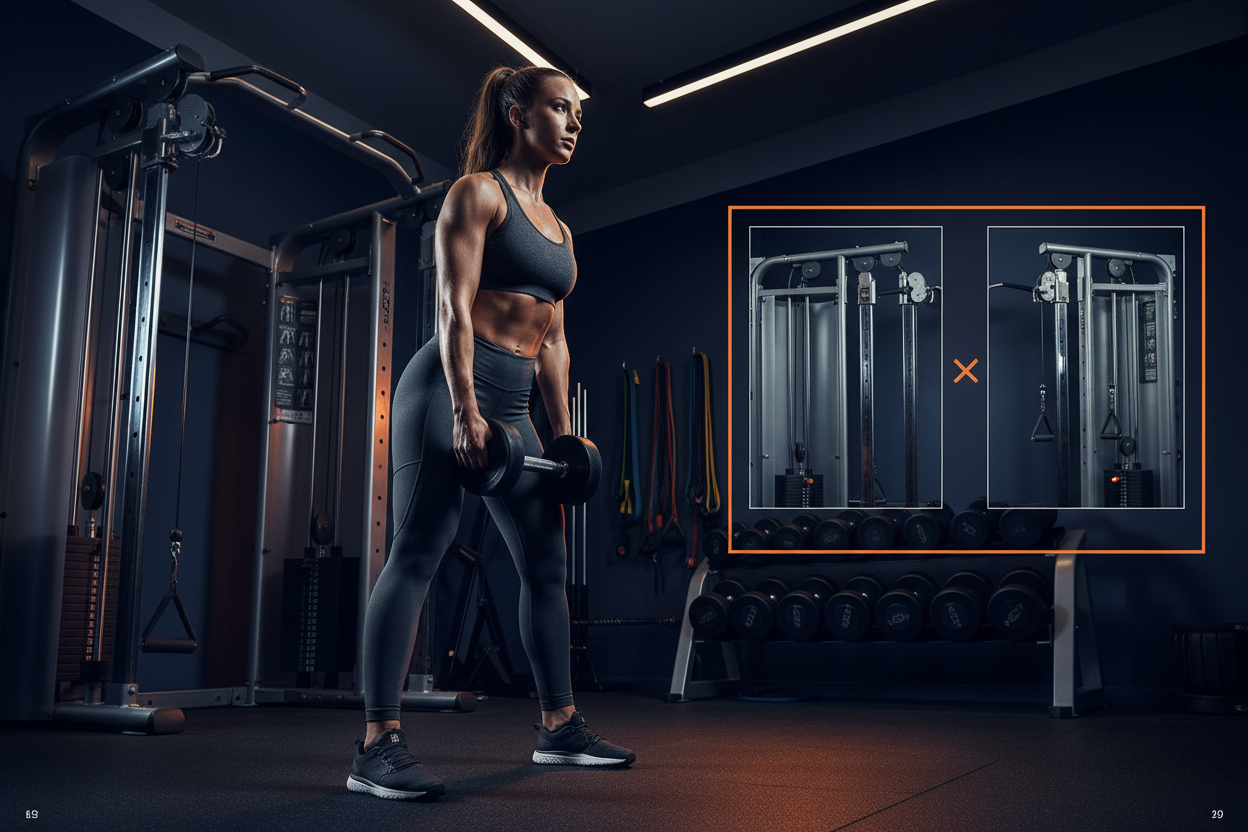
Cable Pull Through With Dumbbell: The Ultimate Home Gym Hack
If you train in a garage or spare bedroom, you already know the struggle of replicating commercial gym leg days without massive, space-hogging equipment. When you hit a plateau with standard barbell movements, finding creative ways to load the posterior chain safely is crucial. Enter the cable pull through with dumbbell—a highly effective, space-saving hack for anyone wanting to build serious lower body strength without a dedicated functional trainer.
This guide will break down exactly how to perform a glute pull through at home using minimal gear, what muscles you are actually targeting, and why this movement deserves a permanent spot in your routine.
Key Takeaways
- Space Efficiency: Replicates the benefits of a cable pull through machine using just a resistance band or basic pulley and a dumbbell.
- Joint-Friendly: Offers constant tension on the glutes and hamstrings with significantly less spinal loading than heavy deadlifts.
- Versatility: Easily adaptable for a complete pull through leg workout or modified for upper body accessory work.
- Hypertrophy Focus: Excellent for isolating the posterior chain, making it a favorite technique highlighted by science-based lifters.
Mastering the Pull Through Leg Workout
How to Cable Pull Through with Limited Gear
Learning how to cable pull through at home requires a bit of ingenuity. If you do not have a standard low cable pull through setup, you can attach a heavy resistance band to a low anchor point (like the base of a power rack) and loop it around the handle of a dumbbell. Stand facing away from the anchor, straddle the band, and grip the top head of the dumbbell between your legs. This mimics the feel of a traditional glute rope pull through. Hinge at the hips, feeling the stretch in your hamstrings, and explosively drive your hips forward, squeezing the glutes at the top of the hip pull through.
Cable Pull-Through vs Deadlift
A common debate in home gym programming is the cable pull-through vs deadlift. While barbell deadlifts are the undisputed king of absolute strength, they place immense shearing force on the lumbar spine. The hamstring cable pull-through, on the other hand, shifts the resistance vector horizontally. This means you get incredible glute and hamstring isolation without the central nervous system fatigue of heavy deadlifts, making it the perfect complementary lift.
Targeting the Right Cable Pull Through Muscles
Lower Body Dominance
The primary cable pull through muscles are the gluteus maximus and the hamstrings. By keeping a soft bend in the knees and focusing on pushing your hips back toward the wall behind you, you maximize the stretch for effective hamstring cable pulls. Whether you are doing a rope pull through legs variation at a gym or the dumbbell hack at home, the mind-muscle connection is what dictates your growth. For those specifically targeting the back of the legs, the hamstring rope pull through variation ensures constant tension through the entire range of motion.
Can You Do a Cable Rope Pull-Through Upper Body?
While typically a lower body movement, the mechanics of a pull through can be adapted. For instance, a bent arm rope cable pull through or a rope pull through back exercise involves facing the pulley and pulling the weight toward your torso to target the lats and mid-back (often referred to as a cable rope pull-through upper body variation). However, when using a dumbbell between the legs, you should strictly keep this as a lower-body hinge movement.
From Our Gym: Honest Take
When I first started programming a cable pull through workout in my basement gym, I was frustrated by the lack of a proper cable pull through machine. I tried using just bands, but the resistance curve felt sloppy at the bottom of the movement. Tying a band to a 50-pound dumbbell completely changed the game. Gripping the cold, knurled handle of the dumbbell between my legs felt surprisingly secure—much like a kettlebell swing but with horizontal resistance.
I remember watching a cable pull through jeff nippard breakdown where he emphasized the horizontal force vector for glute growth, and this home-gym hack replicates that perfectly. The only minor con? If you are using adjustable block-style dumbbells, the square shape can chafe your inner thighs during the hinge. Stick to traditional hex dumbbells or round urethane bells for the smoothest rep execution.
Frequently Asked Questions
What is a reverse cable pull through?
A reverse cable pull through typically refers to facing the anchor point rather than facing away. Instead of pulling the weight through your legs from behind, you are pulling it toward you, which changes the leverage and often shifts the focus more toward the upper back or core, depending on the attachment and arm position.
Is a glute pull through at home as effective as the gym?
Yes, provided you can create enough resistance. Using a heavy resistance band anchored low and wrapped around a heavy dumbbell provides an excellent resistance curve that challenges the glutes at peak contraction, mimicking commercial setups perfectly.
Why do I feel the hamstring pull through in my lower back?
If you feel this movement in your lower back, you are likely squatting the weight instead of hinging, or hyperextending your spine at lockout. Focus on pushing your hips straight back and stopping the forward drive once your glutes are fully squeezed—do not lean backward at the top of the movement.


