Cable Exercises Machine: Is It Worth the Home Gym Investment?
If you have been training in your garage or basement for a while, you know the dreaded dumbbell plateau. Free weights are fantastic for building raw strength, but eventually, you crave the smooth, constant tension that only commercial gym equipment provides. That is exactly where a cable exercises machine changes the game.
Adding this versatile piece of equipment to your setup bridges the gap between basic home setups and professional training facilities. But before you clear out floor space or max out your budget, let's break down exactly what you need to know to make the right choice for your North American home gym.
Key Takeaways
- Unmatched Versatility: A single machine replaces dozens of single-use stations by allowing multi-planar, adjustable movements.
- Space Requirements: Wall-mounted units save crucial floor space, while dual-stack functional trainers require at least a 6x6 foot dedicated footprint.
- Resistance Types: Plate-loaded systems are budget-friendly, whereas selectorized weight stacks offer faster transitions for drop sets and supersets.
- Muscle Isolation: Cables provide constant tension throughout the entire range of motion, which is highly effective for hypertrophy.
Choosing the Right Workout Cable System
Not all cable setups are created equal. When comparing models, you need to balance your budget with your specific training style and the equipment you already own.
Weight Stacks vs. Plate-Loaded
A premium workout cable system usually features a selectorized weight stack. These are incredibly convenient for quick weight changes. However, if you already own a mountain of standard or Olympic plates, a plate-loaded system can save you hundreds of dollars while delivering the exact same functional resistance.
Ratio and Resistance Profiles
Pay close attention to the pulley ratio. A 2:1 ratio means a 100-pound stack provides 50 pounds of actual resistance. This is ideal for explosive movements, functional training, and finer weight increments. If your focus is heavy, slow pulls like lat pulldowns and low rows, look for a 1:1 ratio machine.
Space Planning for an Exercise Pulley Machine
The biggest hurdle for home gym owners is space. An exercise pulley machine can be deceivingly large once you account for the range of motion required during actual use.
Garage and Basement Clearances
Standard freestanding functional trainers typically stand between 80 and 85 inches tall. If you are training in a basement with low 7-foot (84-inch) ceilings, you might literally scrape the joists. Always measure your ceiling height and leave at least 3 to 4 inches of clearance for assembly. Additionally, ensure you have a minimum of three feet of working space in front of the machine for exercises like walking cable crossovers.
Elevating Your Cable Home Workout
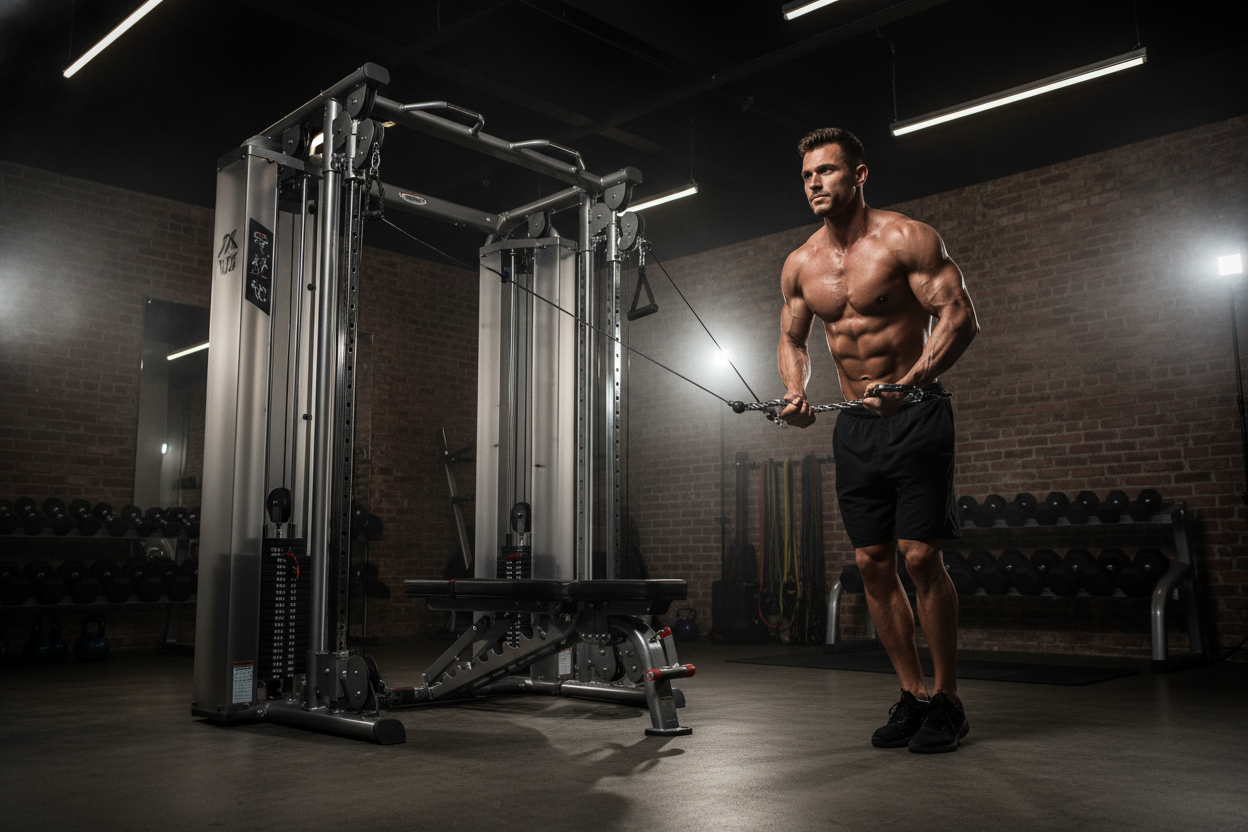
Once installed, a cable home workout opens up a completely new world of programming. Free weights are limited by gravity—they only provide resistance on the vertical plane. Cables allow you to apply horizontal and diagonal resistance, drastically expanding your exercise library.
Targeting the Neglected Angles
You can finally perform true face pulls, triceps pushdowns, and lateral raises with continuous tension at the top of the movement. This constant tension is a primary driver for muscle growth, making cables the perfect complementary tool to your heavy barbell compound lifts.
From Our Gym: Honest Take
We recently installed a mid-tier, plate-loaded dual functional trainer in our testing garage. The aluminum pulleys glide beautifully, and the 180-degree swivel handles make it incredibly easy to transition from low rows to high chest flyes. At 6'2, I also appreciate that the uprights are tall enough to let me get a full stretch on triceps pushdowns—something compact units often fail to deliver.
However, I will be completely honest about a minor drawback: loading and unloading plates on the sliding carriage can get tedious during giant sets. The carriage also requires a quick spray of silicone lubricant every few weeks to prevent sticking when lifting very light weights (under 20 pounds). If I had to do it over and had the extra budget, I would upgrade to a selectorized stack just for the sheer convenience. But for the price-to-performance ratio, this setup is still a massive win for my daily training.
Frequently Asked Questions
Are workout pulley machines loud?
It depends on the build quality. A high-quality workout pulley machine with aluminum or nylon pulleys and sealed bearings is whisper-quiet. Plate-loaded systems can be slightly noisier due to the metal plates clanking against each other on the weight horns.
Can I build muscle with just cables?
Absolutely. Because cables provide constant tension throughout both the concentric and eccentric phases of a lift, they are highly effective for muscle hypertrophy. Many bodybuilders rely heavily on them for isolation work and finishing sets.
What is the minimum footprint needed for a basic setup?
If you opt for a wall-mounted single-column pulley, you only need about a 2x2 foot footprint against the wall, plus room to stand in front of it. Full freestanding functional trainers require significantly more room, typically demanding a 5x5 or 6x6 foot dedicated area.