Building A Safe DIY Smith Machine: The Ultimate Home Gym Guide
Commercial gym equipment prices are enough to make anyone’s wallet sweat. You look at a commercial unit, see the four-figure price tag, and immediately wonder if you can weld, bolt, or rig up a diy smith machine in your garage for a fraction of the cost.
It is a tempting project. The Smith machine offers stability and isolation that free weights cannot replicate, especially for rehabilitation or heavy solo training. However, replicating that smooth, vertical (or slightly angled) fixed path without compromising safety is much harder than building a simple lifting platform.
If you are handy with tools or looking for a conversion solution, this guide breaks down the mechanics, the risks, and the realistic ways to get it done.
Key Takeaways
- Friction is the Enemy: Cheap galvanized pipes will bind under heavy loads. You need linear bearings or polished steel rods for safety.
- Stability Matters: A homemade unit must be anchored. If the frame wobbles, the guide rails will twist, causing the bar to lock up mid-rep.
- Conversion vs. Scratch Build: Buying a conversion kit for an existing rack is generally safer and more cost-effective than building a frame from raw steel.
- Safety Stops are Non-Negotiable: Never build a unit without adjustable safety catches; they are the entire point of using a Smith machine.
The Mechanics: What You Are Actually Building
Before you buy steel, you need to understand the engineering. A Smith machine isn't just a bar in a cage. It relies on a carriage system.
In a professional machine, the barbell runs on linear bearings that glide over hardened steel rods. This removes friction. When you attempt a homemade smith machine using standard plumbing pipes or square tubing without bearings, you introduce drag. This drag changes the resistance curve and can lead to dangerous "stuttering" on the eccentric (lowering) phase of the lift.
Method 1: The "Turn Squat Rack Into Smith Machine" Approach
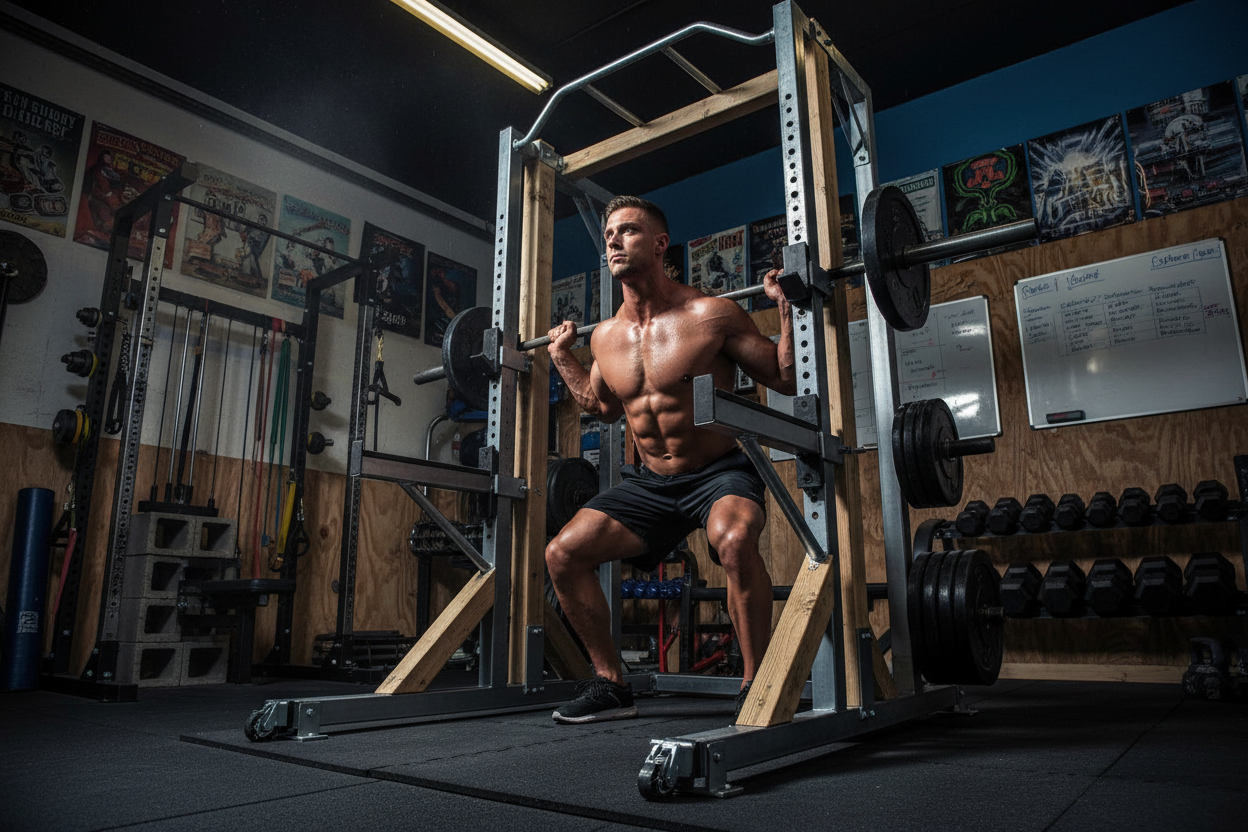
This is the most practical route for 90% of home gym owners. Instead of fabricating a frame, you utilize your existing power rack.
The Conversion Kit
Several manufacturers now sell a smith machine conversion kit designed to bolt onto standard 2x2 or 3x3 power racks. This solves the hardest part of the DIY process: the guide rails.
These kits usually consist of a barbell with attached sleeves that slide over the uprights of your rack. While effective, they have a downside. They force the bar to follow the angle of your uprights. If your rack is not perfectly leveled, the bar will drift.
The Jammer Arm Hack
Another popular method involves using lever arms (jammer arms). By attaching a straight bar across two lever arms, you create a fixed path of motion. While this mimics the stability, it moves in an arc, not a straight line. It feels more like a Hammer Strength machine than a true Smith machine, but it is safer than a sketchy pipe build.
Method 2: The Pipe and Flange Build (High Risk)
If you are determined to build from scratch, you will likely look at the hardware store aisle. This usually involves vertical galvanized pipes acting as guide rails and larger PVC or metal pipe sections sliding over them as the carriage.
I generally advise against this for heavy lifting. Why? Because metal-on-metal friction without lubrication creates heat and metal shavings. If you go this route, you must use grease, and you must accept that the motion will never be perfectly smooth. It works for calf raises or shrugs, but I would hesitate to bench press my max on a rig held together by pipe flanges.
The Critical Safety Component: Adjustable Stops
The primary reason we use this machine is safety during solo training. If your DIY build does not have a mechanism to lock the bar out at any height (the "hook and twist" motion), you have not built a Smith machine; you have built a guillotine.
For a DIY setup, creating a rotating hook system is incredibly complex. A simpler alternative is to use heavy-duty safety pins or spotter arms set at the bottom of your range of motion. Do not rely on your ability to re-rack the weight if the sliding mechanism jams.
My Personal Experience with DIY Smith Machines
I tried the hardware store route back in 2016. I wanted to do vertical leg presses without buying a dedicated machine, so I rigged up a homemade smith machine using 1-inch gas pipes and a standard 1-inch barbell.
Here is the gritty reality that YouTube tutorials don't tell you: the noise. The sound of a steel sleeve scraping against a galvanized pipe is excruciating. But the real issue was the binding. I loaded up 225 lbs for a bench press. On the way down, the left side slid faster than the right because I hadn't perfectly centered my grip. The carriage jammed diagonally. I was stuck under the bar, unable to push it up because the friction lock was stronger than my chest press.
I had to wiggle out sideways, scraping my ribs. The knurling on that cheap bar was non-existent, and my hands were covered in a mix of grey pipe residue and WD-40. I took it apart the next day. If you are going to do this, buy linear bearings online. Do not rely on plumbing supplies for life-safety equipment.
Conclusion
Building a custom machine is a badge of honor for a garage gym owner. However, when you turn squat rack into smith machine setups, prioritize smooth mechanics over cost savings. If the bar binds, the lift is ruined. Start with a conversion kit if you can, or ensure you are using proper bearings if you fabricate from scratch.
Frequently Asked Questions
Can I use PVC pipe for the guide rails?
No. PVC is too flexible and brittle. Under the load of a weighted barbell, PVC guide rails can bow or snap, causing the weight to crash. Always use hardened steel rods or heavy-gauge gas piping for the vertical guides.
Is it cheaper to build or buy a Smith machine?
It depends on your skill level. A safe DIY build with linear bearings will cost around $300-$500 in materials. A cheap commercial Smith machine starts around $1,000. However, if you factor in the time to weld and engineer a safety latch system, buying a used commercial unit or a conversion kit is often better value.
How do I lubricate a homemade Smith machine?
If you are using a metal-on-metal design (like pipes), use white lithium grease or a silicone-based lubricant. Avoid standard oil or WD-40 as they attract dust and grit, which will eventually turn into a grinding paste that damages your bars.