Build Powerful Legs Without a Gym: A Practical Home Guide
You do not need a leg press machine or a squat rack to build a strong, functional lower body. In fact, relying solely on machines can sometimes mask imbalances that become glaringly obvious when you switch to bodyweight or free-weight training. Strengthening legs at home is entirely possible, and for many people, it is actually safer and more effective for building functional stability than locking yourself into a fixed range of motion at the gym.
The key lies in understanding tension. Your muscles do not know if you are holding a metal plate or simply manipulating gravity and leverage; they only understand the demand placed upon them. By slowing down your repetitions and focusing on unilateral (single-leg) movements, you can create a stimulus that forces growth and strength adaptations right in your living room.
A Lesson in Gravity: My Transition from Weights to Floor
A few years ago, I tweaked my lower back trying to deadlift too much weight with poor form. The doctor ordered a complete break from heavy lifting. For someone who measured progress by the number of plates on the bar, this was devastating. I felt like I was going to lose everything I had worked for.
Forced to improvise, I started doing slow-tempo bodyweight lunges and pistol squat progressions. The result was humbling. Despite my "gym strength," I was shaking uncontrollably by the eighth rep of a simple split squat. I realized my stabilizers were weak because the machines had been doing the work for me. That recovery period didn't just heal my back; it gave me the most defined and resilient legs I have ever had. It taught me that intensity isn't just about weight—it's about control.
The Foundation: Basic Leg Strengthening Exercises
If you are starting from zero or returning after a hiatus, you need to master the hinge and the squat patterns before anything else. These basic leg strengthening exercises engage the quadriceps, hamstrings, and glutes while teaching your central nervous system how to balance.
The Air Squat
This is the grandfather of all leg movements. Stand with your feet slightly wider than shoulder-width, toes pointed slightly out. Initiate the movement by pushing your hips back as if you are closing a car door with your glutes, then bend your knees. Go as deep as your mobility allows without your heels lifting off the floor or your lower back rounding. Press through your mid-foot to return to standing.
The Reverse Lunge
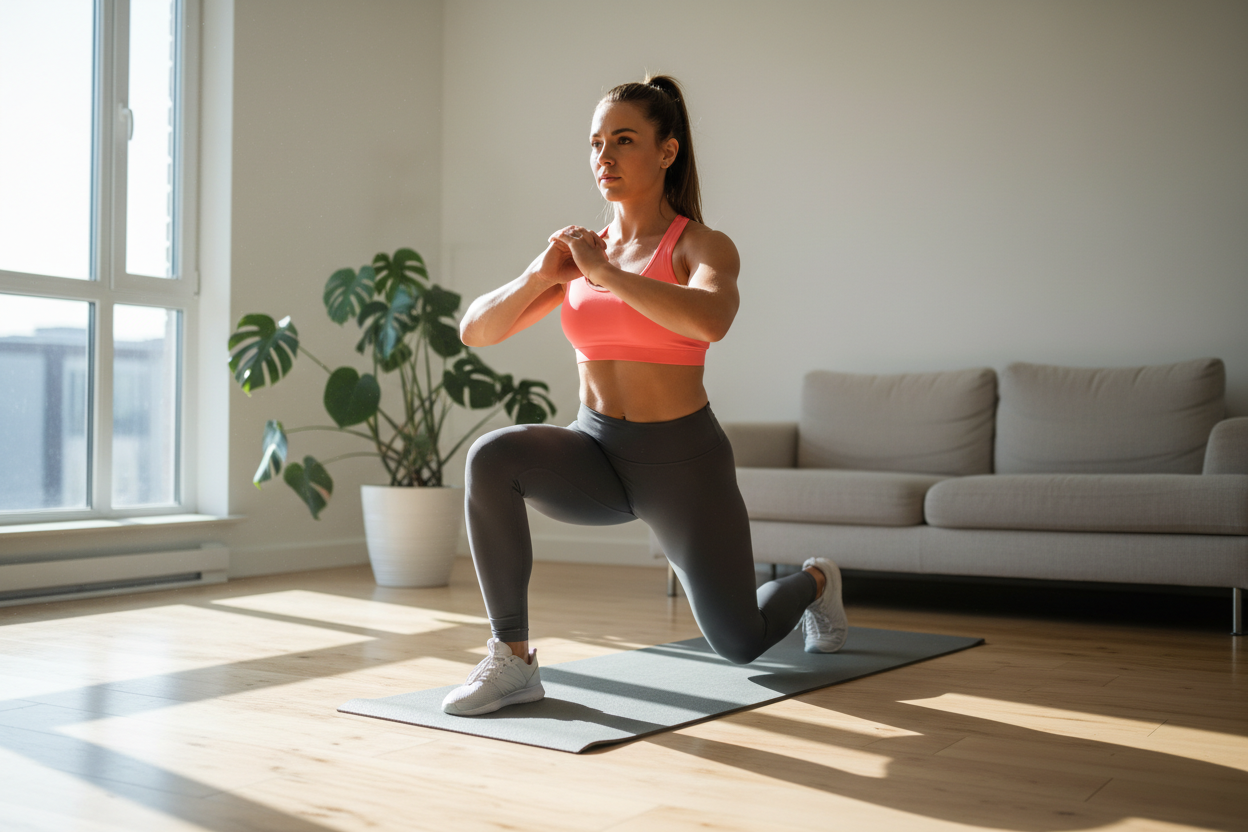
Forward lunges can be tough on the knees if you lack deceleration strength. Reverse lunges are generally friendlier. Step back with one foot, dropping the back knee toward the floor until both knees form 90-degree angles. Keep your torso upright. This movement targets the glutes and quads heavily while challenging your balance.
Targeting Specific Muscles at Home
Once you have the basics down, you need to increase the complexity to keep progressing. Effective exercises to strengthen leg muscles at home often require you to isolate specific areas that air squats might miss, particularly the posterior chain (the back of your legs).
Glute Bridges
Lie on your back with your knees bent and feet flat on the floor. Drive your hips toward the ceiling by squeezing your glutes hard at the top. To make this effective, do not hyperextend your lower back. The movement should come entirely from the hips. If two legs are too easy, lift one leg in the air and perform the movement with a single leg. This is exceptional for counteracting the effects of sitting in a chair all day.
Calf Raises
Your lower legs act as the shock absorbers for your entire body. Stand on the edge of a step or a sturdy book. Lower your heels toward the ground to get a full stretch, then drive up onto your toes as high as possible. Hold the top position for two seconds. That pause is crucial; bouncing through the reps destroys the benefit.
The Leg Hand Exercise Connection
Coordination between your upper and lower body is vital for athleticism. A "leg hand exercise" generally refers to movements where your hands act as a counterbalance or a target to ensure proper hip hinging. The best example of this is the Single-Leg Romanian Deadlift (RDL).
Stand on one leg with a slight bend in the knee. Hinge at your hips, sending your free leg straight back behind you like a pendulum. Simultaneously, reach your opposite hand toward the toe of the standing leg. You do not need to touch your toe, but the reaching motion keeps your shoulders square and prevents your hips from rotating open. This drill builds incredible hamstring strength and ankle stability. If you are doing it right, you will feel a deep stretch in the hamstring of the standing leg.
Structuring Your Home Routine
Randomly doing a few squats when you remember them won't yield results. You need a structured approach. A solid home routine should be performed 3 to 4 times a week, allowing for rest days in between.
Try this circuit:
- Bodyweight Squats: 15-20 reps
- Reverse Lunges: 12 reps per leg
- Single-Leg RDL (the leg hand exercise): 10 reps per leg
- Glute Bridges: 20 reps
- Calf Raises: 20 reps
Repeat this circuit 3 or 4 times. Rest for 60 to 90 seconds between rounds. To apply the principle of progressive overload without weights, simply reduce your rest time, add more reps, or slow down the tempo of every repetition (take 3 seconds to lower yourself, 1 second to rise).
Consistency Over Intensity
The biggest mistake people make with home workouts is underestimating them. Because you aren't loading a barbell, it is easy to zone out and go through the motions. You have to bring the intensity mentally. Squeeze the muscle at the top of every rep. Control the descent. If you treat your living room workout with the same respect you would give a heavy gym session, your legs will get stronger, your joints will feel better, and you will build a foundation of fitness that lasts.
Frequently Asked Questions
How long does it take to see results from home leg workouts?
You will typically feel stronger and more stable within two to three weeks of consistent training. Visible muscle definition usually takes about 6 to 8 weeks, provided your nutrition supports muscle growth and you are progressively challenging your muscles.
Can I build big legs without heavy weights?
Yes, but it requires higher volume and intensity. You must push your muscles close to failure using high repetitions, slow tempos, or explosive movements (like jump squats) to stimulate hypertrophy without external load.
What should I do if my knees hurt during squats?
Check your form to ensure your knees are tracking over your toes and not collapsing inward. You can also reduce the range of motion or switch to glute-dominant exercises like bridges and Romanian deadlifts until your joint stability improves.