Build Powerful Legs and Glutes Without Stepping Foot in a Gym
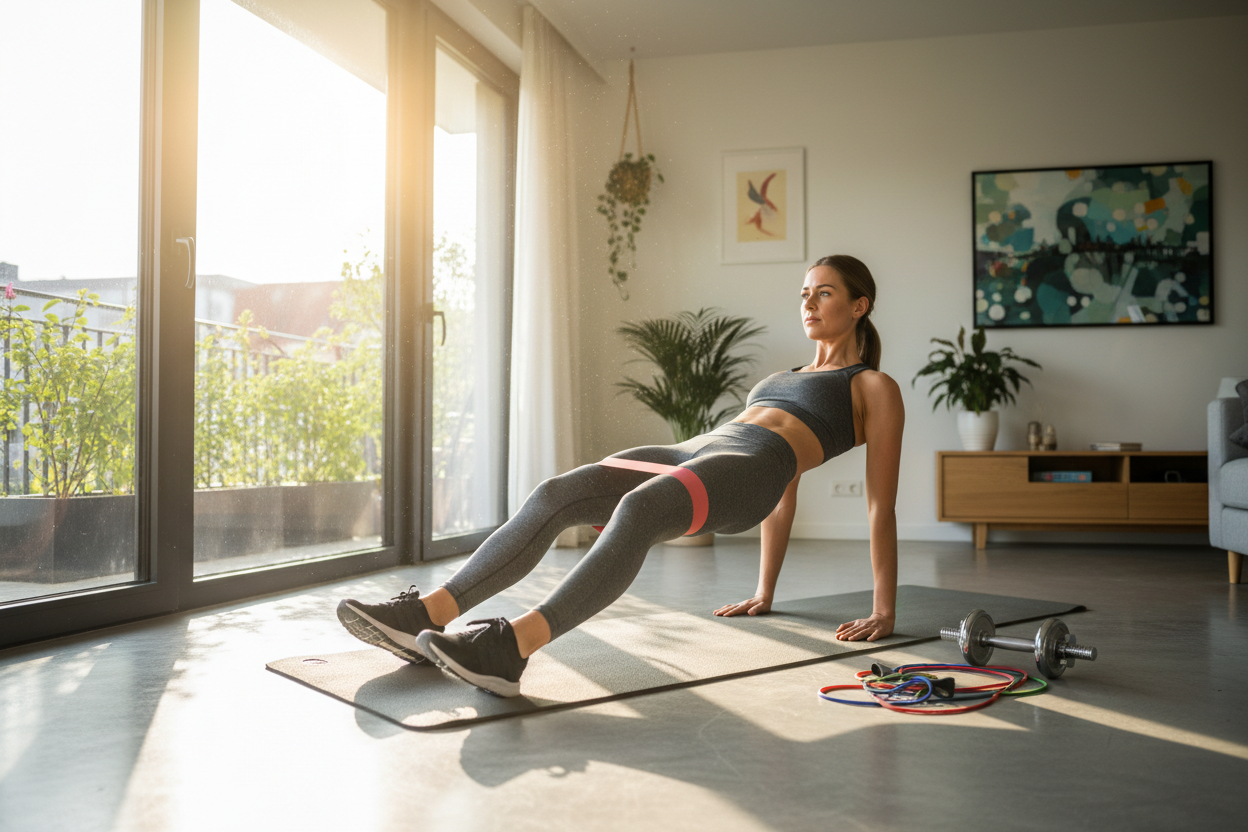
Building a strong, defined lower body does not strictly require a squat rack or heavy plates. Many people believe that without external load, muscles simply won't grow. That is a misconception. Your muscles understand tension, not location. Whether that tension comes from a barbell in a commercial facility or gravity and biomechanics in your living room, the physiological response remains largely the same if the intensity is high enough. You can absolutely sculpt your quads, hamstrings, and glutes with nothing but floor space and determination.
I recall a period a few years ago when I was traveling extensively for work, staying in hotels that rarely had more than a broken treadmill. I was terrified of losing the lower body strength I had spent years building. I decided to commit to a daily regimen of high-volume calisthenics. I specifically remember the first time I did 100 consecutive walking lunges followed by pause-squats. My legs were shaking more violently than they ever had after a heavy leg press session. That experience taught me that bodyweight training isn't just a backup plan; it is a legitimate tool for hypertrophy when applied correctly.
The Science of Growing Legs at Home
To stimulate muscle growth, you need mechanical tension and metabolic stress. In a gym, we usually achieve this by adding weight. When performing a legs and glutes workout at home, we have to manipulate different variables. Since we cannot easily add 200 pounds to our backs, we must increase the time under tension, decrease rest periods, or increase the range of motion.
Unilateral training—working one leg at a time—is the most effective strategy here. By shifting your entire body weight onto a single limb, you effectively double the load relative to that muscle. This also demands greater stability from the glute medius and core, often resulting in a more functional, athletic physique than machine-based isolation can provide.
Essential Movements for Lower Body Development
An effective routine focuses on movement patterns rather than just random exercises. You need a squat pattern, a lunge pattern, and a hinge pattern to hit the posterior chain comprehensively.
The Squat Pattern
The air squat is your foundation, but to drive adaptation, you need to evolve it. Start with a standard stance, feet shoulder-width apart. As you descend, drive your knees outward and keep your chest upright. Do not just drop down; pull yourself down actively to engage the hamstrings.
Once standard squats become too easy, transition to the 1.5 rep squat. Go all the way down, come up halfway, go back down, and then return to the top. This increases the time your quadriceps spend under tension, creating a burning sensation that signals metabolic stress. This technique turns a basic movement into a grueling component of your glute and leg workouts at home.
The Lunge Pattern
Lunges are non-negotiable for glute development. The reverse lunge is generally safer for the knees than the forward variation. Step back far enough that your front shin remains vertical. To target the glutes specifically, lean your torso forward slightly—about 15 to 20 degrees—while keeping your back flat. This hip flexion stretches the glute max at the bottom of the movement.
For those ready to advance, the Bulgarian Split Squat is the king of home leg exercises. Elevate your rear foot on a couch or chair. Lower your hips until the rear knee almost touches the floor. This movement puts immense stretch on the quads and glutes and corrects muscular imbalances quickly.
The Hinge and Bridge
Neglecting the posterior chain is a common mistake. Your hamstrings and glutes need direct work. The Single-Leg Glute Bridge is a staple. Lie on your back, one foot flat on the floor, the other in the air. Drive through your heel to lift your hips. Squeeze hard at the top. If you don't feel it, you are likely using your lower back instead of your hips. Tuck your pelvis slightly to fix this.
The Single-Leg Romanian Deadlift (RDL) complements the bridge. Stand on one leg with a slight bend in the knee. Hinge at the hips, sending your glutes back as your torso lowers. You should feel a deep stretch in the hamstring of the standing leg. This balance-intensive move is crucial for a complete glutes and leg workout at home.
Structuring Your Routine
Random effort leads to random results. A structured approach ensures you hit every muscle fiber without overtraining. Perform this circuit 3 to 4 times, resting 60 to 90 seconds between rounds.
- Bulgarian Split Squats: 12-15 reps per leg (Control the descent for 3 seconds).
- Single-Leg RDLs: 12 reps per leg (Focus on the stretch).
- 1.5 Rep Bodyweight Squats: 20 reps (Keep constant tension, do not lock out at the top).
- Glute Bridges (Single Leg): 15 reps per leg (Hold the top contraction for 2 seconds).
- Lateral Lunges: 12 reps per leg (Targeting the inner thighs and outer glutes).
This sequence ensures that your quads, hamstrings, glutes, and adductors are all stimulated. By moving from one exercise to the next with minimal rest, you also get a significant cardiovascular stimulus.
Progressive Overload Without Weights
The biggest challenge with an at home legs and glutes workout is continuing to make progress once the bodyweight reps become easy. You cannot simply add a plate, so you must change the mechanics. Tempo is your best friend here. Slowing down the eccentric (lowering) phase of a squat to 4 or 5 seconds causes significantly more muscle damage—the good kind—than a fast rep.
Another method is adding plyometrics. Jump squats or alternating jump lunges recruit Type II fast-twitch muscle fibers, which have the highest potential for growth. Add a set of explosive jump squats at the very end of your workout to fully deplete the legs.
Consistency and Frequency
Leg muscles are large and resilient. Because bodyweight training imposes less systemic fatigue on the central nervous system compared to heavy deadlifts, you can train legs more frequently. A frequency of two to three times per week is optimal for most people. This frequency keeps the metabolic signal for muscle growth turned on.
Remember that recovery is where the growth happens. Sleep and nutrition play massive roles. Even the best workout won't yield results if you aren't consuming enough protein to repair the tissue. Hydration is equally critical for keeping the fascia—the connective tissue around your muscles—supple and healthy.
Common Mistakes to Avoid
Form breakdown is the enemy of progress. In an effort to get more reps, people often cut their depth short or let their knees cave inward. Quality always trumps quantity. Ten perfect reps of a split squat will do more for your physique than fifty sloppy air squats. Furthermore, failing to engage the core is a recipe for lower back pain. Treat every squat and lunge like a standing plank; keep your abs braced to protect your spine.
Training at home removes the barriers of commute time and gym anxiety. It strips fitness down to its rawest elements: your body and gravity. By focusing on intensity, proper biomechanics, and consistent progression, you can build a lower body that is both strong and aesthetically pleasing.
FAQ
How often should I do this leg workout?
Since bodyweight exercises generally cause less joint stress than heavy weightlifting, you can perform this routine 2 to 3 times per week. Ensure you have at least one rest day between sessions to allow for muscle repair and recovery.
Can I really build muscle without weights?
Yes, muscle growth is triggered by tension and fatigue, not just heavy iron. By utilizing high repetitions, slowing down your movement tempo, and performing unilateral (single-leg) exercises, you can create enough stimulus to induce hypertrophy effectively at home.
What if I have knee pain during lunges?
If you experience knee pain, check that your front knee isn't collapsing inward and that your weight is in your heel, not your toes. You can also swap forward lunges for reverse lunges, which place significantly less shear force on the knee joint, or reduce the range of motion until your strength improves.