
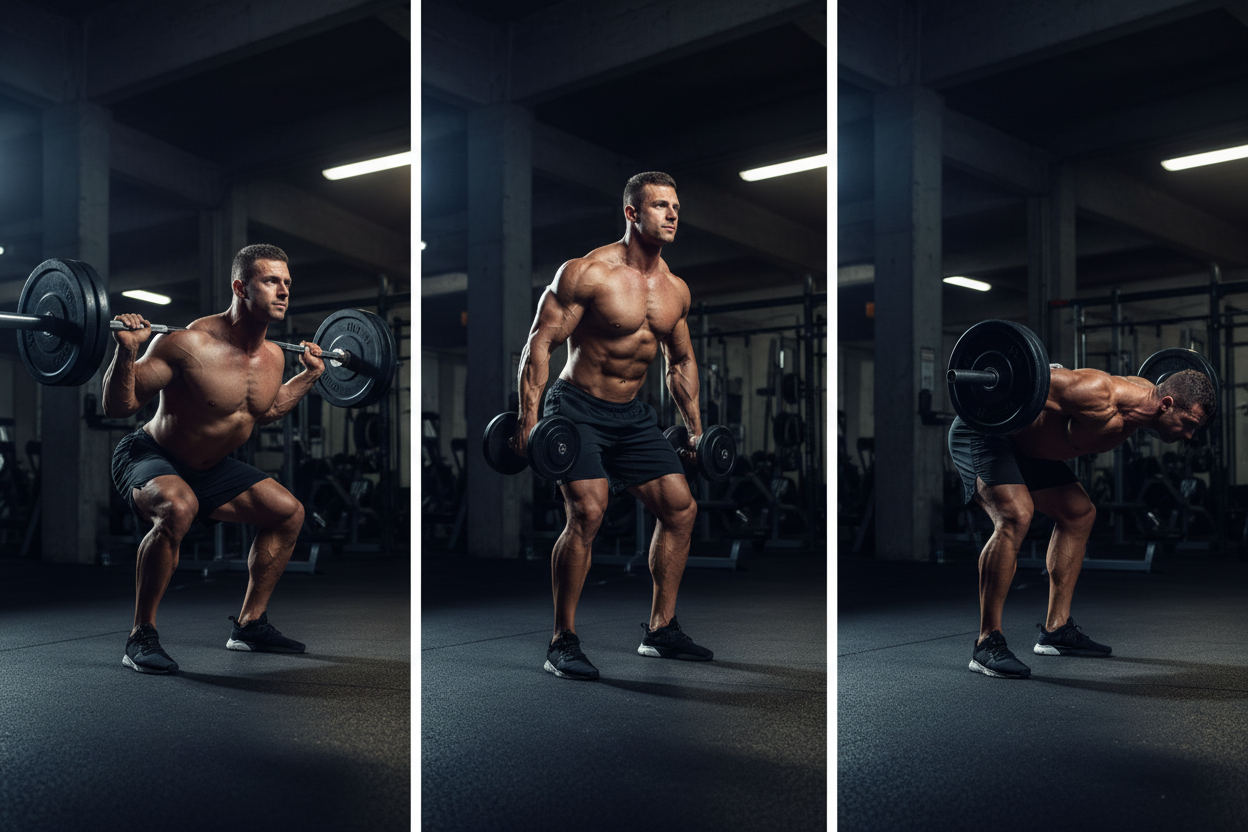
Build Massive Legs With Just These 3 Lower Body Exercises
Walk into any commercial gym, and you will see a dizzying array of machines designed to isolate every fiber of your legs. It leads to analysis paralysis. The truth is, you do not need a twelve-step routine to build a powerful foundation. You need intensity applied to the right movement patterns. To maximize hypertrophy and strength, you only really need to focus on 3 lower body exercises executed with perfect form.
Quick Summary: The Essential Trio
If you are looking for the most efficient path to leg development, focus your energy here. These three movement patterns cover every major muscle group in the lower body:
- The Squat Pattern (Knee Dominant): Targets the quadriceps and core (e.g., Barbell Back Squat or Goblet Squat).
- The Hinge Pattern (Hip Dominant): Targets the hamstrings, glutes, and lower back (e.g., Romanian Deadlift).
- The Unilateral Movement (Single-Leg Stability): Fixes imbalances and targets stabilizers (e.g., Bulgarian Split Squat).
Understanding the Anatomy
Before we look at the specific movements, we need to understand what we are trying to stimulate. An effective routine must hit the 5 lower body muscles that contribute to size and athletic performance: the quadriceps, hamstrings, glutes, calves, and adductors.
Many lifters neglect the adductors (inner thigh) and glutes by only doing leg extensions. The compound movements listed below force these muscle groups to work together as a unit, which is how human physiology is designed to function.
1. The Squat Variation (The King)
You cannot talk about lower body workout names without starting here. Whether it is a High-Bar Back Squat, a Front Squat, or a heavy Goblet Squat, the knee-dominant pattern is non-negotiable.
Why It Works
Squats allow for the greatest mechanical tension on the quadriceps. By taking the knee through a full range of motion (deep flexion), you stretch the muscle fibers under load. This mechanical tension is the primary driver of muscle growth.
2. The Hinge Variation (The Posterior Chain)
While the squat handles the front of the leg, the Hinge handles the back. The Romanian Deadlift (RDL) is the superior choice here over a conventional deadlift for pure hypertrophy.
The Science of the Hinge
The RDL keeps constant tension on the hamstrings and glutes by eliminating the "dead stop" on the floor. It focuses on the eccentric (lowering) portion of the lift. This eccentric loading causes significant micro-tearing in the muscle fibers, which leads to a robust repair and growth response.
3. The Unilateral Finisher
If you want examples of lower body exercises that humble even the strongest lifters, look no further than the Bulgarian Split Squat or the Walking Lunge.
Fixing the Imbalance
Bilateral exercises (using both legs) can hide weaknesses. If your right leg is 10% stronger than your left, your right side will take over during a heavy squat. Unilateral work forces each leg to carry its own load, ensuring symmetrical development and engaging the smaller stabilizer muscles that machines ignore.
Creative Lower Body Exercises for Progression
Sticking to three exercises doesn't mean your training has to be boring. You can employ creative lower body exercises by altering the tempo or the implement used.
For example, try a "1.5 rep" style on your squats (go all the way down, come halfway up, go back down, then stand up). This increases time under tension without requiring heavier weights, saving your joints while torching your quads.
My Training Log: Real Talk
I want to be honest about what switching to this minimalist approach actually feels like. When I first stripped my routine down to just these three movements, I thought it would be a "light" day. I was wrong.
Specifically regarding the Bulgarian Split Squat: there is a very distinct, nasty sensation that happens around rep eight on the third set. It's not just the burn in the quad; it's the cramp in the arch of my back foot balancing on the bench. I also noticed that without the stability of a leg press machine, my glute medius (side butt) was screaming just trying to keep my knee from caving inward.
Another detail the textbooks don't mention is the grip fatigue during high-rep Romanian Deadlifts. Even though it's a leg exercise, I found my forearms burning out before my hamstrings did, which forced me to finally start using straps so I could actually take my legs to failure. If you don't feel a deep, almost uncomfortable stretch in the belly of the hamstring at the bottom of an RDL, you aren't pushing your hips back far enough.
Conclusion
You don't need to confuse your muscles; you need to overload them. By mastering a Squat, a Hinge, and a Unilateral movement, you cover every base required for massive, strong legs. Focus on adding weight or reps to these three lifts over the next six months, and the results will speak for themselves.
Frequently Asked Questions
Can I build big legs with only 3 exercises?
Absolutely. Muscle growth is determined by volume and intensity, not variety. If you perform enough hard sets (close to failure) of these three compound movements, you will stimulate more growth than doing ten easy isolation exercises.
What are the best 5 lower body muscles to target?
To build a complete lower body, you must target the Quadriceps, Hamstrings, Glutes, Calves, and Adductors. The three exercises listed above hit the first three directly, while the adductors and calves work heavily as stabilizers.
How often should I do this workout?
For most natural lifters, hitting legs twice a week is the sweet spot. This allows you to accumulate enough volume for growth while giving your central nervous system 48 to 72 hours to recover between sessions.


