Build Massive Legs at Home: The Ultimate No-Gear Guide for Men
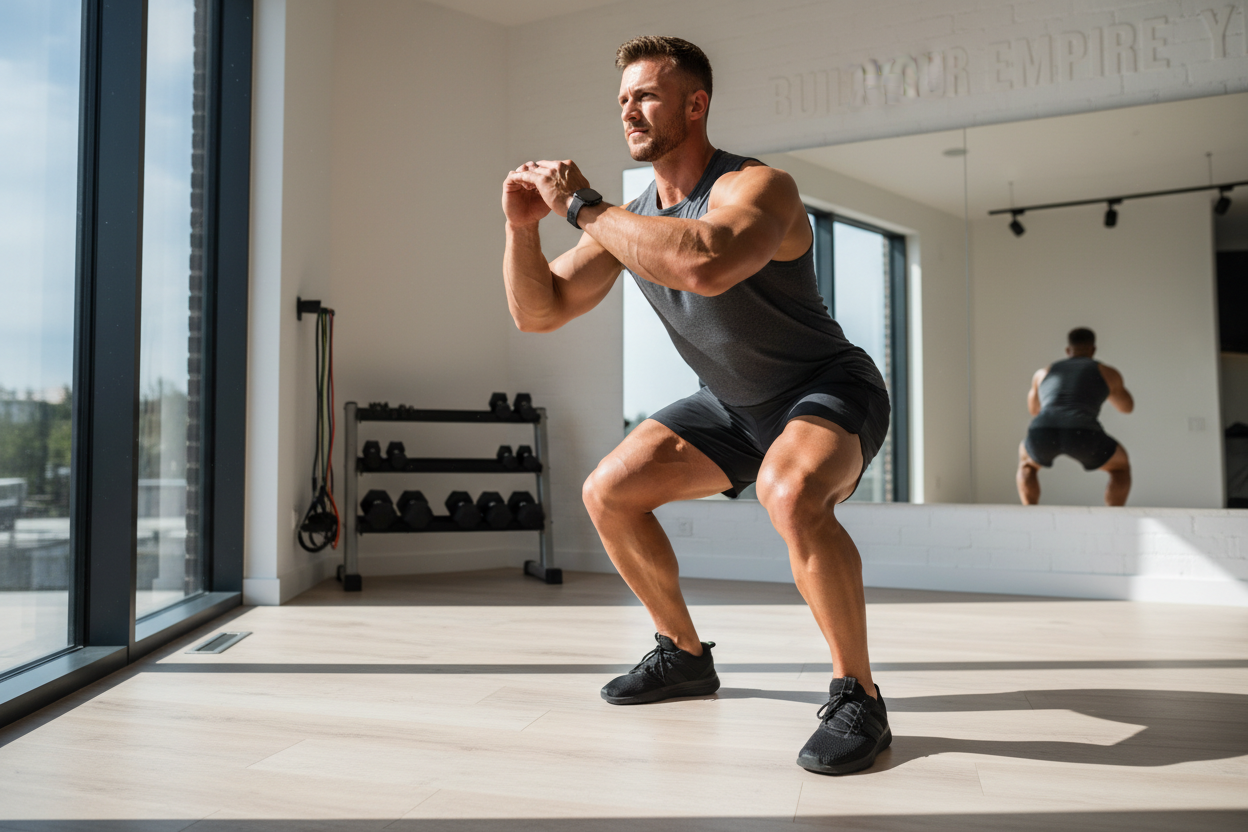
You do not need a squat rack, a leg press machine, or hundreds of pounds of iron to build a powerful lower body. While heavy lifting has its place, your own body weight is a formidable tool for generating hypertrophy and strength if you apply the right intensity. The secret lies in manipulating leverage, tempo, and rest periods to force your muscles to adapt. If you are looking for effective leg exercises for men no equipment required, the answer is simple: focus on unilateral movements and high tension.
Many guys skip leg day when they can't get to the gym because they assume air squats are too easy. If you just bounce up and down for twenty reps, they are. But if you shift your weight to one leg, slow down the eccentric (lowering) phase to four seconds, and eliminate the pause at the top, you create a stimulus that can humble even experienced lifters. The goal is to maximize time under tension.
The Mechanics of Bodyweight Growth
Building muscle without external load requires a different mindset than barbell training. With a barbell, you progressively overload by adding 5 pounds. With calisthenics, you overload by decreasing leverage or increasing mechanical disadvantage. This usually means moving from two-legged exercises to single-leg variations. Unilateral training forces one leg to stabilize and lift your entire body weight, which effectively doubles the load relative to the limb while engaging the core and stabilizers significantly more than machine work.
The Essential Movement Patterns
A complete leg workout for men no equipment needed should cover the quads, hamstrings, glutes, and calves. Neglecting the posterior chain (hamstrings and glutes) is a common mistake in home workouts because quads are easier to target. The following movements correct that imbalance.
The Bulgarian Split Squat
This is arguably the king of bodyweight leg training. It places the back leg on an elevated surface (like a couch or chair) and forces the front leg to do all the work. It takes the lower back out of the equation, which is often the limiting factor in back squats, and places the tension directly on the quadriceps and glutes.
To perform this correctly, stand a few feet in front of a sturdy chair. Place the top of your rear foot on the seat. Lower your hips until your front thigh is parallel to the floor, ensuring your front knee tracks over your toes but doesn't cave inward. Drive back up through the front heel. If you want to make this harder, do 1.5 reps: go all the way down, come halfway up, go back down, and then return to the top. That counts as one rep.
The Pistol Squat
For those seeking advanced leg exercises for men without equipment, the pistol squat is the gold standard. It requires immense mobility, balance, and strength. It is a full single-leg squat where the non-working leg is held straight out in front of you.
Most men cannot do this immediately. Start by sitting back onto a chair on one leg and standing back up. As you get stronger, lower the surface until you can perform the full movement without support. This exercise builds thick, athletic legs and bulletproof knees.
Nordic Hamstring Curl Negatives
Hamstrings are notoriously difficult to train at home without bands. The Nordic curl changes that. You will need a partner to hold your ankles down, or you can hook your heels under a very heavy piece of furniture (like a sofa loaded with books).
Kneel on a soft surface with your ankles secured. Keep your hips locked in a straight line with your torso. Slowly lower your body toward the floor using only your hamstrings to control the descent. Most people will fail and catch themselves with their hands—that is expected. Push yourself back up and repeat the lowering phase. The eccentric tension here is massive for growth.
Glute Bridges and Single-Leg Hip Thrusts
To target the glutes specifically, lie on your back with knees bent. Drive your hips toward the ceiling, squeezing hard at the top. To increase the difficulty, lift one leg off the ground and perform the movement with a single leg. This pairs perfectly with the quad-dominant squat variations to ensure balanced leg development.
My Experience with Living Room Leg Days
I learned the hard way that weights aren't mandatory for size. A few years ago, I was recovering from a lower back injury that strictly prohibited spinal loading. No barbells, no leg press. I was terrified my legs would shrink. I committed to a regimen of high-volume Bulgarian split squats and walking lunges three times a week. I focused purely on the mind-muscle connection and slowing down every rep.
After three months, not only did my legs not shrink, but the separation in my quads actually improved. I realized that in the gym, I was often moving weight from point A to point B using momentum. At home, stripped of the ego-lifting heavy plates, I was forced to own every inch of the movement. The soreness I felt after those sessions rivaled my heaviest squat days. It shifted my perspective entirely on what constitutes an "effective" workout.
Structuring Your Routine
To get the most out of these movements, you should arrange them in a circuit or perform them with short rest periods to induce metabolic stress. Here is a sample routine designed to exhaust the lower body muscles.
- Bodyweight Squats: 20 reps (Warm-up, fast tempo)
- Bulgarian Split Squats: 12 reps per leg (3 seconds down, 1 second up)
- Single-Leg Hip Thrusts: 15 reps per leg (Hold the squeeze at the top for 2 seconds)
- Reverse Lunges: 20 reps alternating legs (Keep tension constant, do not lock out knees at the top)
- Nordic Curl Negatives: 8 reps (Go as slow as possible)
- Single-Leg Calf Raises: 20 reps per leg (Use a step or ledge for full range of motion)
Perform this circuit 3 to 4 times. Rest for 90 seconds between rounds. Because there is no external load, you can train legs more frequently, perhaps two or even three times a week, as your central nervous system recovers faster than it would from heavy deadlifts.
Progressive Overload Without Weights
The principle of progressive overload still applies, but you apply it differently. Once you can easily hit the rep ranges above, you must change the stimulus. Decrease your rest time between rounds from 90 seconds to 60. Add a pause at the bottom of every squat. Try explosive jump squats to engage fast-twitch muscle fibers.
Consistency is the final piece of the puzzle. A leg workout for men no equipment style requires grit because high-rep lower body training burns. It creates a lot of lactic acid. Pushing through that burn is where the muscle growth happens. If you treat these bodyweight movements with the same respect and intensity you give the barbell, your legs will grow.
Frequently Asked Questions
Can you really build big legs without weights?
Yes, you can build significant muscle size without weights by utilizing high volume, shorter rest periods, and unilateral exercises. By isolating one leg at a time, you apply enough resistance to stimulate hypertrophy through mechanical tension and metabolic stress.
How often should I do bodyweight leg workouts?
Since bodyweight exercises generally place less stress on the central nervous system than heavy weightlifting, you can train legs more frequently. Aim for 2 to 3 times per week, ensuring you have at least one rest day between sessions to allow for muscle repair.
What if bodyweight squats become too easy?
If standard squats feel too easy, progress to single-leg variations like pistol squats or Bulgarian split squats. Alternatively, you can increase the difficulty by slowing down your tempo, adding explosive jumps, or holding the bottom position of the squat to eliminate the stretch reflex.