
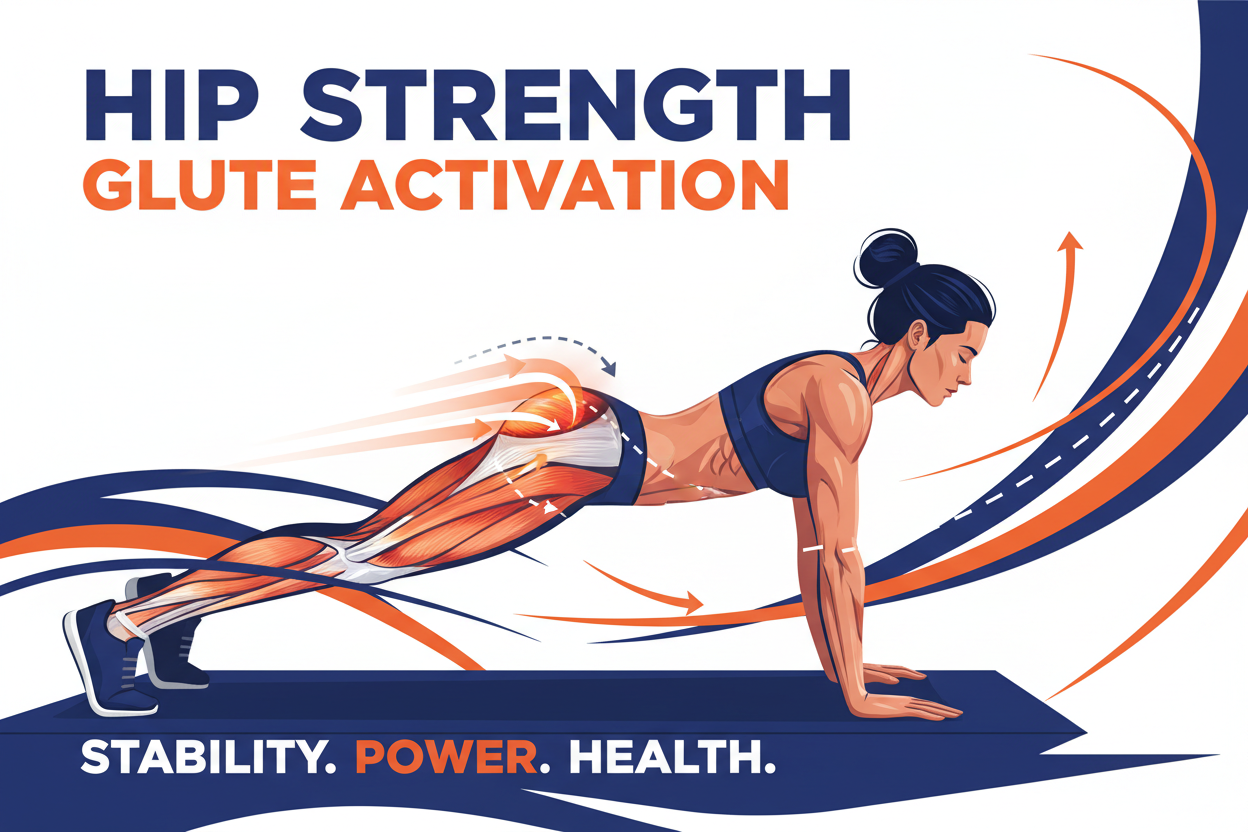
Build Bulletproof Hips: The Real Secret to Waking Up Your Glutes
Most people treat glute training as purely aesthetic work, relegated to the end of a leg day if there is time left on the clock. This is a massive oversight. Your glutes are the engine of your body, serving as the primary powerhouse for running, jumping, and lifting, while simultaneously acting as the anchor for your lower back health. If your hips are weak, your mechanics collapse, leading to a cascade of issues ranging from knee valgus to chronic lumbar pain. The solution isn't just doing more squats; it requires a strategic approach to activation and loading.
I learned this lesson the hard way a few years ago. Despite squatting heavy twice a week, I developed a nagging pain in my lower back and right knee whenever I went for a run. I assumed my legs were strong enough to handle the mileage, but a visit to a physical therapist revealed the uncomfortable truth: I was "quad dominant." My glutes had essentially gone to sleep, forcing my lower back and hamstrings to take over the load. Once I shifted my focus from simply moving weight to actual glute strength training, the pain vanished, and my lifts went up. It wasn't about working harder; it was about working the right muscles.
Understanding the Powerhouse
Before diving into the movements, you need to understand what you are actually training. The gluteal complex consists of three main muscles: the maximus, medius, and minimus. The maximus creates that forward thrust (hip extension), while the medius and minimus stabilize the pelvis, keeping your hips level when you stand on one leg. If you ignore the stabilizers, you lose power leaks through your kinetic chain.
Many gym-goers stick to bilateral movements like leg presses, which are great for raw output but often mask imbalances. To build a resilient body, you need a mix of heavy compound lifts and targeted functional glute exercises that mimic real-world demands, such as stabilizing the body while moving through different planes of motion.
The King of Hip Extension: The Hip Thrust
If you want to isolate the gluteus maximus without your lower back taking over, the barbell hip thrust is non-negotiable. While squats and deadlifts recruit the glutes, the hip thrust places the point of maximal tension exactly where the glutes are fully shortened. This makes it arguably the most effective glute strengthening exercise for raw hypertrophy and strength.
To perform this correctly, set up with your upper back against a bench. The height of the bench matters; it should hit just below your shoulder blades. When you drive the weight up, focus on a posterior pelvic tilt—think about tucking your tailbone slightly under at the top. This prevents lumbar hyperextension. Your shins should be vertical at the top of the movement. If your feet are too far forward, you will feel it in your hamstrings; too close, and your quads take over. Hold the top position for a distinct pause to ensure the glutes are doing the work, not momentum.
Mastering the Hip Hinge: Romanian Deadlifts
While the thrust builds the muscle in its shortened position, the Romanian Deadlift (RDL) strengthens the glutes while they are lengthening. This eccentric strength is vital for decelerating the body and preventing injuries. As far as exercises for glute strength go, the RDL teaches you how to dissociate hip movement from spinal movement.
Start with the bar or dumbbells in your hands. Keep a soft bend in your knees—this is not a stiff-legged deadlift—and push your hips backward as if you are trying to close a car door with your butt. Keep the weight close to your shins. The range of motion ends when your hips stop moving back. If you go lower than that, you are likely rounding your spine. Drive your hips forward to return to standing, squeezing the glutes hard at the lock-out.
Unilateral Stability: The Bulgarian Split Squat
Bilateral strength hides unilateral weakness. You might have a 300-pound squat, but if you cannot stabilize yourself on one leg, you are building strength on a shaky foundation. The Bulgarian Split Squat is a humbling exercise for strong glutes that targets the gluteus medius and challenges your balance.
Place one foot on a bench behind you and step the other foot forward. The distance is key here. A longer stride targets the glutes, while a shorter stride hits the quads. Lower your back knee toward the floor while keeping a slight forward lean in your torso. This forward lean increases the stretch on the glute of the working leg. Drive through the heel of the front foot to stand back up. If you find yourself wobbling, that is a sign your stabilizers are finally waking up.
Lateral Movement: Banded Walks and Clamshells
Heavy lifting is essential, but high-repetition metabolic work has a place, specifically for the smaller glute muscles. These movements are often dismissed as "warm-ups," but when performed with high tension, they are incredible for durability.
Lateral band walks target the gluteus medius. Place a resistance band around your ankles or just above your knees. Assume a quarter-squat position and step laterally, maintaining tension on the band the entire time. Do not let your knees cave inward. This constant tension creates a burning sensation that indicates high metabolic stress, which triggers muscle growth and improves the mind-muscle connection before you move on to heavier lifts.
Programming Your Glute Training
You do not need a separate "glute day" to see results. Instead, integrate these movements into your existing lower body or full-body routines. A balanced approach might look like starting with a heavy compound movement like a squat or deadlift, following up with a hip thrust variation for higher volume, and finishing with unilateral work like lunges or split squats.
Frequency is often more important than volume in a single session. Hitting these muscle groups 2 to 3 times a week allows for sufficient recovery while providing enough stimulus for adaptation. Remember, the goal of glute strength training is not just to be sore the next day; it is to improve your capacity to produce force and stabilize your body.
Common Pitfalls to Avoid
The most common mistake in glute training is using the lower back to achieve a greater range of motion. We often see this in kickbacks or bridges where the athlete arches their back aggressively. This disengages the glutes and compresses the lumbar spine. Range of motion is only useful if you can control it.
Another issue is rushing the tempo. Glutes respond well to time under tension. Slow down the eccentric (lowering) phase of your lifts and pause at the peak contraction. By removing momentum, you force the muscle fibers to do the heavy lifting, ensuring that your efforts translate into real-world strength and stability.
Frequently Asked Questions
How long does it take to see results from glute training?
Neurological adaptations, such as better activation and balance, often happen within the first 2-4 weeks. Visible muscle growth typically takes 8-12 weeks of consistent training combined with adequate nutrition.
Can I train glutes every day?
It is not recommended to train them with high intensity every day, as muscles grow during rest, not during the workout. However, you can perform low-intensity activation exercises, like bodyweight bridges or clam shells, daily to combat the effects of sitting.
Why do I feel leg exercises in my lower back instead of my glutes?
This usually indicates a weak core or poor pelvic control, often called "glute amnesia." Regress the movement to simpler variations like floor bridges to re-establish the mind-muscle connection before adding heavy loads again.


