
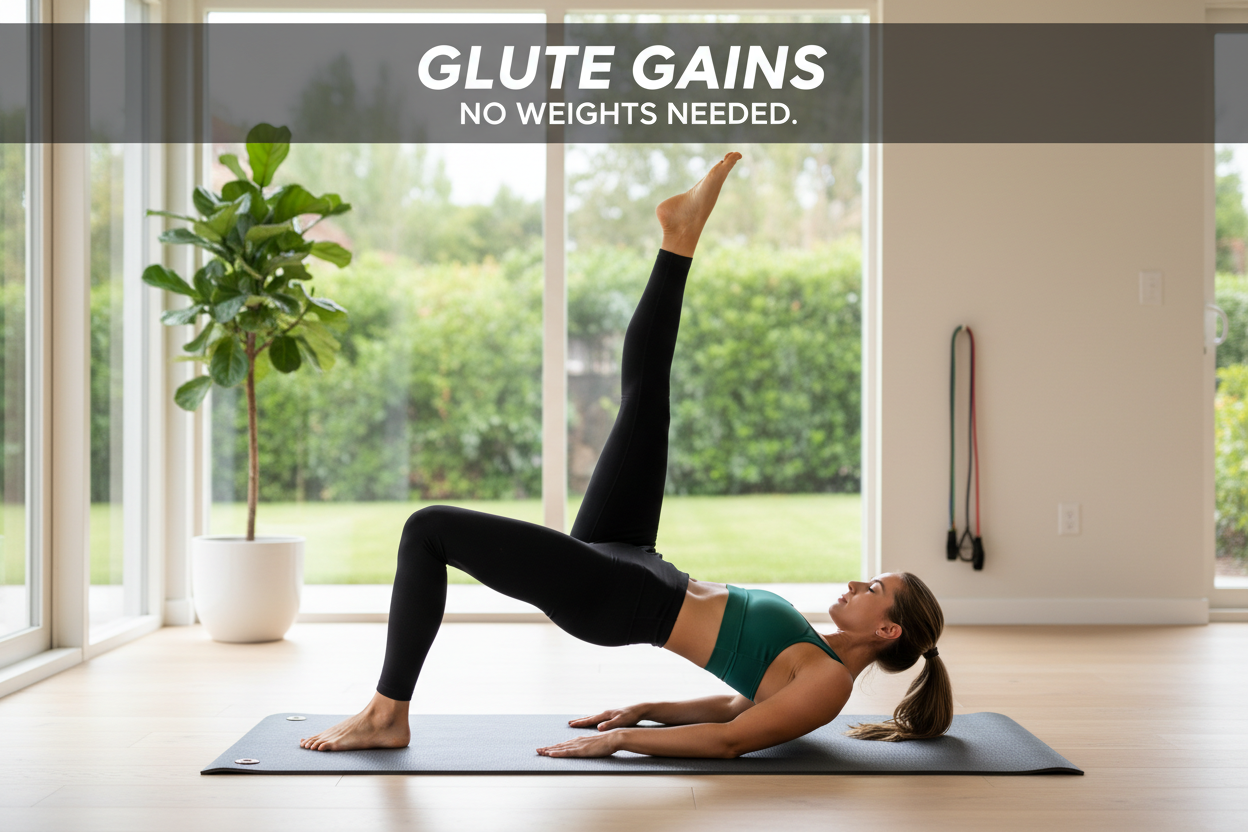
Build a Powerful Posterior: The Ultimate Guide to Glute Training Without Weights
You do not need a heavy barbell or a gym membership to build strong, functional, and shapely glutes. While heavy resistance training has its place, your body weight is a powerful tool if you understand how to manipulate leverage and tension. The secret lies in intention. Simply going through the motions won't trigger growth, but applying mechanical stress through full ranges of motion will. If you are looking for the best bodyweight glute exercises to transform your lower body routine, the answer lies in mastering hip extension and abduction with high precision.
To give you the answer straight away: the most effective movements are single-leg variations. Unilateral exercises like the Bulgarian split squat, the single-leg hip thrust, and the step-up place the entire load on one glute at a time, effectively doubling the intensity compared to two-legged movements. These exercises force the gluteus maximus to work overtime to stabilize the pelvis while generating force, providing a stimulus that rivals weighted squats.
My Realization: Weights Aren't Everything
I spent years convinced that unless I had 300 pounds on a bar, I wasn't growing. That changed during a month-long trip where I had absolutely no access to equipment. I was terrified of losing my progress. Out of desperation, I committed to a high-volume routine focused entirely on tempo and unilateral work. I remember doing single-leg glute bridges with a three-second hold at the top. By the third set, my muscles were shaking in a way they rarely did with heavy iron. That month taught me that metabolic stress—the burn you feel from constant tension—is a potent driver for hypertrophy. I didn't lose size; I actually improved my muscle activation and fixed a muscular imbalance in my left hip that had plagued my heavy lifting for years.
Understanding the Anatomy of the Glutes
Before jumping into the routine, it helps to visualize what you are working. The gluteal complex is made up of three main muscles. The gluteus maximus is the powerhouse, responsible for the shape and size of your rear. Its main job is hip extension—moving your leg behind you. The gluteus medius and minimus are located on the side of the hip. They are crucial for stability and hip abduction (moving the leg away from the midline). A well-rounded program hits all three.
Many people suffer from "glute amnesia," a condition where the hip flexors are so tight from sitting all day that the glutes forget how to fire. Bodyweight training is actually superior for fixing this because it allows you to focus entirely on the mind-muscle connection without the fear of being crushed by a weight.
The Top Movements for Maximum Growth
Here is a breakdown of the movements that should form the cornerstone of your home training. These are selected based on their ability to recruit the maximum number of muscle fibers.
1. The Bulgarian Split Squat
This is arguably the king of leg exercises, weighted or not. By elevating your rear foot, you shift the majority of your weight onto the front leg. This requires immense stability from the glute medius and raw power from the glute maximus.
To target the glutes specifically, lean your torso forward slightly (about 45 degrees) while keeping your spine straight. This angle stretches the glute more at the bottom of the movement than an upright torso, which targets the quads. Lower yourself until your back knee hovers just above the ground, then drive through the heel of your front foot. Do not bounce; control the descent.
2. Single-Leg Hip Thrust
While squats are great, they also heavily involve the quads and lower back. If you want pure isolation, the hip thrust is non-negotiable. It is widely considered one of the best bodyweight exercises for glutes because it maintains tension at the point of maximum contraction.
Set up with your upper back against a couch or sturdy chair. Lift one leg off the ground and drive the other foot into the floor to lift your hips. The goal is to create a straight line from your shoulder to your knee. At the top, squeeze as hard as you can. A common mistake is hyperextending the lower back. Keep your chin tucked and your ribs down to ensure the movement comes from the hip, not the spine.
3. The Glute-Dominant Step-Up
Step-ups are often performed poorly, with people pushing off their bottom leg to launch themselves up. To make this a true glute builder, find a stable surface roughly knee-height. Place one foot on the box.
Lean forward, putting your weight over the working leg. Drive up slowly, focusing on dragging yourself up using only the top leg. The trailing leg should be dead weight. Lower yourself back down with a slow 3-4 second count. The eccentric (lowering) portion of this movement causes significant muscle breakdown, which is essential for growth.
4. Reverse Lunges with a Deficit
Lunging backward is safer for the knees than lunging forward and allows for a greater hip angle, which favors the glutes. To increase the difficulty, stand on a small step or block (about 2-4 inches high). Lunging backward off this deficit increases the range of motion, stretching the glute fibers further under load. The deeper the stretch, the greater the potential for hypertrophy.
Applying Progressive Overload Without Weights
A common critique of calisthenics is that you eventually run out of resistance. This is only true if you lack imagination. You must replace "adding weight" with other forms of progression.
- Tempo: Slow down. Perform the lowering phase of a squat for 4 seconds, pause for 2 seconds at the bottom, and explode up. This increases time under tension.
- Rest Periods: Cut your rest time between sets from 90 seconds to 45 seconds. This increases metabolic demand.
- Range of Motion: Go deeper. If you can do a split squat easily, elevate the front foot as well to increase the travel distance.
- Volume: Simply doing more reps is the most obvious method. High-rep training (20-30 reps) to failure is highly effective for the glutes, which are endurance-oriented muscles.
Sample Home Glute Routine
To put this into practice, try this circuit. Perform these exercises back-to-back with minimal rest. Complete the circuit 3 to 4 times.
- Single-Leg Hip Thrusts: 15 reps per leg (hold the top of every rep for 2 seconds).
- Bulgarian Split Squats: 12 reps per leg (take 3 seconds to lower down).
- Deficit Reverse Lunges: 15 reps per leg (alternating).
- Frog Pumps: 30 reps (lie on your back, feet together knees out, pump hips up fast).
Consistency remains the most critical factor. The best bodyweight glute exercises are only effective if performed with high effort and regularity. Treat your bodyweight sessions with the same respect you would a heavy gym session. Focus on the contraction, fight through the burn, and you will see changes in your physique.
Frequently Asked Questions
How often should I train my glutes with bodyweight?
Since bodyweight exercises generally cause less central nervous system fatigue than heavy lifting, you can train them more frequently. Aim for 3 to 4 times per week, allowing at least one day of rest between sessions for recovery and muscle growth.
Can I actually build mass with just bodyweight exercises?
Yes, but you must train close to failure. Hypertrophy occurs when muscle fibers are fatigued, regardless of whether that fatigue comes from 5 reps of heavy weight or 30 reps of body weight. You need to push until you can hardly complete another rep with good form.
Why do I feel these exercises in my quads instead of my glutes?
This usually happens due to being too upright or having tight hip flexors. Try leaning your torso forward slightly during squats and lunges to shift the center of mass, and focus on driving through your heels rather than your toes to better engage the posterior chain.


