Build 3D Delts: The Ultimate Gym Routine for Shoulders
You want that V-taper. You want shirts to fit tighter across the top and the kind of upper body width that commands respect. But endless pressing hasn't gotten you there. The problem usually isn't lack of effort; it's a lack of structural balance in your **gym routine for shoulders**.
Most lifters obsess over the front delts because they can see them in the mirror, leaving the side and rear heads underdeveloped. This creates a slouched posture rather than the "capped" 3D look you are chasing. Let’s fix your programming with a strategy that prioritizes width and joint health equally.
Quick Summary: The Blueprint
- Prioritize the Side Delts: For visual width, lateral raises are more important than heavy presses.
- Volume over Ego: The shoulder joint is complex; controlled reps (12-15 range) often beat low-rep heavy lifting for hypertrophy.
- Rear Delt Frequency: Train rear delts twice a week to counteract slouching from desk work and chest pressing.
- Compound First: Start your shoulder day workout with your heaviest overhead movement while fresh.
Understanding the Anatomy for Better Gains
Before touching a weight, you need to understand what you are targeting. A complete program for shoulder workout needs to hit three distinct heads.
1. Anterior (Front) Delt
This head handles forward arm elevation. It gets hammered during bench presses and pushups. Most people overtrain this area, leading to forward-rounded shoulders.
2. Medial (Side) Delt
The money maker. This muscle creates width. It is difficult to stimulate with heavy compounds alone, which is why your shoulder routine workout must include isolation movements.
3. Posterior (Rear) Delt
The most neglected area. It stabilizes the joint and gives your shoulder that thick, round look from the side. Without rear delt work, your shoulder looks flat.
The Core Routine: Execution & Science
This isn't just a list of exercises; it is a structured shoulder weight routine designed to pre-exhaust, overload, and then pump the muscle.
1. The Heavy Compound: Standing Overhead Barbell Press
Sets: 4 | Reps: 6-8
We start here because this movement requires the most core stability and raw energy. Standing forces your stabilizers to fire, recruiting more overall muscle fibers than seated variations.
Coach's Tip: Squeeze your glutes hard. It creates a stable shelf for you to press from. If your lower back arches excessively, drop the weight.
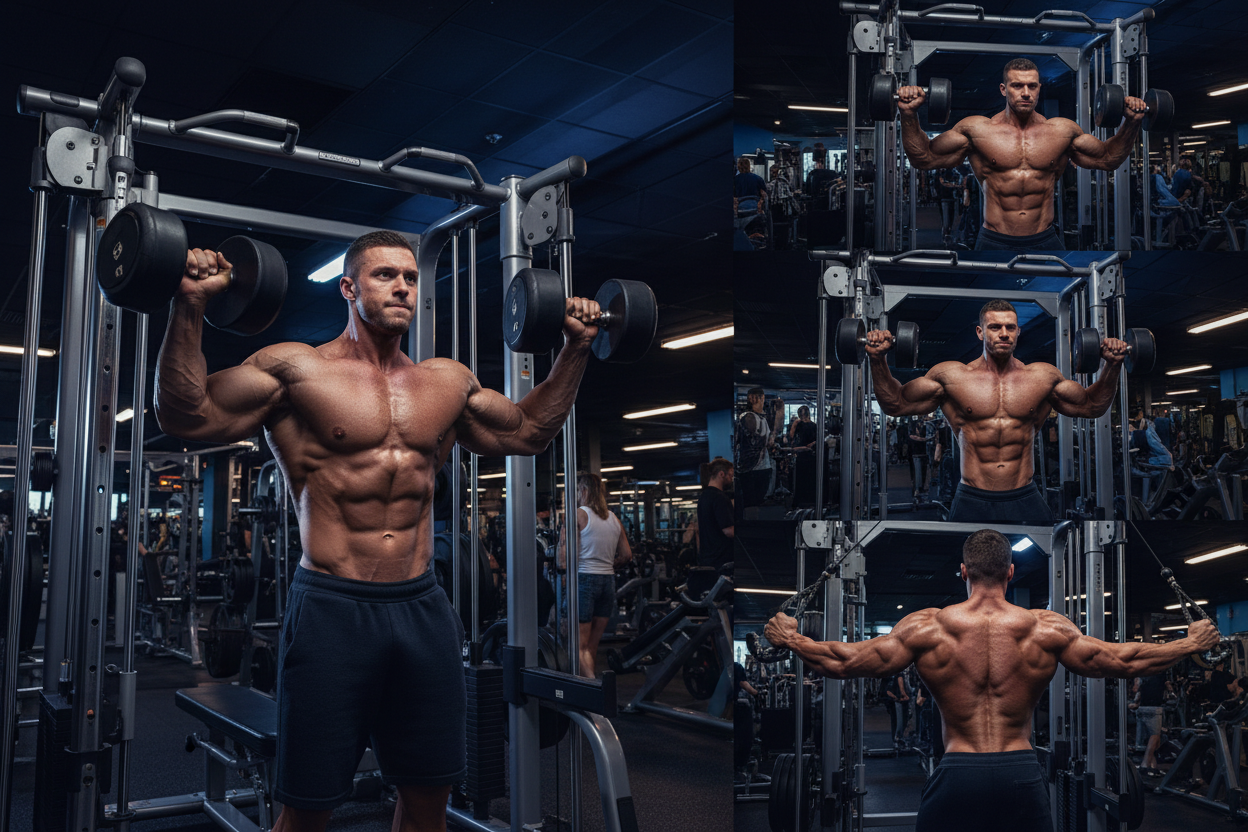
2. The Width Builder: Egyptian Cable Lateral Raises
Sets: 3 | Reps: 12-15
Why cables? Dumbbells lose tension at the bottom of the movement. Cables keep constant tension on the medial delt throughout the entire range of motion. This is a staple in any effective shoulder gym routine.
Coach's Tip: Lean away from the machine. Don't pull with your traps (shrugging). Imagine you are pushing your knuckles toward the walls, not lifting up to the ceiling.
3. The Posture Fixer: Face Pulls
Sets: 4 | Reps: 15-20
This is arguably the most important shoulder exercise set for longevity. It targets the rear delts and the rotator cuff simultaneously.
Coach's Tip: Use the rope attachment. Pull the rope apart as it nears your face, aiming to get your hands back behind your ears. Do not go heavy here; focus on the squeeze.
4. The Finisher: Dumbbell Rear Delt Flys
Sets: 3 | Reps: 20 (Burnout)
We end with high volume to flush blood into the muscle. A high-rep shoulder set workout ensures we deplete every last bit of glycogen in the rear delts.
My Training Log: Real Talk
I want to be honest about my personal experience with gym routine for shoulders, specifically regarding the "ego lift." For years, I thought the Standing Overhead Press was the only thing that mattered. I chased a 225lb press obsessively.
The result? My numbers went up, but my shoulders didn't look any wider. Worse, I developed a nagging impingement in my right shoulder. I can still remember the specific, grinding sensation—like sand in a bearing—every time I lifted my arm past parallel to grab a plate off the rack. It wasn't a sharp pain, just a dull, sickening click that warned me something was wrong.
I had to completely drop the heavy barbell work for three months. I switched to high-volume lateral raises and band pull-aparts. The humbling part was struggling with 15lb dumbbells on lateral raises because I stopped using momentum. But that's when my shoulders actually started to pop. The "grit" in the joint disappeared, and my shirts started fitting tighter in the sleeves. Sometimes, the heaviest weight isn't the answer.
Common Mistakes in Shoulder Routines
Internal Rotation on Lateral Raises
You’ve probably heard the cue "pour the pitcher." Be careful with this. Excessive internal rotation (thumbs down) can cause impingement. Keep your hand flat or thumbs slightly up to protect the joint while executing your sample shoulder workout.
Ignoring Tempo
Shoulders respond well to time under tension. If you are swinging the weight up and letting it drop, you aren't building muscle; you're testing gravity. Control the eccentric (lowering) phase for at least two seconds.
Conclusion
Building impressive shoulders requires patience and geometry, not just brute force. By prioritizing the side and rear delts and respecting the mechanics of the joint, you will build a physique that looks wide from every angle. Implement this workout routine for shoulders for 8 weeks, focus on form over weight, and watch your delts grow.
Frequently Asked Questions
How often should I perform this shoulder routine?
For most lifters, training shoulders twice a week is optimal. You might do a dedicated shoulder day workout once, and then add a few sets of lateral raises on your chest or back day to increase frequency without overtraining.
Can I superset these exercises?
Yes. A great superset for a shoulder set workout is pairing Face Pulls with Lateral Raises. Since they target different heads (rear vs. side), you can perform them back-to-back without losing performance.
Why do my traps hurt after shoulder workouts?
This usually happens when you go too heavy on lateral raises. Your body compensates by shrugging the weight up using the upper traps. Lower the weight, depress your scapula (shoulders down), and focus purely on lifting with the elbows.