Best Flat Abs Exercises: Why Your Current Routine Fails
If you have ever spent thirty minutes doing endless crunches on a thin basement mat only to end up with a sore neck and zero core definition, you are not alone. One of the most common frustrations we hear from home gym owners is hitting a plateau with their midsection. You have the rack, the bench, and the weights, but finding the best flat abs exercises often feels like a guessing game wrapped in fitness industry myths.
In this guide, we are cutting through the noise. We will break down exactly which movements actually engage your deep core, how to utilize your existing home gym equipment to maximize resistance, and how to structure a routine that delivers real results.
Key Takeaways
- Core visibility relies heavily on kitchen habits, but structural core strength requires progressive overload.
- The best workouts for a flat stomach prioritize the transverse abdominis over superficial muscles.
- High-rep, unweighted crunches are inefficient compared to stability and resistance-based movements.
- You can execute elite-level core training with minimal gear like a pull-up bar or a simple ab roller.
The Anatomy of a Strong Midsection
Why Traditional Crunches Fall Short
Many beginners assume that feeling a 'burn' means an exercise is working. However, traditional sit-ups and crunches primarily target the rectus abdominis (the visible six-pack) while neglecting the deep stabilizing muscles. If your goal is a tight, drawn-in midsection, you need to focus on movements that act like a natural corset. This is why the best workouts for a flat tummy incorporate anti-extension and anti-rotation movements rather than just spinal flexion.
Top Core Movements for Your Home Gym
Floor-Based Stability Training
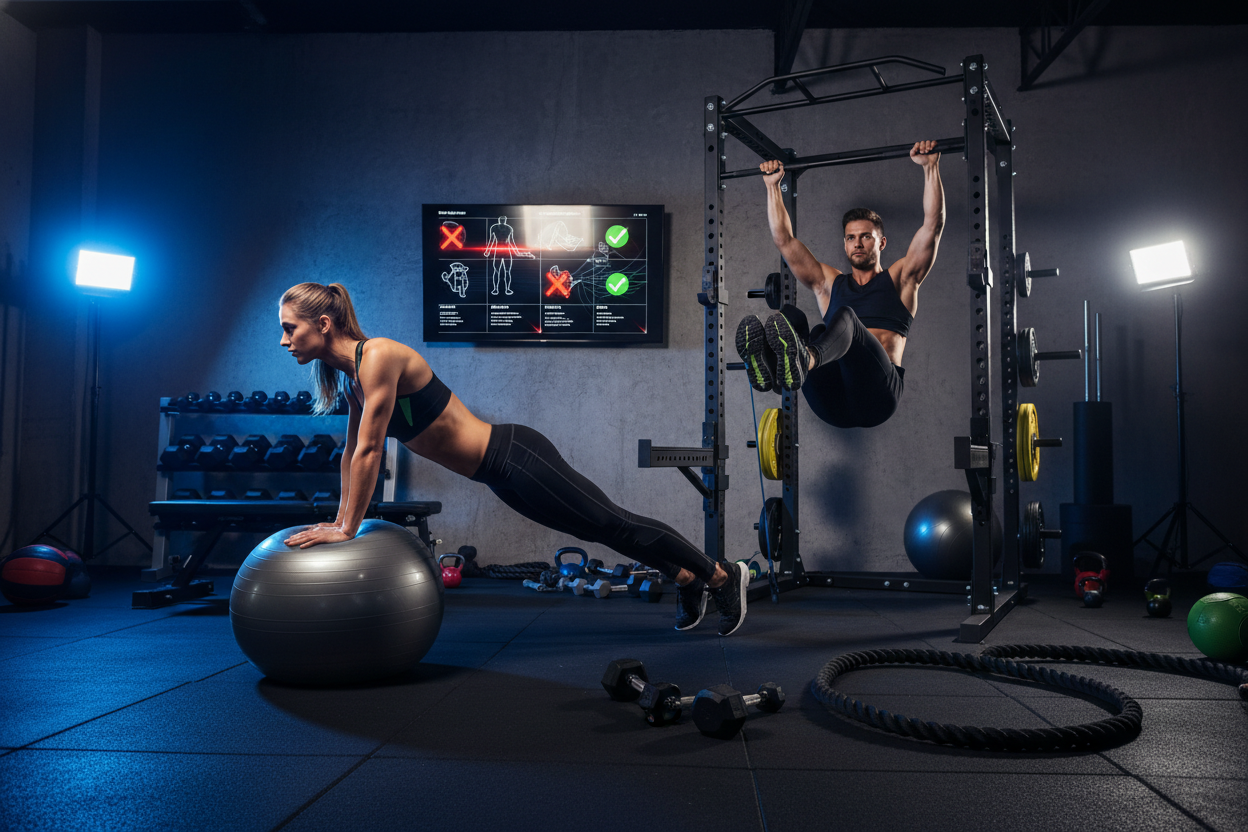
You do not need a commercial machine to build an iron core. Floor-based exercises like the Hollow Body Hold and the RKC Plank are foundational. These movements force your entire anterior chain to fire in unison. They are arguably the most accessible yet brutal best tummy flattening workouts because they demand absolute tension. All you need is a high-density exercise mat to protect your tailbone on hard garage or basement floors.
Equipment-Leveraged Power
To truly progress, you need to add resistance and leverage. If you have a power rack or a wall-mounted pull-up bar, Strict Hanging Leg Raises are phenomenal. They decompress the spine while forcing the lower abdominals to initiate the lift. Similarly, the Ab Wheel Rollout is a masterclass in anti-extension. When integrated properly, utilizing these tools creates the best workout to flatten belly profiles by building dense, functional muscle that shows through once body fat is reduced.
Structuring Your Core Routine
Treat your abs like any other muscle group. Instead of tacking on a sloppy five minutes at the end of your workout, dedicate specific days to core progression. Aim for 3 to 4 days a week, choosing 2 to 3 exercises per session. Focus on 3 sets of 8 to 15 reps for dynamic movements (like leg raises) and 30 to 45 seconds for isometric holds (like planks). Quality of contraction always beats quantity of reps.
From Our Gym: Honest Take
I used to be the guy doing 100 crunches a day with nothing to show for it. It was not until we set up our first heavy-duty power rack in the garage that my training shifted. I started incorporating weighted hanging knee raises. The knurling on our pull-up bar is noticeably aggressive, so my chalked grip held solid, forcing my core to do 100% of the work without my forearms giving out first. I also learned the hard way that an ab wheel on a concrete floor is unforgiving on the knees—always use a drop pad or a thick mat. The takeaway? Ditch the high reps. Add leverage, add gravity, and focus on strict, controlled tension.
Frequently Asked Questions
Do I need expensive equipment for a flat stomach?
Not at all. While a power rack with a pull-up bar or an adjustable bench opens up new variations, some of the best workouts for a flat stomach require nothing more than your body weight, gravity, and a comfortable mat.
How much space do I need for a core workout?
Core training is highly space-efficient. A standard 6-foot by 4-foot footprint (roughly the size of a standard yoga mat) is plenty of clearance for planks, rollouts, and hollow body holds in an apartment or tight basement gym.
Will these exercises burn belly fat directly?
No exercise can spot-reduce fat. The best workout to flatten belly fat is a combination of these targeted core-strengthening exercises paired with a caloric deficit and a consistent, protein-rich diet.