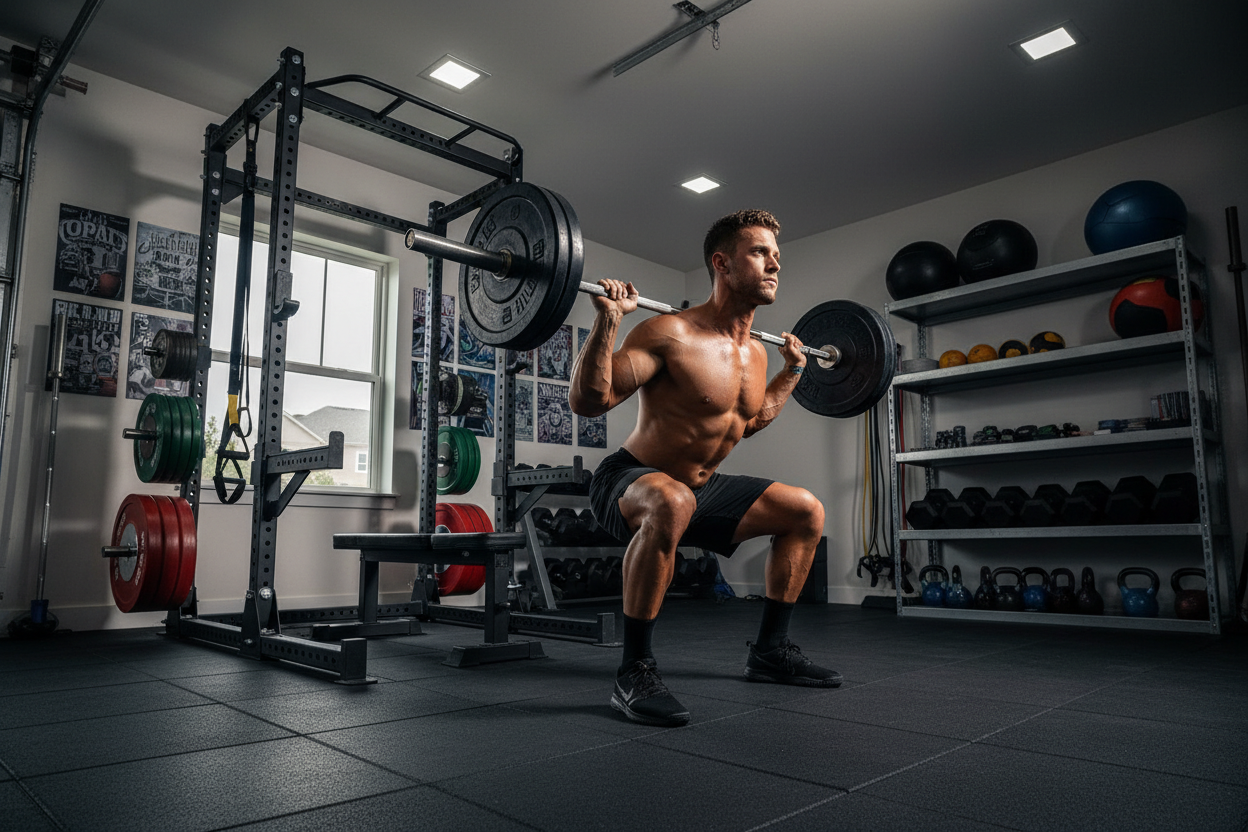
Best Exercise for Quad Hypertrophy: The Scientific Truth
Most lifters spend years under a heavy barbell only to find their legs haven't grown in proportion to their effort. They chase strength numbers, assuming size will automatically follow. While there is a correlation, hypertrophy requires a specific mechanical environment.
If you are looking for the best exercise for quad hypertrophy, you need to stop thinking about how much weight you can move and start thinking about how much knee flexion you can achieve under load. The answer isn't as simple as "just squat," but the science points us toward a clear winner for pure muscle growth.
Key Takeaways: The Short Answer
- The Overall Winner: The Heel-Elevated High Bar Squat (or Hack Squat) offers the best balance of load and deep knee flexion.
- The Missing Piece: Squats do not effectively train the Rectus Femoris; you must pair compounds with Leg Extensions.
- Stability is King: For pure hypertrophy, stable machines (like Hack Squats) often outperform free weights because they allow you to push closer to failure safely.
- Range of Motion: If your hamstrings touch your calves, you are maximizing the stretch, which is crucial for growth.
The Mechanics of Growth: Why Depth Matters
To understand why certain movements work better than others, we have to look at biomechanics. The quadriceps main function is to extend the knee. Therefore, the exercises that place the knee in the greatest degree of flexion (bending) and require it to extend against resistance will stimulate the most growth.
This is where the low-bar powerlifting squat often fails bodybuilders. By sitting back to leverage the hips and glutes, you actually reduce the tension on the quads. For maximum hypertrophy, knees must travel forward over the toes.
The Contender: Heel-Elevated High Bar Squat
If we are talking about free weights, the high bar squat with elevated heels is superior to the flat-footed version. Elevating the heels (using weightlifting shoes or a wedge) increases ankle mobility artificially.
This allows your torso to stay upright and your knees to travel further forward. The result? A massive stretch on the vastus lateralis and vastus medialis. This is often cited as one of the best quad hypertrophy exercises because it demands systemic recruitment while hammering the thighs.
The Real Winner: The Hack Squat
While the barbell squat is iconic, the Hack Squat might actually take the title for pure hypertrophy. Here is the reasoning: Stability.
When you squat with a barbell, your lower back or core is often the limiting factor (the weak link) before your quads truly fail. In a Hack Squat, your back is supported. You don't have to balance the load.
This external stability allows you to drive the quads to absolute mechanical failure without the risk of crumbling under the bar. You can grind through reps that would be dangerous with free weights.
Don't Forget the Rectus Femoris
Here is a critical nuance many miss. The quadriceps are made of four muscles. Three of them cross only the knee joint. The fourth, the Rectus Femoris, crosses the hip as well.
During a squat, the Rectus Femoris is essentially neutralized because it shortens at the hip while lengthening at the knee. To build a complete leg, you cannot rely solely on squats. You must include Leg Extensions or Sissy Squats to isolate this specific head.
My Training Log: Real Talk
I want to be honest about what it feels like to actually prioritize hypertrophy over ego lifting. A few years ago, I swapped my heavy low-bar squats for full range-of-motion Hack Squats.
The first thing I noticed wasn't the pump—it was the nausea. There is a specific, gritty feeling when you are locked into a machine, grinding out a rep that takes a full six seconds. I remember the shoulder pads on the old Cybex machine digging into my traps so hard it left bruises, but I couldn't stop because my legs hadn't failed yet.
The most humbling part? I had to cut the weight in half. Moving 400lbs with half-reps felt cool, but moving 200lbs with my hamstrings smashing against my calves made me walk funny for three days. That specific "wobble" when walking down the gym stairs—where your knee just decides to give out—is the only metric that matters.
Conclusion
There is no single magic bullet, but there is a hierarchy. For pure size, prioritize stable movements that allow deep knee flexion, like the Hack Squat or Heel-Elevated Squat. Complement this with leg extensions to hit the head that squats miss. Drop the ego, elevate your heels, and embrace the burn.
Frequently Asked Questions
1. Can I build big quads with just leg press?
Yes, the leg press is excellent for hypertrophy because it offers high stability. However, you must ensure you are not ego-lifting. Place your feet lower on the platform to maximize knee bend and ensure you are getting a full range of motion without your lower back rounding off the pad.
2. How many reps are best for quad growth?
Quads respond exceptionally well to higher volumes. While 8-12 reps is the standard hypertrophy range, the legs often endure higher rep ranges (15-20) effectively. This increases metabolic stress, which is a key driver for leg growth.
3. Why do my knees hurt when I squat deep?
Knee pain often stems from poor ankle mobility or weak tendons, not the depth itself. If your heels lift off the ground, the force transfers unevenly to the knee. Try using heel wedges or weightlifting shoes to improve your mechanics and reduce joint strain.