Best Beginner Rowing Machine: The Definitive Buyer’s Guide (2025)
Walking into the world of indoor rowing feels a bit like learning a new language. You hear terms like "damper setting," "split time," and "drag factor," all while trying to figure out if a $300 machine will break in a month or if you truly need that $2,000 model with the HD screen. Finding the best beginner rowing machine isn't just about price; it is about finding a piece of equipment that encourages you to actually sit down and row, rather than letting it become an expensive clothes hanger.
This guide cuts through the marketing noise to help you understand the mechanics, the ergonomics, and the reality of rowing at home.
Key Takeaways: Choosing Your First Rower
If you are in a rush, here are the core factors that determine the right machine for a novice:
- Resistance Type Matters Most: Air provides infinite resistance (harder you pull, harder it gets), while magnetic is quiet and consistent. Water offers the best aesthetic and sound.
- Check the Rail Length: If you are over 6'0", many budget "compact" rowers will be too short, preventing full leg extension.
- Monitor Simplicity: As a beginner, you only need strokes per minute (SPM), time, and distance. Don't overpay for complex data you won't use yet.
- Build Quality vs. Features: Prioritize a steel frame and aluminum rail over a fancy touchscreen.
Understanding Resistance: The Engine of Your Workout
When looking for the best starter rowing machine, the resistance mechanism is your most critical decision. It dictates how the stroke feels and how loud the machine is.
1. Magnetic Resistance (The Silent Operator)
Magnetic rowers use magnets moving closer to or further from a metal flywheel to create drag.
The Science: Because there is no friction or air displacement, these are nearly silent. This is often the best rower for beginners living in apartments or shared spaces. However, the resistance is static. Pulling harder doesn't make it heavier; you have to manually turn a dial to increase difficulty.
2. Air Resistance (The Gold Standard)
If you have ever seen the Concept2 in a CrossFit gym, you know air resistance. As you pull, you spin a fan blade against the air.
The Science: Air creates "variable resistance." The harder and faster you pull, the more resistance the fan generates. This mimics the physics of a boat moving through water. It is ideal for learning proper pacing, but it generates a significant "whoosh" noise that might wake the neighbors.
3. Water Resistance (The Aesthetic Choice)
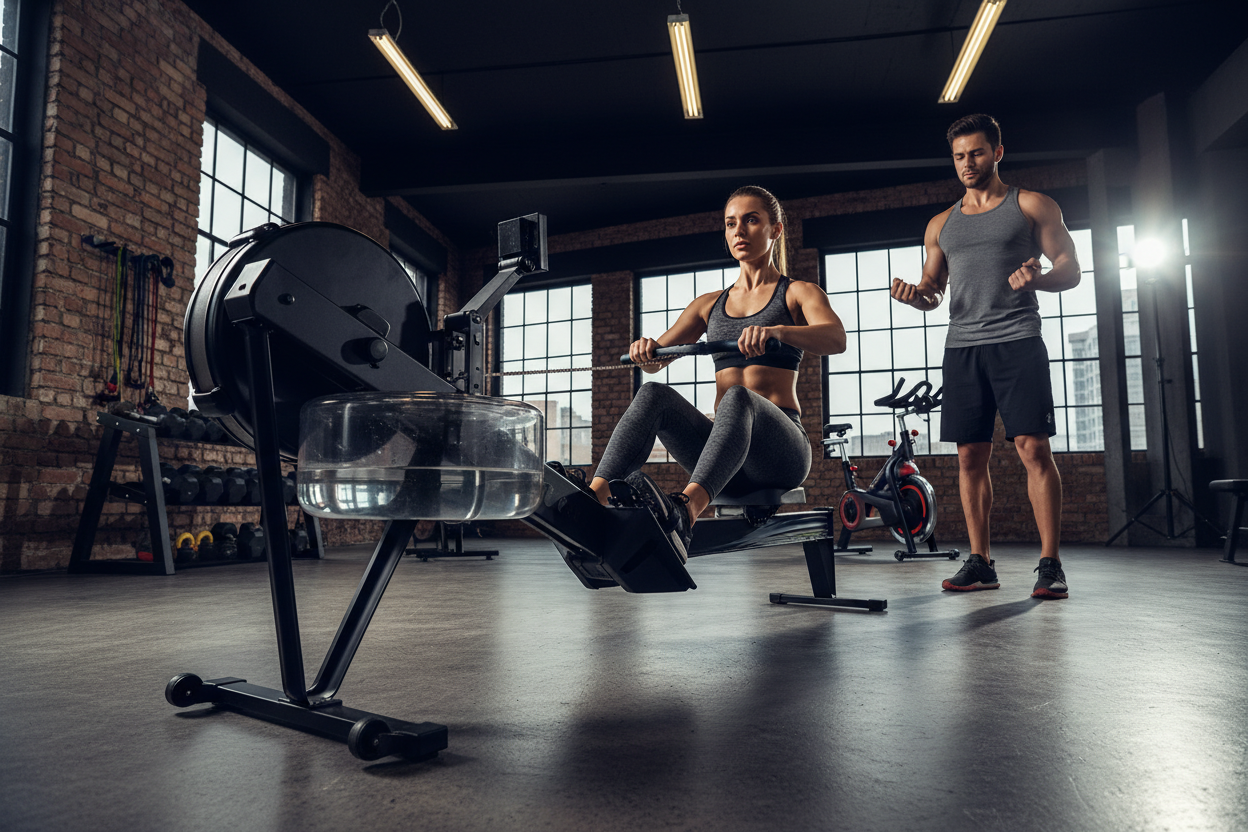
These machines feature a tank of water with paddles inside.
The Science: Like air, the resistance is dynamic based on your effort. The main advantage here is the sensory feedback. The swishing sound is meditative, and the catch (the start of the stroke) feels incredibly smooth, with no mechanical jerkiness.
The "Smart" Trap: Do You Need a Subscription?
A common mistake beginners make is assuming they need a connected fitness device with a monthly subscription to learn how to row. While follow-along classes are great for motivation, they aren't strictly necessary for mechanics.
The best starter rowing machine focuses on the feel of the stroke. Many budget-friendly machines now come with tablet holders. You can simply stream a free YouTube workout on your iPad and save the $40 monthly fee. Focus your budget on the hardware (the seat, the handle, the chain) rather than the software.
Ergonomics: The Hidden Dealbreaker
You can have the smoothest flywheel in the world, but if the machine doesn't fit your body, you will quit.
Foot Placement and Pivot
Look for footplates that are adjustable. On cheap models, the footplates often pivot too freely. This causes beginners to lift their heels too high during the catch, which reduces power and can strain the Achilles tendon. You want a firm footplate that keeps your heel relatively grounded.
The Seat Rail
Inseam matters. If you are tall, a short rail prevents you from fully straightening your legs at the drive's finish. This limits your range of motion and creates a choppy, ineffective stroke. Always check the maximum user height rating.
My Personal Experience with Best Beginner Rowing Machine Models
I want to be real with you about what testing these machines actually feels like, beyond the spec sheets. I remember vividly the first time I bought a budget magnetic rower off Amazon to save a few bucks.
On paper, it looked fine. But the moment I strapped in, I noticed the "dead spot." At the very beginning of the pull (the catch), there was about two inches of slack where I felt zero resistance before the magnets actually engaged. It felt jerky, like pulling a loose lawnmower cord. It threw off my rhythm completely.
Another detail people rarely mention is the monitor placement. On that starter machine, the monitor was so low near my feet that I had to hunch my back just to see my split time. That bad posture translated to lower back pain after just 20 minutes.
Conversely, when I finally tried a quality air rower, the handle knurling was rougher—it actually blistered my hands the first week because I wasn't used to the grip—but the tension was immediate. That instant connection from the foot drive to the handle pull is what teaches you to row correctly. Don't sacrifice the mechanics for a softer seat or a quieter flywheel.
Conclusion
Selecting the best beginner rowing machine is a balance between your living situation (noise levels) and your training goals. If you want silence and steady-state cardio, go magnetic. If you want to train for performance and learn true rowing mechanics, air resistance is the superior teacher.
Start with a machine that feels good to use. You can always upgrade the tech later, but you can't fix a jerky, uncomfortable stroke.
Frequently Asked Questions
What is the difference between magnetic and air rowers for beginners?
Magnetic rowers provide constant resistance and are nearly silent, making them great for apartments. Air rowers provide dynamic resistance (it gets harder the faster you row) and mimic real water rowing, but they are much louder.
Can I lose weight using a beginner rowing machine?
Absolutely. Rowing is a full-body workout that recruits roughly 86% of your muscles. Because it combines strength and cardio, it burns calories efficiently while building endurance, making it a highly effective tool for weight management.
How much space do I need for a home rowing machine?
A standard rowing machine is about 7 to 8 feet long and 2 feet wide. However, you need an extra foot of clearance behind the machine for your torso to lean back during the finish of the stroke. Many beginner models fold up or stand vertically to save space when not in use.