Best At Home Exercises: Mastering Unilateral Leverage
I remember training a client in a 400-square-foot apartment when all the commercial gyms suddenly closed. He had zero floor space for a power rack and was frustrated because standard bodyweight squats just were not challenging his legs anymore. He thought he was doomed to lose his barbell gains. That is when I introduced him to the concept of unilateral leverage. By manipulating your body mechanics to load one limb at a time, you can turn basic movements into heavy strength builders. If you want to build serious muscle without a massive iron setup, the best at home exercises require you to shift your center of gravity.
You do not need 300 pounds of plates to trigger muscle growth. You just need to know how to make your own bodyweight feel like 300 pounds. This 'unilateral leverage' perspective changes everything about how we program living room training sessions.
Quick Takeaways
- Unilateral training forces one side of your body to move your entire bodyweight, instantly doubling the resistance.
- Shifting your center of gravity creates mechanical tension identical to heavy barbell lifting.
- Single-limb movements inherently train the core through anti-rotation.
- High-traction flooring is mandatory to safely perform heavy unilateral leg work.
Why the Best At Home Exercises Rely on Leverage, Not Iron
Most people approach living room fitness by just doing higher and higher reps of basic movements. Doing 100 air squats will give you a pump, but it falls short for actual strength development. To build dense muscle, you need high mechanical tension in the 5 to 15 rep range. That is why shifting your center of gravity is the secret to creating effective at home workouts.
Think of your body as a seesaw. If you stand on two feet, your weight is distributed evenly. Lift one foot off the ground, and suddenly the working leg has to manage 100% of your upper body mass. But leverage goes deeper than just lifting a limb. By changing the angle of your torso, extending a non-working arm, or elevating a rear foot, you change the lever arm length. A longer lever arm means the working muscle has to generate significantly more force to move the same amount of weight.
I have tested dozens of living room programs, and the ones that actually build size always prioritize leverage over volume. You stop chasing fatigue and start chasing muscular failure through mechanical disadvantage.
How Single-Limb Training Defines Effective Home Workouts
Let's look at the biomechanics of why isolating one side of the body is so powerful. When you perform a standard push-up, you are pressing roughly 64% of your total body weight. For a 180-pound person, that is about 115 pounds distributed across two arms. It is a great warm-up, but eventually, your chest and triceps adapt. Effective home workouts require progressive overload.
If you shift 80% of that load to your right arm by performing an archer push-up, that single arm is now pressing nearly 92 pounds on its own. You have effectively doubled the load on the working muscle without buying a single dumbbell. This concept applies to every muscle group. Single-limb training forces the nervous system to recruit more fast-twitch muscle fibers to stabilize the joint while simultaneously pushing the heavy load.
There is one honest downside to unilateral training that I always warn my clients about: your workouts will take longer. Hitting 4 sets of 10 on your left leg, and then 4 sets of 10 on your right leg, takes twice the time of a standard bilateral squat session. However, the joint health, balance improvements, and sheer strength gains make the time investment completely worth it.
Lower Body Leverage: The Most Effective At Home Exercises
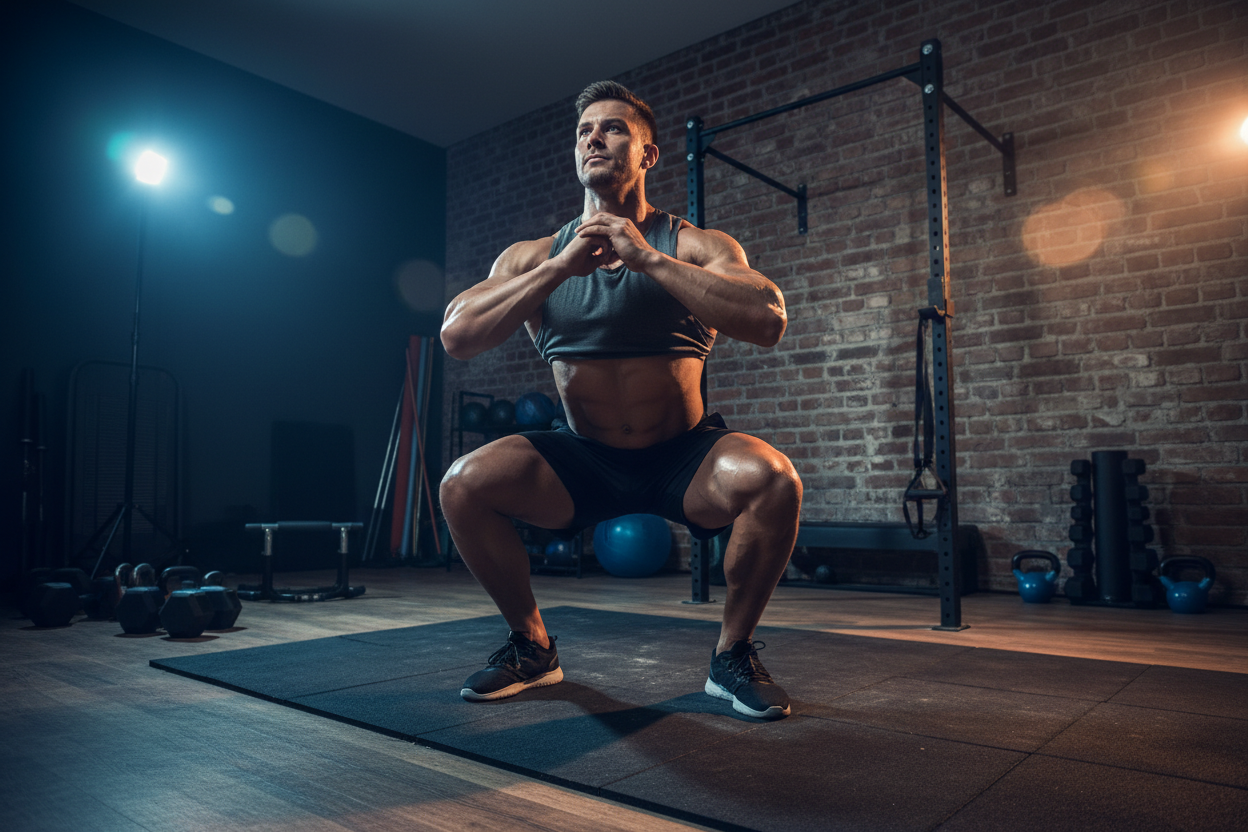
The lower body is notoriously difficult to train heavy without a rack, but unilateral leverage solves this. The most effective at home exercises for legs demand high balance, immense single-leg drive, and a solid connection to the floor.
The Bulgarian split squat is the king of this category. By elevating your rear foot on a couch or chair, you force the front leg to take on roughly 85% of your body weight. If you weigh 200 pounds, your front quad and glute are driving 170 pounds out of the hole. As you get stronger, you can progress to the airborne lunge, where the rear foot never touches the ground, creating a massive demand on the glute medius for stabilization.
I learned the hard way that doing heavy airborne lunges on bare hardwood is a recipe for a groin tear. Sweat drips, feet slide, and suddenly you lose tension. You absolutely need a high-traction surface to push maximum force safely. I always require my clients to invest in a large exercise mat for home gym use to anchor their working foot. A dense 6x6 foot mat provides the grip necessary to drive hard through the heel without fear of slipping.
Pistol squats are another incredible tool, but they require significant ankle mobility. I usually start clients by having them perform pistol squats to a chair, slowly lowering themselves over a 4-second negative to build eccentric strength before attempting the full range of motion.
Progression Strategies for Single-Leg Movements
To make these the best home workout exercises you will ever do, you have to manipulate the variables. Once a movement gets easy, do not just add reps. First, manipulate the tempo. Try a 3-second descent, a 2-second pause at the bottom, and an explosive concentric push. This increases time under tension dramatically.
Next, adjust your depth. Stand on a thick book or a sturdy box to create a deficit for your split squats, forcing the muscle to stretch further under load. Finally, play with foot placement. Moving your front foot closer to the bench in a Bulgarian split squat targets the quads, while stepping further out shifts the heavy leverage onto the glutes and hamstrings.
Upper Body Unilateral Leverage Techniques
Upper body pulling and pushing can also be manipulated for maximum tension. The archer push-up, where one arm remains straight while the other bends to lower the body, is a brutal chest builder. You control the resistance by how much weight you allow the straight arm to assist with. Over time, you use less and less of the straight arm until you are performing genuine one-arm push-ups.
For the back, single-arm sliding pull-downs on a slick floor (using a towel under your hands) force the lats to pull your entire body weight. If you have a sturdy table, single-arm inverted rows are exceptional. You position yourself under the table, grab the edge with one hand, and pull your chest to the wood. The rotational force on your torso makes this incredibly difficult.
If you do have access to a pair of 5-52.5 lb adjustable weights, you can easily combine these bodyweight leverage tactics with a traditional chest and back workout with dumbbells. For instance, pre-exhaust your chest with archer push-ups, then immediately grab your dumbbells for a set of heavy floor presses. This hybrid approach guarantees muscle failure.
Core Stability and the Unilateral Challenge
People often ask me for core routines, and I usually tell them to just do heavy unilateral leg and back work. When you hold a heavy weight in one hand, or press your bodyweight with one arm, your torso desperately wants to twist. Resisting that twist is called anti-rotation.
The anti-rotational forces inherent in one-sided movements inherently train the obliques, transverse abdominis, and lower back stabilizers. Doing a single-arm push-up requires your core to lock down like a steel beam. If it does not, your hips will sag and rotate toward the floor. Because you are bracing against heavy leverage rather than just doing crunches, unilateral training is arguably the most effective home workout for developing dense, functional abdominal strength.
Building Your Unilateral Home Setup
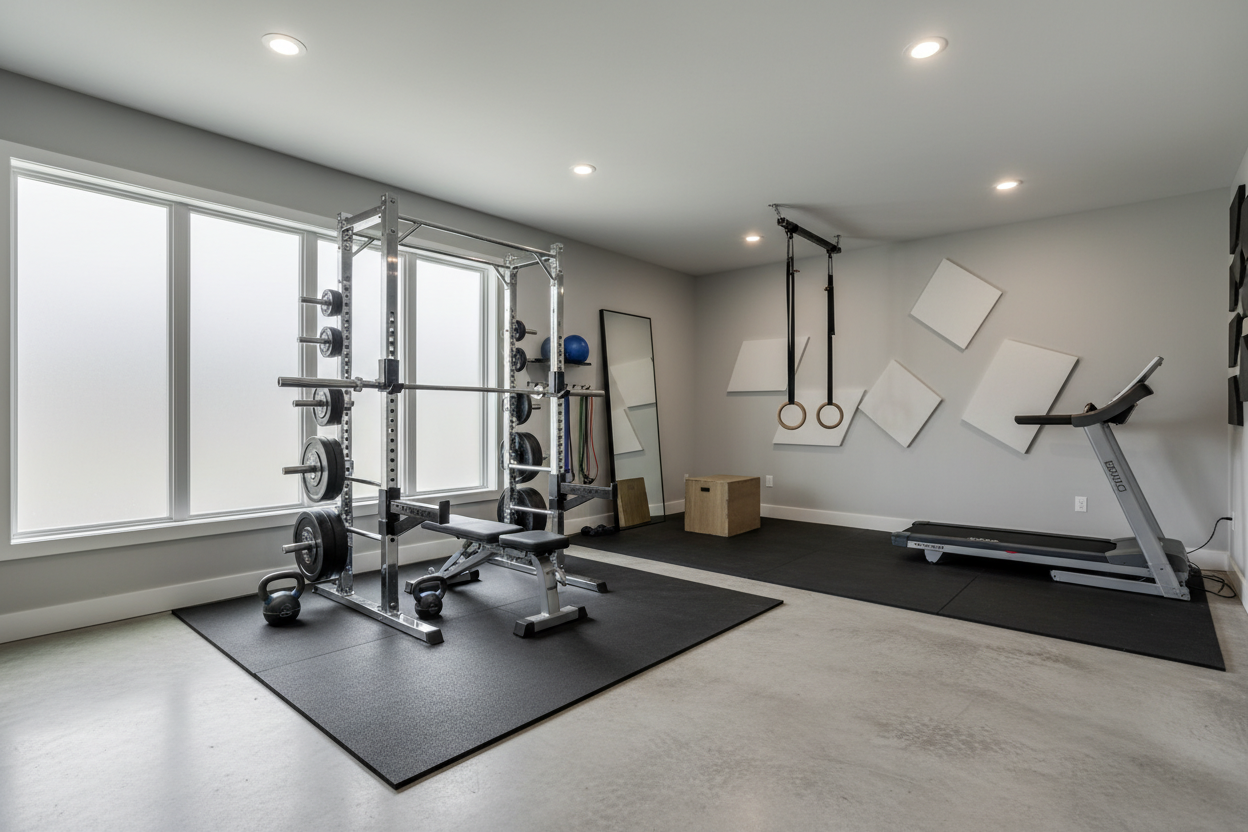
You do not need much to make this work. When summarizing the top home workout equipment for a leverage-based routine, I keep the list incredibly short. You need a high-density mat to prevent slipping, a sturdy chair or box for foot elevation, and ideally a set of gymnastic rings that you can hang from a doorway pull-up bar.
Rings are the ultimate unilateral tool because they allow for infinite micro-adjustments in leverage. You can perform single-arm ring rows, adjusting the difficulty simply by walking your feet an inch further forward. Master your body's leverage, and you will never be at the mercy of gym operating hours again.
FAQ
Can I build mass with unilateral home exercises?
Yes. Muscle growth requires mechanical tension and proximity to failure. By shifting your weight to one limb, you can easily create enough tension to reach muscular failure in the 8 to 12 rep range, which is perfect for hypertrophy.
How often should I train single-limb movements?
Aim for 2 to 3 times per week per muscle group. Because unilateral exercises require heavy central nervous system engagement for balance, you need adequate recovery days between intense sessions.
Are unilateral exercises safe for bad knees?
Often, they are safer than bilateral squats because they expose and correct muscle imbalances. However, you must control the eccentric (lowering) phase and ensure your working knee tracks properly over your toes without caving inward.