Beginner Squat: The Definitive Guide to Proper Form (2024)
You have been squatting your entire life. Every time you sit in a chair or pick something up off the floor, you are performing a variation of this fundamental movement pattern. However, transitioning from unconscious movement to a deliberate exercise requires attention to detail. Mastering the beginner squat is the single most important investment you can make in your fitness journey.
Many novices avoid squats due to knee pain or fear of injury, but these issues usually stem from poor mechanics rather than the exercise itself. If you want to build lower body strength, improve mobility, and burn more calories, you have to get comfortable getting low. This guide cuts through the noise to teach you exactly how to execute a safe, effective squat from day one.
Key Takeaways
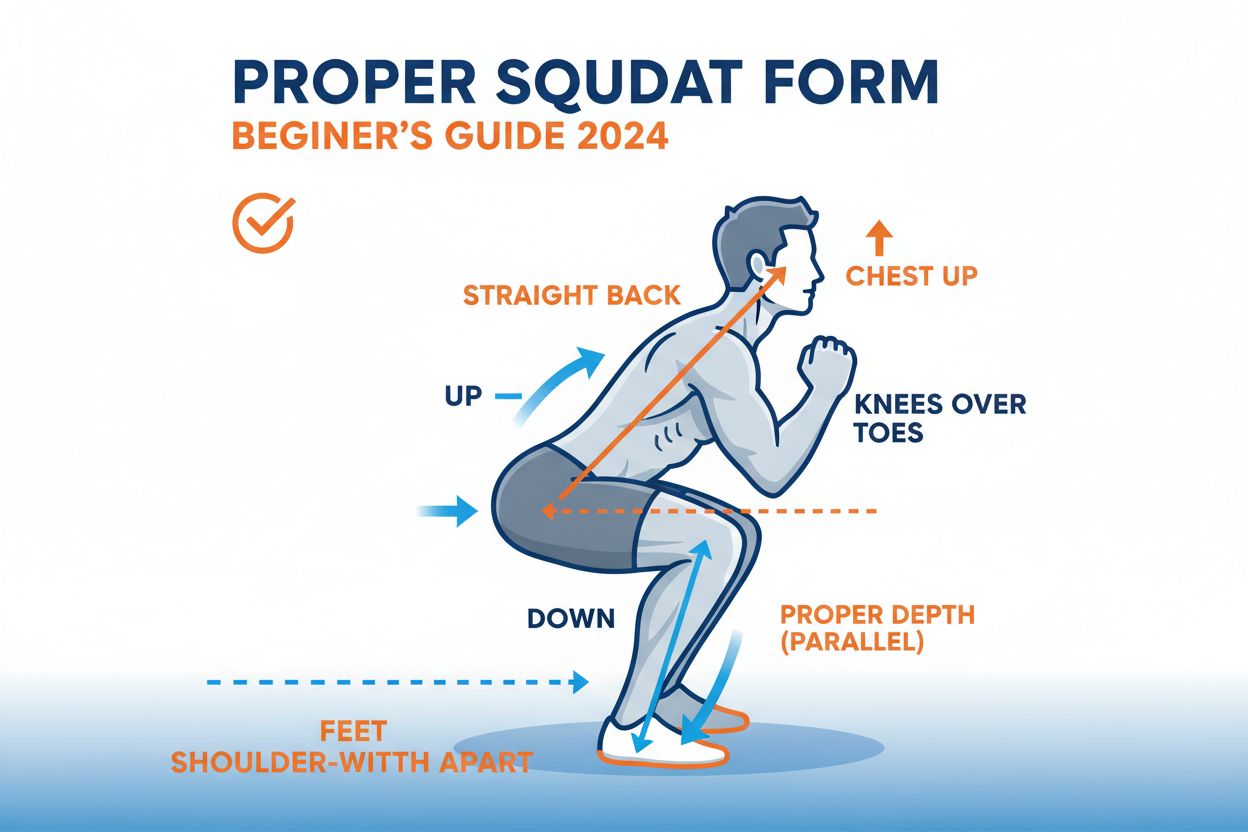
- Stance Width: Start with feet shoulder-width apart, toes turned slightly out (15-30 degrees) to accommodate hip anatomy.
- The Hip Hinge: Initiate the movement by pushing your hips back before bending your knees, as if reaching for a chair behind you.
- Depth: Aim to get your hip crease parallel with your knees, but only go as low as you can while keeping your heels flat and back straight.
- Core Bracing: Keep your chest up and core tight to protect your lumbar spine throughout the rep.
Why Squats Are Non-Negotiable
Before we break down the mechanics, understand the science. Squats are a compound movement, meaning they recruit multiple muscle groups and joints simultaneously. While they are famous for building quads, glutes, and hamstrings, a proper squat also heavily engages your core stabilizers and lower back.
For a beginner, this systemic load triggers a hormonal response that aids in muscle growth and fat loss more effectively than isolation machines like leg extensions. Furthermore, learning how to start squats correctly improves ankle and hip mobility, which translates to better movement in daily life.
How to Do a Proper Squat for Beginners
Let’s break down the squat technique for beginners into a repeatable process. Forget about barbells for now; we are focusing on the air squat (bodyweight).
1. The Setup
Stand with your feet slightly wider than shoulder-width. Point your toes outward slightly. This "duck stance" opens up the hips, preventing the femoral neck from impinging on the hip socket, which allows for deeper, pain-free movement.
2. The Descent
This is where most people mess up. Do not just drop straight down. Instead, unlock your hips and push your butt back. Imagine you are shutting a car door with your glutes. Once the hips move back, bend the knees. Keep your chest proud—if you were wearing a logo on your shirt, someone in front of you should be able to read it the whole time.
3. The Bottom Position
Descend until your thighs are at least parallel to the floor. If you lack mobility, go as low as you can without your heels lifting off the ground or your lower back rounding (the "butt wink"). Pause for a split second to eliminate momentum.
4. The Ascent
Drive through your mid-foot and heel to stand back up. As you rise, think about "spreading the floor" with your feet to engage your glutes. Exhale sharply at the top and squeeze your glutes to finish the rep.
Common Mistakes (And How to Fix Them)
Even with a good squat guide, errors happen. Here is what to watch for.
The Heel Lift
If your heels pop off the ground at the bottom of the squat, your weight is too far forward, or your ankles are stiff. This puts unnecessary shear force on the knees.
The Fix: Widen your stance slightly and focus on curling your toes upward inside your shoes. This forces your weight back into your heels.
Knee Valgus (Caving In)
When you push up, your knees might collapse inward toward each other. This is a primary cause of ACL strain.
The Fix: Use a tactile cue. Wrap a light resistance band around your thighs just above the knees. As you squat, fight against the band to keep your knees tracking over your toes.
Progression: Moving Beyond the Air Squat
Once you can perform 15 perfect air squats, it is time to load the movement. Do not jump straight to a barbell back squat. The best squat exercise for beginners to add load is the Goblet Squat.
Hold a dumbbell or kettlebell against your chest with both hands. This front-loaded weight acts as a counter-balance, actually making it easier to keep your torso upright and hit proper depth. It is the safest way to learn how to squat for beginners with weight.
My Training Log: Real Talk
I want to share a specific struggle I had when I was relearning my squat mechanics years ago. On paper, the advice is always "keep your chest up." But when I tried to do that, I felt this sharp, pinching sensation in my lower back.
I realized I was over-arching. I was mistaking "chest up" for hyperextending my lumbar spine. The cue that actually fixed it for me wasn't about my chest at all—it was "pull your ribcage down." I recall the specific feeling of bracing my abs as if someone was about to punch me in the stomach before I started the descent. Suddenly, the pinch vanished, and I felt the tension shift entirely to my quads and glutes. If you feel your lower back pumping up more than your legs, you're likely arching rather than bracing. Trust me, fix the brace first.
Conclusion
Learning how to do a squat for beginners is a journey of mobility and motor control. It will feel awkward at first. You might feel like you are going to fall backward. That is normal. Stick to the cues: heels down, knees out, chest up. Consistency with starter squats now will build the foundation for heavy lifting later.
Frequently Asked Questions
Can my knees go past my toes?
Yes, absolutely. The old myth that knees shouldn't pass toes has been debunked. As long as your heels remain flat on the ground and you don't feel pain, allowing the knees to travel forward is necessary for hitting full depth, especially for people with long femurs.
How many squats should a beginner do?
For beginner squats workout routines, start with 3 sets of 10 to 12 repetitions. Rest for 60 to 90 seconds between sets. Focus on quality over quantity. If your form breaks down at rep 8, stop there.
What if I can't squat low without falling?
This is a balance and mobility issue. Try the "Box Squat." Place a chair or sturdy box behind you. Squat down until your butt taps the seat, then stand back up. This removes the fear of falling and teaches you to sit back properly.