Barbell vs. Hip Thrust With Band: Which Builds More Glutes?
I remember the first time I loaded three plates on a barbell for thrusts. My glutes felt okay, but my pelvic bone looked like I’d gone fifteen rounds with a heavyweight. If you’re tired of the bruise-and-setup routine, switching to a hip thrust with band setup isn’t just a convenience play—it’s a better way to train the peak of the movement. Setting up resistance bands for hip thrusts takes thirty seconds, and the tension is far more targeted than a clumsy iron bar.
- Bands provide variable resistance, meaning the load is heaviest when your glutes are most active.
- No more bruised hips or awkward barbell balancing acts.
- Perfect for home gyms where space for 7-foot bars is tight.
- You can combine bands and weights for a brutal hybrid stimulus.
Why Traditional Heavy Glute Work Leaves You Bruised
Let’s be real: setting up a barbell hip thrust is a chore. You have to drag the bench to the rack, find a squat pad that hasn't been flattened to a pancake, and then wiggle under a heavy bar. By the time you’re ready for set one, you’re already annoyed. Then there’s the actual lift. A barbell provides a constant load, but because of the mechanics of the movement, the lift actually feels 'easier' at the very top—the exact spot where your glutes should be working the hardest.
Most of the lifters I talk to complain about the same thing: pelvic pain. Even with a high-end pad, 315 pounds is still 315 pounds pressing into your hip bones. If you're chasing a pump but your bones are quitting before your muscles do, the resistance curve is working against you. You end up cutting the range of motion short just to avoid the bite of the steel. Using a hip thrust band removes that hard pressure point, allowing you to focus on the contraction rather than the discomfort.
The Biomechanics of the Hip Thrust With Band
This is where the banded hip thrust changes the math. Unlike a barbell, a resistance band has a variable resistance curve. At the bottom of the rep, the band is slack or lightly stretched. As you drive your hips up, the tension increases exponentially. This aligns perfectly with your glutes’ strength profile; they are strongest at full extension (the top of the thrust). It turns a standard move into a resistance hip thrust that fights you every inch of the way.
When you perform a resistance band hip thrust, you’re forced to fight for that final inch of lockout. This creates a level of metabolic stress that's hard to replicate with gravity-based weights alone. I've seen plenty of people move from expensive resistance training for women at home programs into serious garage lifting, only to realize that a thick 100-lb pull-up band feels heavier at the top than a 135-lb barbell. A banded bodyweight hip thrust might look easy on Instagram, but when you're 15 reps deep with a heavy band, the burn is undeniable.
Booty Bands vs. Heavy Resistance Bands: Don't Mix Them Up
I see people get this wrong all the time. A hip thrust with band around knees (using a small loop or 'booty band') is primarily an abduction move. It forces your knees outward, hitting the glute medius. There are plenty of hip thrust with band around knees benefits, like improved knee tracking and lateral stability, but it’s not your primary builder. For real strength, you need a long, heavy-duty 41-inch hip thrust resistance bands setup anchored across your hips.
The real secret sauce is the banded weighted hip thrust. This is where you put a dumbbell in your lap AND a booty band hip thrust loop around your knees. You get the vertical load from the weight and the lateral tension from the loop. Your glutes have nowhere to hide. If you aren't shaking by rep twelve, you aren't using a heavy enough band for hip thrust work. You can even do banded hip raises as a finisher to completely exhaust the muscle fibers.
How to Anchor Your Bands Without a Commercial Gym Rig
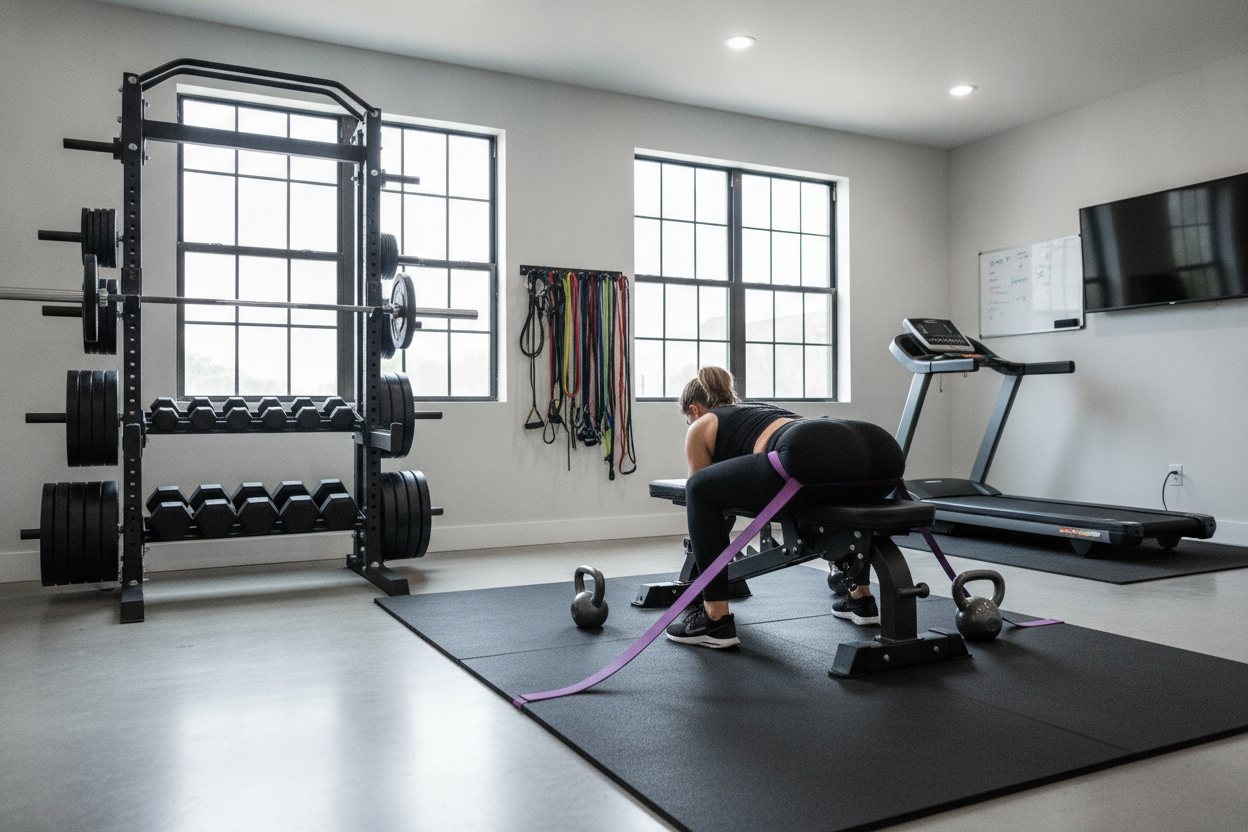
If you’re doing a band hip thrust at home, you don’t need a $2,000 power rack. The easiest way to set this up is the 'feet anchor' method. Sit on the floor, loop the band over your hips, and hook the ends around your feet. As you drive up, your own body weight keeps the band in place. This banded hip thrust on floor variation is surprisingly effective for high-rep burnout sets, especially if you're doing hip thrust with bands at home without any other gear.
For a more stable setup, anchor the band under a pair of heavy dumbbells on either side of you. This is where your flooring matters. I always recommend a large exercise mat for home gym use because it provides the grip needed to keep your feet from sliding out as the band tension ramps up. There is nothing worse than being mid-rep and having your sneakers lose traction on a slick garage floor while trying to keep thrusting resistance bands against high tension. Learning how to do hip thrusts with resistance bands safely is all about that friction.
Building the Ultimate At-Home Banded Thrust Station
If you’re serious about this, quit using your couch. It’s too soft, it slides, and it's usually at the wrong height for your shoulder blades. A dedicated Gxmmat Hip Thrust Bench is the right move here. It’s built at the correct height to hit the pivot point of your back, and it won’t tip over when you’re pushing 150 lbs of band tension. It turns a hip thrust workout with bands from a struggle into a professional session.
Combine that bench with a banded dumbbell hip thrust or a barbell banded hip thrust for the ultimate setup. To do a barbell hip thrust with resistance band, just loop the bands over the ends of the barbell and anchor them to the bottom of the bench or heavy dumbbells. It makes the lockout feel like you're trying to push through a brick wall. This hip thrust bench with bands approach is how I finally broke through my glute growth plateau after years of just doing standard reps. If you're wondering how to do hip thrusts with resistance bands at home with max intensity, this station is the answer.
Can I do these without a bench?
Yes. A hip thrust with band on floor or a resistance band hip thrust at home without a bench is technically a glute bridge. The range of motion is shorter, but if you focus on a hard squeeze at the top, it still builds mass. It’s a great hip thrust with resistance band at home option when you're traveling or short on space.
What size band should I use for hip thrusts?
For a thrusting bands setup, start with a 'medium' or 'heavy' 41-inch loop band (usually purple or green). These typically offer 35 to 100 lbs of tension. If you can do 20 reps easily with a hip thrust band only, it’s time to double up or move to a thicker band for more hip thrusts with resistance band resistance.
Are bands as good as weights for glutes?
Bands are superior for the 'peak' contraction, while weights are better for the stretch. The best results come from a banded weighted hip thrust where you use both. If you only have bands for hip thrusts, increase the time under tension by holding the top for 3 seconds on every rep.