At Home Workout Schedule For Beginners: The Add-A-Day Method
I remember my first client who tried to start a fitness routine in her cramped, 400-square-foot apartment. She bought a set of 5-52.5 lb adjustable dumbbells, cleared a tiny corner next to her couch, and committed to a punishing six-day split she found on social media. By day four, she was so sore she couldn't comfortably sit at her desk, and the dumbbells gathered dust for the next six months. This is exactly why finding a sustainable at home workout schedule for beginners is the hardest part of getting fit.
Quick Takeaways
- Start with just two days a week to prevent central nervous system burnout.
- Space your initial workouts 72 hours apart to allow joints and tendons to adapt.
- Add one training day every two weeks to slowly build the habit of showing up.
- Transition to an upper/lower split once you hit four days a week for optimal recovery.
- Keep your workout space permanently set up to eliminate pre-workout friction.
Why Most Beginners Fail Their First Home Routine
Most people approach fitness with an all-or-nothing mindset. You decide it is time to get in shape, so you plan to work out Monday through Friday for an hour a day. This is a massive shock to an untrained body. When you jump from zero activity to high-volume training, you trigger extreme delayed onset muscle soreness (DOMS) and central nervous system fatigue.
I have seen clients push through this for a week, only to wake up feeling like they were hit by a truck. Your muscles need time to repair micro-tears, and your tendons and ligaments require even longer to adapt to new mechanical stress. If you train a sore muscle too soon, your form breaks down, increasing your injury risk.
Mental burnout is just as dangerous as physical fatigue. Going from zero days to five days requires a massive overhaul of your daily routine. You have to carve out time, figure out what exercises to do, and force yourself to sweat when you would rather relax. It is simply too much friction for a new habit to survive.
The Add-A-Day Escalating Strategy Explained
The solution to this burnout trap is what I call the Add-A-Day method. Instead of focusing on physical exhaustion, we focus on the minimal effective dose needed to stimulate muscle growth while building the habit of consistency. A solid beginner home workout schedule should feel almost too easy during the first week.
By starting with a low frequency, you give your body ample time to recover. You also give your brain a realistic target. Showing up twice a week is a highly achievable goal, even if you work long hours or have kids running around the house. You hit your target, feel a sense of accomplishment, and build momentum.
Every two weeks, you systematically add one workout day to your routine. This escalating frequency tricks your brain. Because you have already established the baseline habit, adding just one more session feels like a minor adjustment rather than a massive life overhaul. Over six weeks, you smoothly transition from a sedentary lifestyle to a consistent training routine without the mental overwhelm.
Weeks 1-2: The Two-Day Base Schedule
For your first 14 days, your exercise schedule for beginners at home consists of just two full-body workouts. I recommend scheduling these sessions 72 hours apart, such as a Tuesday and Friday split. This gives your body three full days to recover between bouts of resistance training.
Keep the workouts simple. Focus on foundational movement patterns: a squat, a hinge, a push, and a pull. For example, you might pair bodyweight squats with dumbbell floor presses, followed by glute bridges and dumbbell rows. Aim for 3 sets of 10 to 12 reps per exercise, resting 90 seconds between sets.
During these first two weeks, your primary goal is practicing form and getting used to the feeling of exertion. Do not push to absolute failure. Leave two or three reps in the tank on every set. You will likely experience some soreness after the first session, but the 72-hour rest window ensures you are fresh and ready to go by your second workout.
Weeks 3-4: Progressing to Three Days
By week three, your body has started adapting to the mechanical stress, and the extreme soreness should subside. Now, we add a day. Transition your routine to a Monday, Wednesday, and Friday split. This is the classic three-day full-body setup used by lifters for decades.
Because you are training three times a week, you can slightly increase the volume and introduce new movement variations. Monday might be a heavier lower-body focus with squats and lunges, while Friday leans heavier on deadlifts and upper-body pulls. Wednesday becomes the perfect slot to challenge your cardiovascular stamina and core endurance.
If you are unsure how to structure that new middle session, I highly recommend following a 45 minute workout routine for beginners at home. This gives you a structured, time-capped template to fill that newly added third day without overthinking your programming. Keep your rest periods strict at 60 to 90 seconds to keep your heart rate elevated.
Weeks 5-6: The Four-Day Sweet Spot
Entering week five, you are ready to hit the sweet spot for most home gym enthusiasts: the four-day split. Training full-body four times a week is usually too taxing for a beginner, so this is where we divide the body into specific focuses. An upper/lower split works perfectly here, training Monday, Tuesday, Thursday, and Friday.
Monday and Thursday are dedicated to your lower body, hitting the quads, hamstrings, and glutes. Tuesday and Friday are reserved for your chest, back, arms, and shoulders. This beginner workout schedule at home ensures every muscle group gets hit twice a week while still allowing 72 hours of localized recovery before you train those specific muscles again.
On your upper body days, you can start isolating specific muscle groups that need extra attention. Incorporating a dedicated shoulder workout at home for beginners into your upper-body days will help build that vital overhead pressing strength and shoulder stability. Focus on strict dumbbell overhead presses and lateral raises, keeping the rep ranges between 12 and 15 for joint health.
Setting Up Your Space for Schedule Consistency
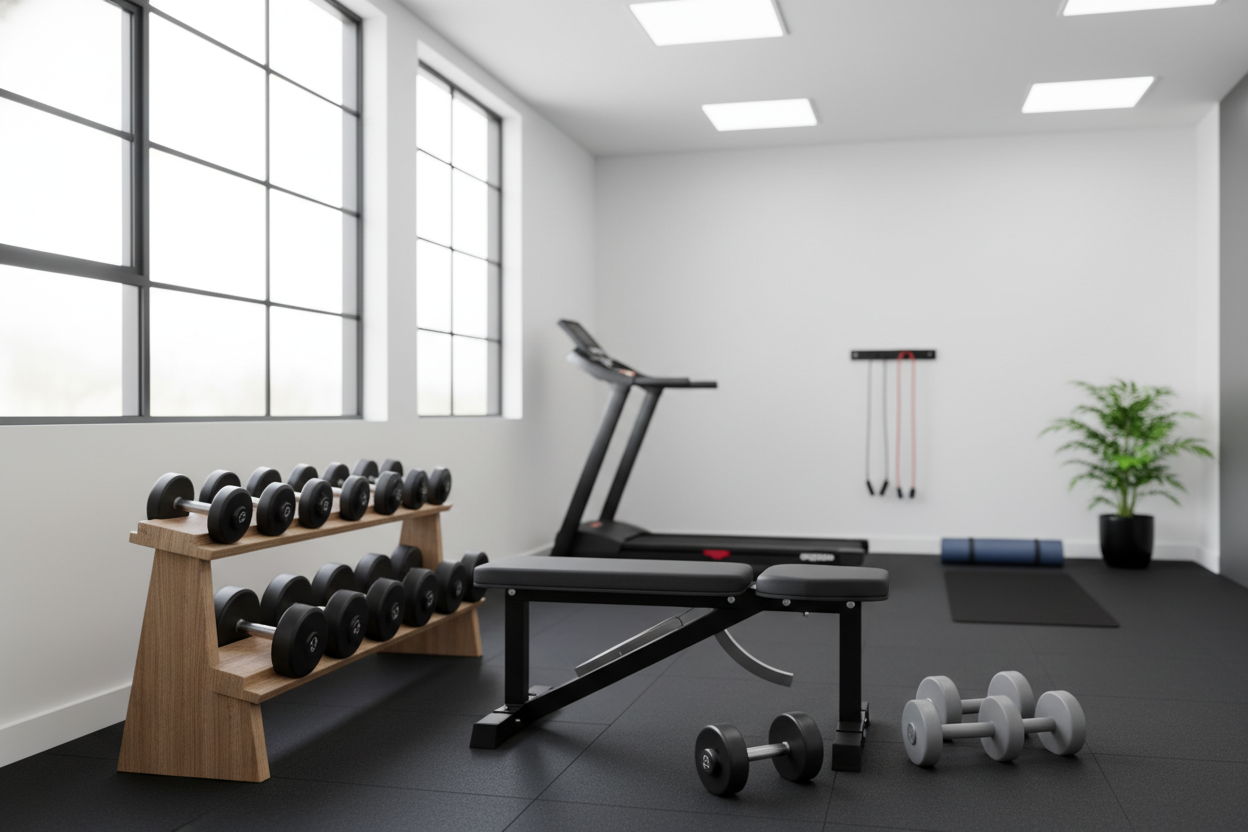
One crucial lesson I have learned from building dozens of home gyms is that environmental friction destroys consistency. If you have to move the coffee table, unroll a flimsy mat, and drag dumbbells out of a closet every time you want to train, you will eventually skip workouts. You need a dedicated, permanent training zone.
Defining your space visually changes how you interact with it. I always advise my clients to invest in a large exercise mat for home gym setups, even if they are just training in the corner of a living room. Leaving the mat out permanently signals to your brain that this area is reserved for work.
When I tested various flooring options in my own garage gym, I found that a 6x8ft exercise mat is the ideal size. It provides enough surface area to perform walking lunges, burpees, and wide-stance squats without ever stepping off the edge. Plus, the 7mm thickness absorbs the impact of dropping a 50-pound dumbbell, protecting both your floors and your joints. The only downside is that a mat this large is heavy and difficult to move, which is exactly why it should be a permanent fixture.
Adapting When Life Interrupts Your Plan
No matter how perfectly you plan your escalating schedule, life will eventually get in the way. You will get sick, have to work late, or simply feel too exhausted to train. When this happens, do not panic and do not try to cram two workouts into one day to catch up.
If you miss a Tuesday session, just push it to Wednesday. If your whole week falls apart, accept it and restart your current phase the following Monday. Flexibility is far more important than perfection. The goal of the Add-A-Day method is to build a lifelong habit, not to rigidly adhere to a calendar at the expense of your sanity. Show yourself some grace, adjust the schedule, and keep moving forward.
Frequently Asked Questions
How long should a beginner home workout last?
For your first few weeks, aim for 30 to 45 minutes per session. This is enough time to complete a brief warm-up, 3 to 4 compound exercises, and a quick cooldown without causing excessive fatigue.
Should I do cardio on my rest days?
During the two-day and three-day phases, light active recovery like a 20-minute walk is great. Avoid high-intensity interval training (HIIT) or heavy running on rest days until your body is fully adapted to the four-day lifting split.
What if I am still sore on my scheduled workout day?
If the soreness is mild, a thorough warm-up will usually loosen the muscles, and you can train as planned. If the soreness is severe to the point where it alters your movement mechanics, take an extra rest day.