Assisted Pull Up Machine: Stop Struggling and Start Growing
For many home gym owners, the strict pull-up is the ultimate white whale. You either struggle to get your chin over the bar, or you hit a plateau where you can't add enough volume to trigger real back growth. Resistance bands are a common workaround, but they offer inconsistent tension—providing too much help at the bottom and barely any at the top. Enter the assisted pull up machine.
Historically reserved for commercial facilities, the modern pull up exercise machine has finally evolved to fit residential spaces. Whether you're building a garage gym or outfitting a basement studio, this guide will walk you through exactly what to look for, how to integrate it into your routine, and whether this piece of pull up gym equipment is truly worth the floor space.
Key Takeaways
- Counter-intuitive resistance: Unlike traditional weight machines, adding weight to an assist pull up machine makes the exercise easier by providing more counterbalance.
- Space requirements: A standard weight assisted pull up machine requires at least 8 feet of ceiling clearance and roughly 15 square feet of floor space.
- Kneeling vs. standing: A kneeling pull up machine isolates the lats better by minimizing body sway, while a standing assisted pull up machine engages more core stabilizers.
- Versatility: Most modern units double as an assisted chin up machine and dip station, offering a complete upper-body workout solution.
Finding the Best Assisted Pull-Up Machine for Your Space
When you decide to bring a gym pull up machine into your home, the biggest hurdle is usually logistics. These are robust pieces of equipment designed to handle heavy loads safely.
Dimensions and Ceiling Clearance
Before you buy any pull up assistance machine, measure your ceiling. Most commercial-grade units stand between 82 and 90 inches tall. If you are placing a pull-up machine in a basement, you need to account for the height of your head extending above the machine at the top of the movement. We recommend a minimum ceiling height of 96 inches (8 feet) for comfortable use. If you're short on vertical space, a kneeling pull up machine is often more compact than a standing pull-up machine.
Weight Stacks vs. Plate-Loaded Models
A true pull up machine with weights usually features a selectorized weight stack. These are incredibly convenient for quick drop sets but come with a higher price tag and heavier shipping weight. Conversely, plate-loaded pull up support machines utilize the Olympic plates you already own. If you want the best assisted pull-up machine on a budget, a plate-loaded pull up trainer machine is the most cost-effective route.
Mastering the Pull-Up Machine How to Use Guide
Knowing how to use the assisted pull-up machine properly is crucial for targeting the right muscle groups. Many people hop on a pull up workout machine and let momentum do the work, completely missing out on lat activation.
Proper Form and Setup
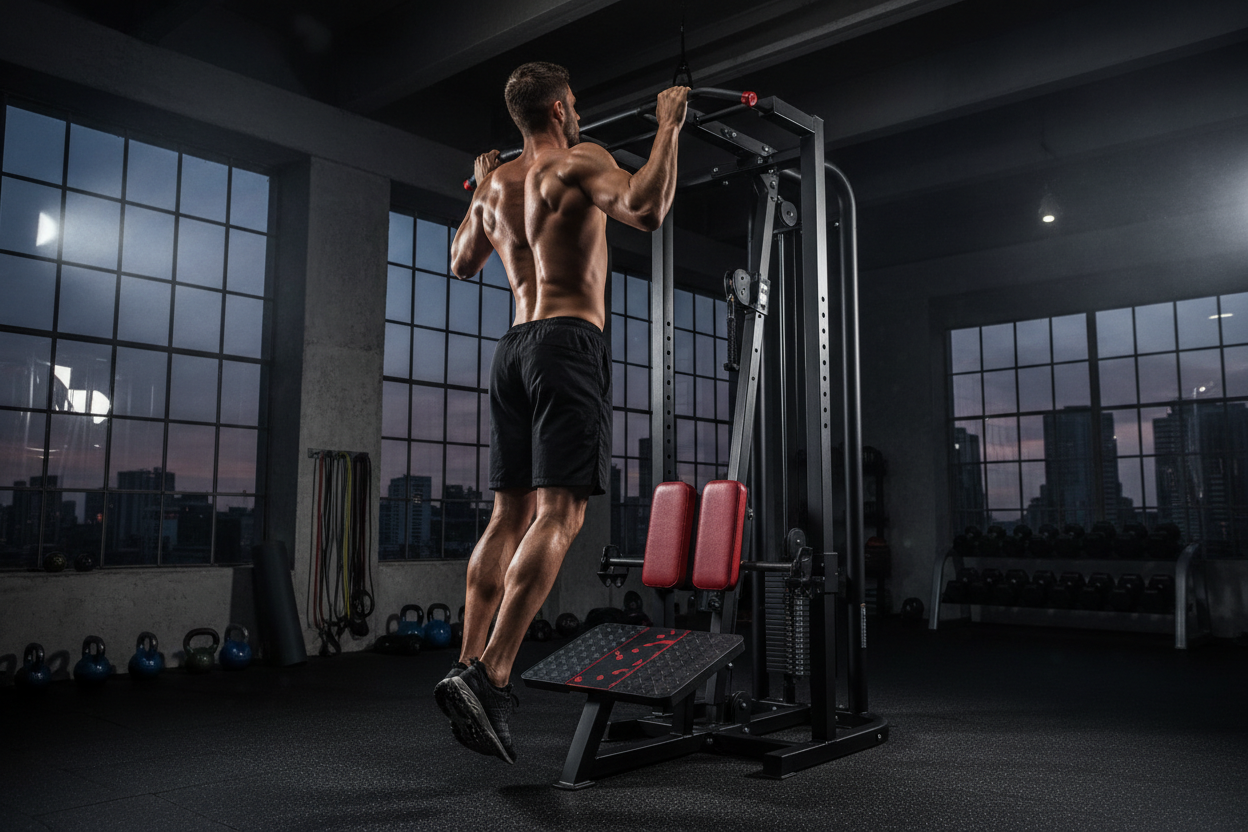
If you're wondering how to do assisted pull-up machine workouts effectively, start by selecting a counterbalance weight that allows you to perform 8-12 strict reps. Step onto the platform or rest your knees on the pad. Grip the handles—wide for lats, narrow or underhand if you are using it as a chin-ups machine. Lower yourself under control until your arms are fully extended. Pull your elbows down and back to lift your body, squeezing your lats at the top. Do not let the weight stack slam on the way down; controlling the eccentric phase on a machine assisted pull up is where the real muscle tearing and rebuilding happens.
Beyond the Standard Pull-Up
Your pull-ups exercise machine isn't a one-trick pony. By adjusting your grip, it easily functions as a weight assisted chin up machine for bicep isolation. Additionally, almost every pull up bar with weight assist includes parallel bars, allowing it to function as an assisted push up machine or dip station for triceps and chest development.
From Our Gym: Honest Take
We recently tested a commercial-grade pull up weight machine in our 400-square-foot garage gym facility. At 6'1", I've always found resistance bands frustrating because they snap me up too fast from the bottom of the movement. Transitioning to a dedicated pull up machine assisted by a 200lb selectorized stack was an absolute game-changer for my hypertrophy blocks.
The linear guide rods on the kneeling pad provided buttery-smooth resistance, allowing me to focus entirely on my mind-muscle connection rather than stabilizing my swinging body. However, I'll be honest: it takes up a massive footprint. At 42 inches wide and 55 inches deep, we had to completely rearrange our power rack setup to make it fit. If you have a tight space, a bulky weighted pullup machine might cramp your style. But if you have the room and want to build a wider back, the localized isolation is unmatched.
Frequently Asked Questions
How much weight should I use on a pull up machine with assist?
It depends on your body weight and strength level. Remember, the weight you select is the amount of help you get. If you weigh 200 lbs and select 100 lbs on the pullups machine, you are effectively lifting 100 lbs of your own body weight. Start with a heavier assist (about 60-70% of your body weight) and decrease the machine weight as you get stronger.
Is a pull-up helper machine better than resistance bands?
Yes, for consistent tension. Bands provide variable resistance—maximum help at the bottom, minimum at the top. A weight assisted pull-up unit provides linear, consistent assistance throughout the entire range of motion, which is far superior for tracking progressive overload and isolating the back muscles.
Can beginners use an assisted pull up exercise machine?
Absolutely. In fact, a pull ups assisted machine is the perfect starting point for beginners. It teaches the central nervous system the exact motor pattern of a perfect pull-up without the frustration of failing reps. Once you can comfortably do reps with minimal assistance on the pull ups machine gym equipment, transitioning to a free-hanging bar becomes seamless.