Are Your Bodybuilding Working Sets Actually Building Any Muscle?
I remember staring at my first pair of adjustable dumbbells in my garage, sweating through a 45-minute circuit and wondering why my arms still looked like noodles. I was 'working out,' sure, but I wasn't actually training. I was just moving. If you’ve ever finished a session feeling exhausted but looking exactly the same as you did three months ago, you’re likely failing to understand what a bodybuilding working set actually is.
Quick Takeaways
- Sweat is a metric of temperature, not muscle growth.
- A true working set requires you to train within 1-3 reps of technical failure.
- Stability is the foundation of force; if you are sliding, you aren't growing.
- Logbooks are more important than the bathroom scale for beginners.
The Real Difference Between 'Just Exercising' and Bodybuilding
Most people walk into their garage, throw some weight around, get their heart rate up, and call it a day. That’s exercise. It’s great for your heart, but it’s a terrible bodybuilder guide for actual hypertrophy. For a bodybuilding beginner, the hardest mental shift isn't the physical pain—it's the transition from blindly burning calories to applying intentional, localized mechanical tension to a specific muscle group.
When you start exercise at home for beginners, you usually focus on the movement. You think, 'get the bar from point A to point B.' In bodybuilding, the movement is just a tool to load the muscle. If you’re doing a row, you aren't just pulling a handle; you’re trying to stretch and contract your lats until they have no choice but to grow. This is the basic of bodybuilding: intention over momentum.
I’ve seen guys spend two hours in a gym doing 'junk volume'—sets that are too light to stimulate growth but heavy enough to make them tired. They leave exhausted, but their muscles never actually got the signal to adapt. If you want to know how to start being a bodybuilder, stop chasing the burn and start chasing tension. You need to learn how to isolate a muscle and make a light weight feel heavy. That is the beginning bodybuilding secret no one tells you.
This shift in mindset is how you start to bodybuilding effectively. You aren't a CrossFit athlete or a powerlifter. You are an architect of your own physique. Every rep should be a brick, not just a swing of the hammer. If you don't feel the target muscle working, the set didn't count. This is how to start bodybuilding at home without wasting years on 'cardio with weights.'
What Actually Counts as a True Working Set?
Let’s talk about the bodybuilding working set. A set isn't 'working' just because you did 10 reps and checked a box. If you finish a set of 10 and you could have easily done 15, you just did a glorified warm-up. This is the most common mistake in a bodybuilding starter guide. You’re leaving the gains on the table because you’re afraid of the 'dark place' at the end of a set.
To understand how to bodybuilding, you need to understand RIR (Reps in Reserve). If your program says 10 reps, you should pick a weight where rep 11 would be a struggle and rep 12 would be impossible without breaking form. This is bodybuilding for beginners 101: the growth happens in those final two or three reps where your bar speed involuntarily slows down. If the bar is moving at the same speed on rep 10 as it did on rep 1, you didn't trigger hypertrophy.
I use a simple rule in my own training: the 'Grind Test.' If the last two reps didn't make your face look ugly, it wasn't a working set. Bodybuilding techniques for beginners often focus on fancy splits, but the real technique is learning how to push. You need to reach that point where the muscle is screaming, and you still maintain a controlled eccentric (the lowering phase). That 3-second negative is where the damage—and the subsequent growth—happens.
When starting to body build, your nervous system will try to quit before your muscles do. Your brain wants to protect you. It will tell you to stop when it gets uncomfortable. But bodybuilding for starters is about overriding that signal. How start bodybuilding? By realizing that the first 8 reps are just the buy-in. Reps 9, 10, and 11 are the ones that actually pay the bills. If you aren't hitting that wall, you're just a person holding dumbbells, not a bodybuilder.
Why Instability Kills Your Home Gym Gains
You can have the best guide for bodybuilding beginners in the world, but if your feet are sliding on a dusty garage floor during a set of split squats, you aren't going to grow. I’ve seen it a hundred times. A guy buys a nice rack and some plates, but he’s lifting on slick concrete or a cheap, thin yoga mat. When your brain senses instability, it pulls the emergency brake on your power output. This is called neural inhibition.
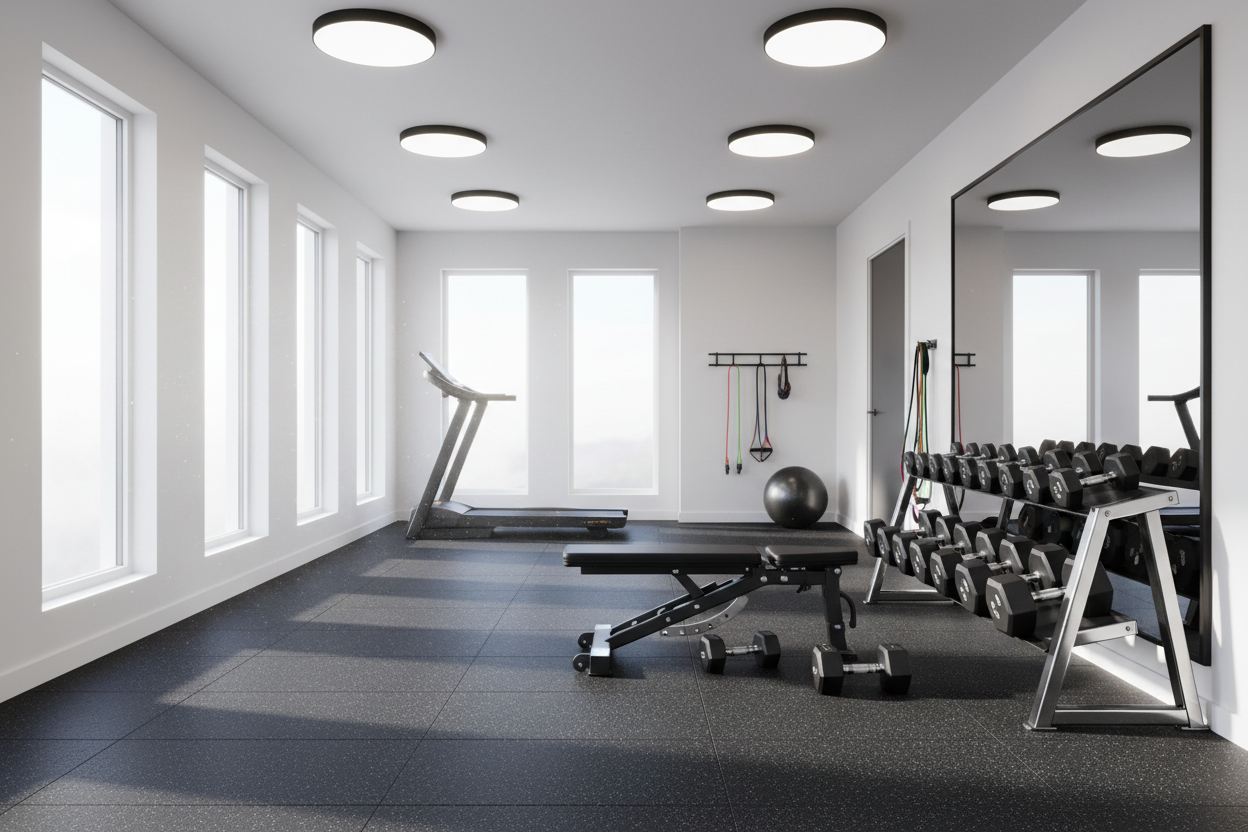
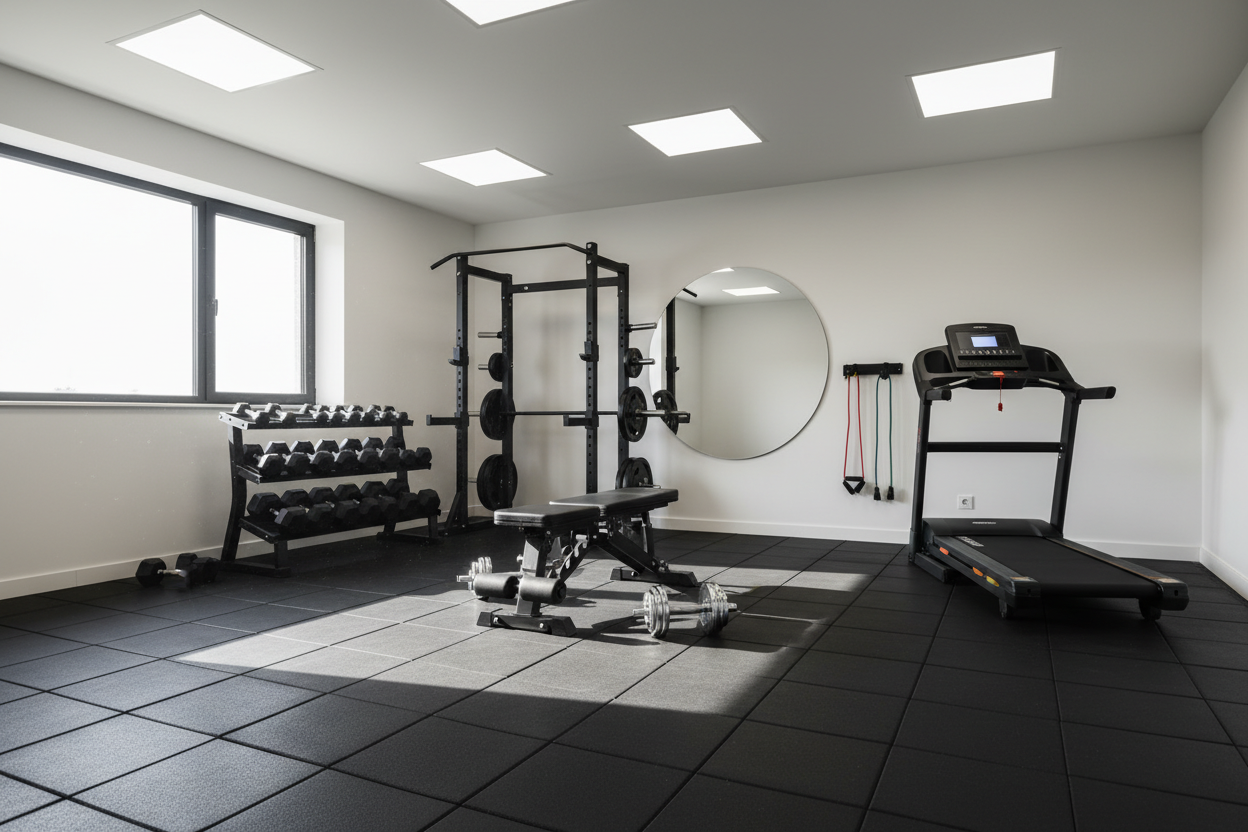
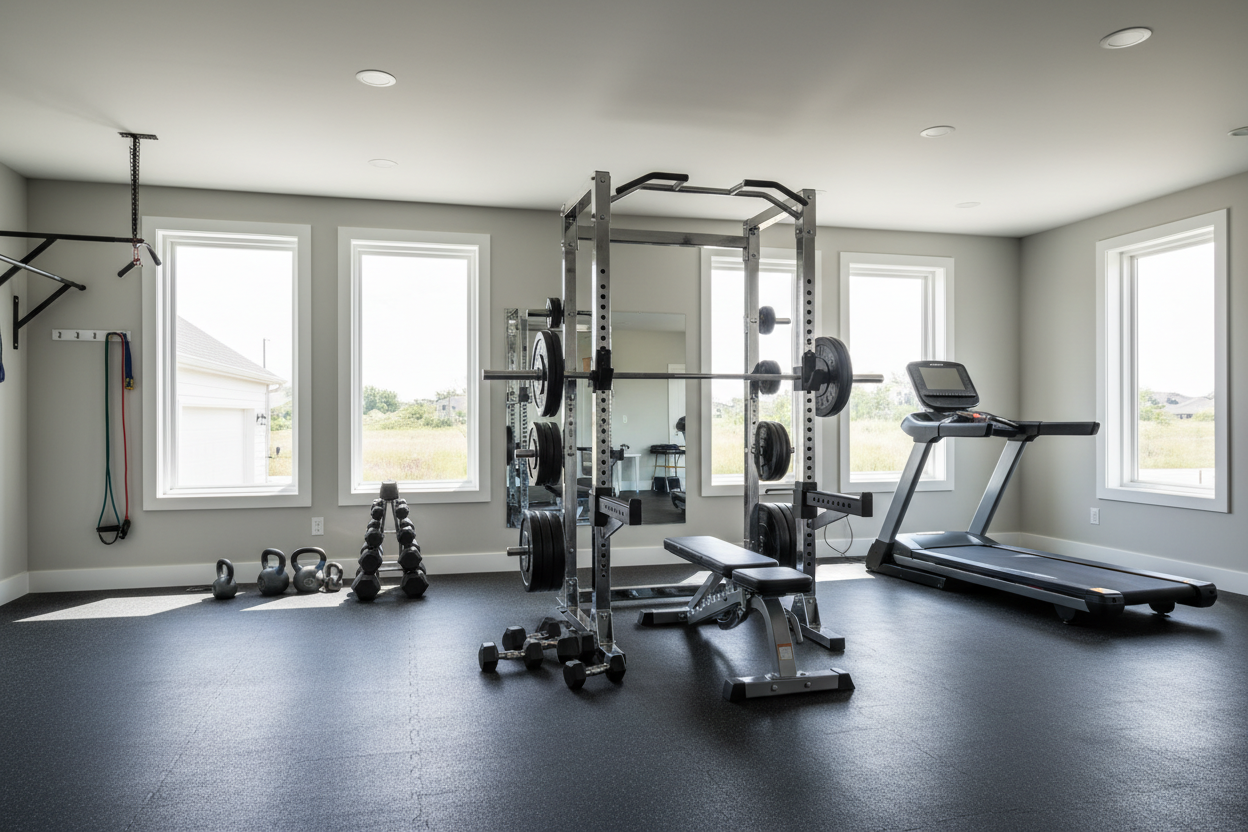
If you want to know how to get into bodybuilding seriously, you have to secure your foundation. Your nervous system won't let your quads fire at 100% capacity if it thinks you're about to slip and break a hip. This is why I always tell people to invest in proper gym flooring for home workout. You need a surface that bites back. High-density rubber allows you to drive through your heels and create the stability required for maximal muscle fiber recruitment.
Think about it: how can I start bodybuilding if I'm wobbling? You can't. Whether you're doing heavy presses or lunges, your body needs to feel 'locked in.' When I transitioned from a commercial gym to a home setup, my numbers initially dipped because I was lifting on a slick floor. Once I put down some real mats, my strength—and my mind-muscle connection—returned instantly. Don't let a $50 flooring problem ruin a $1,000 equipment investment. This is a crucial part of any bodybuilding basics checklist.
3 Brutally Honest Signs You Are Actually Growing
Forget the bathroom scale for the first eight weeks. Seriously. If you’re getting started in bodybuilding, your weight will fluctuate based on water, salt, and inflammation. It’s a lying metric that will only discourage you. Instead, look for these three indicators that your bodybuilding beginner tips are actually working.
First, check your logbook. If you did 100 lbs for 8 reps last week, and this week you did 100 lbs for 10 reps with the same form, you grew. Period. Progressive overload is the only guide to bodybuilding that never fails. You are forcing the muscle to handle more work. If the numbers aren't going up over a month, you aren't a bodybuilder; you're a hobbyist. This is the intro to bodybuilding reality check.
Second, look at the tape measure and your clothes. How to get bodybuilding results isn't always about the total weight; it's about where the weight is. Do your shirt sleeves feel tighter around your triceps? Do your jeans feel snug in the thighs but loose in the waist? These are 'local' wins. Bodybuilding is about shape. If your shoulders are capping out and your back is widening, you're on the right track, even if the scale hasn't budged.
Third, look for the 'pump' and muscle hardness. As a bodybuilding for beginner trainee, your muscles will start to hold more glycogen and water as they adapt. They’ll feel 'fuller' even when you aren't training. If you wake up and your muscles feel like soft pillows, you probably aren't training hard enough. If they feel like dense rubber, you’re doing it right. This is how do you start bodybuilding and actually see the mirror change.
How to Stop Guessing and Start Building
The biggest hurdle in how to get started in bodybuilding is overcomplicating the process. You don't need a 6-day 'pro' split. You need to pick five or six big movements—squats, rows, presses, and hinges—and master them. How do i start bodybuilding? By being boringly consistent. Pick a routine and stick to it for 12 weeks. No 'program hopping' allowed.
Rest is another area where beginning bodybuilding goes wrong. You aren't doing HIIT. If you want a true bodybuilding working set, you need to rest 2-3 minutes between sets. Your muscles need their ATP stores to recover so you can hit that high intensity again. If you're rushing, your lungs will give out before your muscles do, and you'll miss the growth stimulus. You can even use the start exercise at home for beginners approach to manage your time effectively while you build these habits.
Finally, log everything. Write down the weight, the reps, and how the set felt. This is how to begin bodybuilding with a purpose. Next week, your only job is to beat that paper. One more rep. Five more pounds. Better control on the way down. That is how to start bodybuilding and actually see a different person in the mirror six months from now. Stop exercising. Start training. This is your bodybuilding advice for beginners: intensity is the only thing that pays dividends.
Personal Experience: My Biggest Beginner Mistake
When I first started training in my garage, I thought 'more is better.' I was doing 30 sets per workout, six days a week. I was constantly sore, tired, and—honestly—looking pretty flat. I was doing 'junk volume.' I thought I was being a hardcore bodybuilding beginner, but I was just digging a recovery hole I couldn't climb out of. It wasn't until I cut my volume in half and doubled my intensity on every single bodybuilding working set that my chest and back actually started to grow. I learned the hard way that one set taken to absolute failure is worth ten sets of 'just going through the motions.' Quality beats quantity every single time in this game.
FAQ
How do I start bodybuilding at home with limited equipment?
Focus on high-intensity sets and slow eccentrics. If you only have light dumbbells, do 15-20 reps but make sure the last few are absolute grinders. Use floor presses, goblet squats, and weighted push-ups to build a foundation.
How many days a week should a bodybuilding beginner train?
Three to four days is plenty. You grow while you rest, not while you're lifting. A full-body split or an upper/lower split allows you to hit every muscle group with high intensity while giving your nervous system time to recover.
What is the best exercise for bodybuilding for starters?
The 'Big Three' are great, but for bodybuilding, the Romanian Deadlift, the Incline Dumbbell Press, and the Weighted Pull-up are king. These movements allow for a massive stretch and a great mind-muscle connection, which is how to start in bodybuilding correctly.
How can I start bodybuilding if I have no experience?
Start by learning the form of basic movements with just your bodyweight or a PVC pipe. Once the mechanics are 'greased' into your brain, start adding weight slowly. The goal is to feel the muscle, not just move the load.