Are Simple Workout Exercises Enough to Actually Build Muscle?
I remember standing in the middle of a big-box gym three years ago, staring at a $2,500 functional trainer with more pulleys than a medieval sailing ship. I was convinced that if I didn't hit my chest from seventeen different angles, I was leaving gains on the table. I spent forty-five minutes that day just adjusting cables and swapping handles. My reward? Zero progress and a nagging pain in my left shoulder that felt like a hot needle. It wasn't until I stripped my routine down to simple workout exercises that my back actually started to widen and my squat numbers finally moved north of 225 pounds.
Quick Takeaways
- Muscle confusion is a marketing myth designed to sell app subscriptions and variety-based equipment.
- True growth comes from neurological efficiency—getting better at the same movements over time.
- A four-pattern approach (push, pull, squat, hinge) covers 95% of your physiological needs.
- Progressive overload can be achieved through tempo and tension, not just adding more weight.
- Consistency with a boring plan beats intensity with a complicated one every single time.
The Lie We've Been Sold About 'Muscle Confusion'
The fitness industry has a vested interest in making you think you need a complex, ever-changing routine. Why? Because a simple plan is hard to monetize. If I tell you that you only need five movements for the next six months, I can't sell you a 'New Year, New You' 30-day challenge every February. They call it 'muscle confusion,' suggesting that if you don't surprise your biceps with a different curl variation every Tuesday, they'll simply stop growing. It is absolute nonsense.
In reality, your muscles aren't smart enough to be 'confused.' They respond to mechanical tension, metabolic stress, and muscle damage. When you constantly rotate your exercises, you never actually get good at the movement. You spend all your energy on the learning curve of the exercise itself rather than pushing the muscle to its limit. If you're always a novice at the movement, you'll never be an expert at the exertion. I’ve seen guys spend years 'confusing' their muscles only to look exactly the same year after year. Stop chasing novelty and start chasing proficiency.
What Happens When You Stick to Simple Workout Exercises
When you stop program-hopping and commit to a handful of movements, something interesting happens in your central nervous system. The first few weeks of any new exercise are mostly 'neurological gains.' Your brain is learning how to fire the right motor units in the right order. If you quit after week three to try a new TikTok trend, you never actually reach the point where the muscle is the limiting factor. You're just training your brain to be less clumsy.
Once you master the mechanics, you can finally apply real intensity. This is how you build real muscle with a simple exercise routine. You aren't worried about your balance or the setup anymore; you're focused entirely on the contraction. I found that by sticking to the same row variation for six months, I could finally feel my lats engaging in a way that 'variety' never allowed. You become a specialist. And specialists are always stronger and more muscular than generalists who dabble in twenty different machines.
My Blueprint for an Easy to Follow Exercise Routine
If you want to actually see results without spending two hours in the gym, you need to master the Big Four patterns. I don't care if you're using dumbbells, a barbell, or just your body weight—these patterns are non-negotiable. First, you need a squat pattern (goblet squats or split squats). Second, a hinge pattern (kettlebell swings or RDLs) to hit the posterior chain. Third, a push (overhead press or floor press). Fourth, a pull (rows or chin-ups). That is the entire foundation of an sustainable exercise routine workout.
Execution is the only thing that matters here. Instead of doing three sets of ten and checking your phone, I want you to treat every rep like a skill. If you're doing a push-up, I want your core locked, your glutes squeezed, and your elbows tucked. When you strip away the fluff of lateral raises and cable flyes, you have the mental energy to pour everything into these compound movements. This is how you build a physique that actually functions in the real world, not just one that looks okay in a mirror with specific lighting.
Setting Up Your Forgiving Floor Space
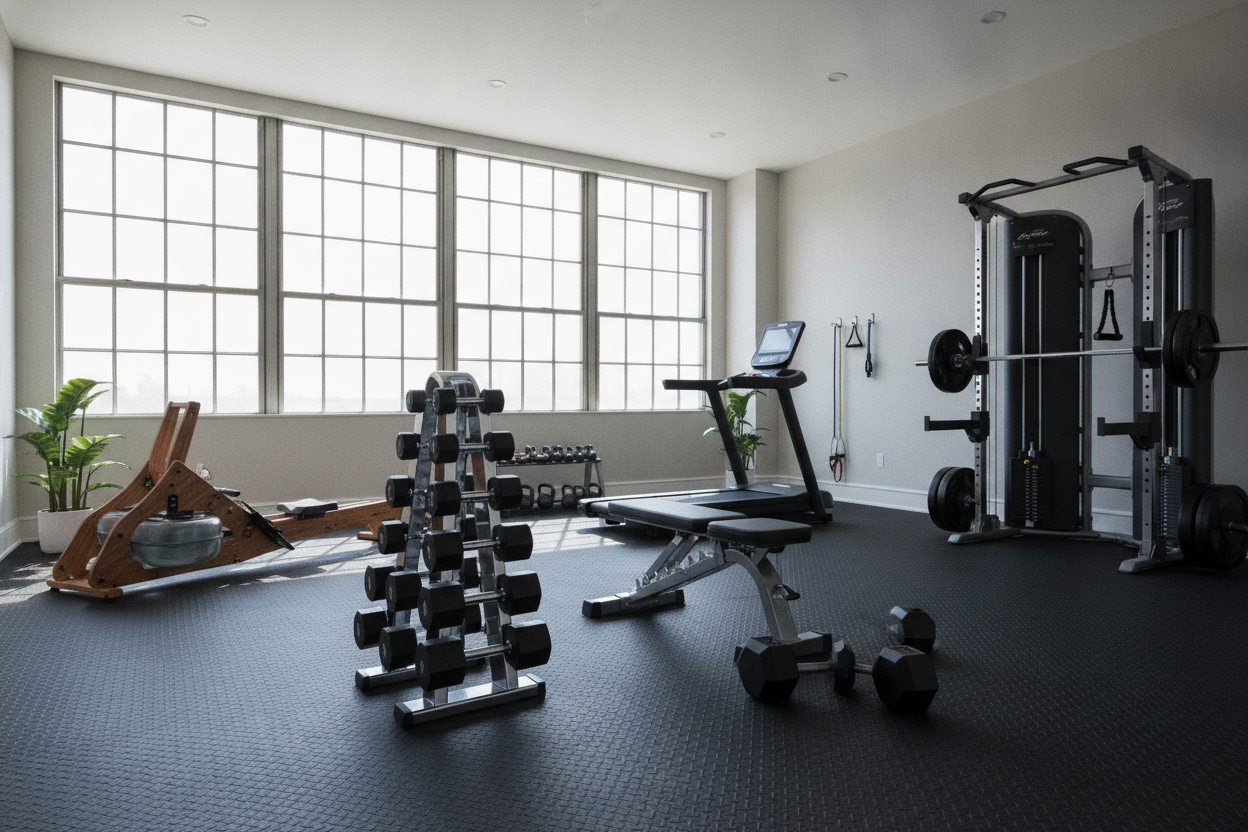
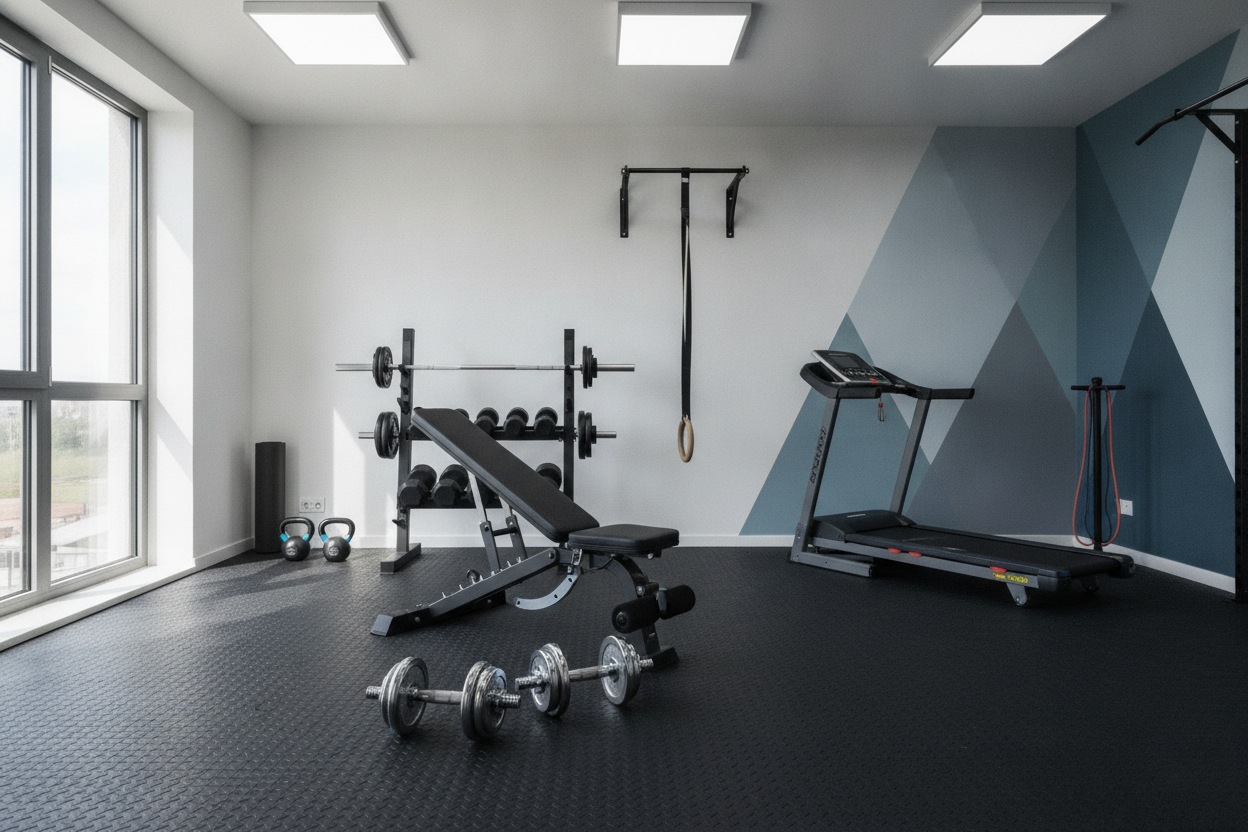
The biggest barrier to a consistent home routine isn't the lack of a squat rack; it's the friction of the setup. If you have to move your coffee table and vacuum the rug every time you want to sweat, you’re going to quit by Wednesday. I learned this the hard way after stubbing my toe on a sofa leg during a set of lunges. You need a dedicated 'go zone.' A high-quality large exercise mat is the single best investment you can make for a minimalist setup. It defines the space and protects your joints.
I personally use a 6x8ft exercise mat because it provides enough real estate to move from a hinge to a push without having to shuffle my weights around. It’s thick enough to dampen the sound of a dropped dumbbell—essential if you have neighbors or a sleeping toddler—and it gives you that 'gym feel' even if you're just in a corner of the basement. Having that dedicated floor space removes the mental hurdle of 'getting ready' to train. You just step on the mat and work.
How to Progress an Easy to Follow Exercise Plan
The most common critique of an easy to follow exercise plan is that it gets 'too easy.' That’s a failure of imagination, not a failure of the program. You don't need a new exercise to make things harder; you need to change the intent. If you can do twenty push-ups easily, don't switch to some weird unstable variation. Instead, start using a 4-0-1-0 tempo. That’s four seconds on the way down, no rest at the bottom, one second to explode up, and no rest at the top.
You can also introduce pause reps. Try pausing for three seconds at the bottom of your squat or the peak of your row. This removes all momentum and forces the muscle to work through the hardest part of the movement. I once spent an entire month doing nothing but '1.5 reps'—going all the way down, halfway up, back down, then all the way up. It was the most brutal leg training of my life, and I didn't add a single pound to the bar. Progress is about finding ways to make simple movements feel harder, not finding harder movements to do poorly.
The Boring (But Effective) Truth About Home Training
Here is the truth that most influencers won't tell you: real training is boring. It is the repetitive, disciplined execution of the same five or six movements week after week, month after month. It doesn't look cool on Instagram, and it doesn't feel like a 'party' in your living room. But it works. I’ve wasted years on fancy programming and high-tech gadgets, only to realize that my best physique came from a pair of dumbbells and a solid floor mat.
Don't be the person who knows every new exercise but has no muscle to show for it. Be the person who masters the basics. When you embrace the simplicity, you remove the stress of planning and replace it with the satisfaction of progress. Put your head down, do your rows, do your squats, and let the results speak for themselves.
FAQ
Can I really build muscle with just bodyweight exercises?
Yes, but you have to manipulate leverage. A standard push-up becomes a completely different animal when you elevate your feet or move to a single-arm variation. Muscle doesn't know if you're holding a $500 barbell or just fighting gravity; it only knows tension.
How many days a week should I do this?
Three to four days is the sweet spot for most people. Recovery is where the actual muscle growth happens. If you're training hard on the basics, you'll need those 48 hours between sessions to repair the tissue and come back stronger.
What if I get bored of the same routine?
Focus on the numbers, not the novelty. If you're bored, it's usually because you aren't tracking your progress. Seeing your row strength go up by 10% is far more exciting than trying a new exercise you saw on a 30-second clip.