Air Rower Machine Mastery: The Truth About Fan Resistance
Walk into any CrossFit box or high-performance gym, and you will hear a distinct sound. It isn't the clanking of weights; it is the rhythmic whoosh of a flywheel spinning against the wind. That sound belongs to the air rower machine, a piece of equipment that has arguably become the gold standard for metabolic conditioning.
Many beginners mistake these machines for simple cardio warm-up tools. That is a mistake. Unlike motorized treadmills that do the work for you, an air rower demands that you earn every meter. It creates a direct relationship between your effort and the resistance you feel.
Whether you are building a home gym or trying to improve your splits at the local club, understanding how this machine utilizes air dynamics is the key to unlocking better fitness.
Key Takeaways: Air Rower Essentials
- Infinite Resistance: The harder you pull, the more resistance the fan generates. There is no upper limit.
- Damper vs. Resistance: The lever on the side adjusts airflow (drag factor), not the actual weight of the pull.
- Form is King: Efficiency beats brute strength. Power comes from the legs, not the arms.
- Maintenance: Fan rowers require chain oiling and cage vacuuming to maintain accurate drag factors.
The Science: How a Fan Rowing Machine Works
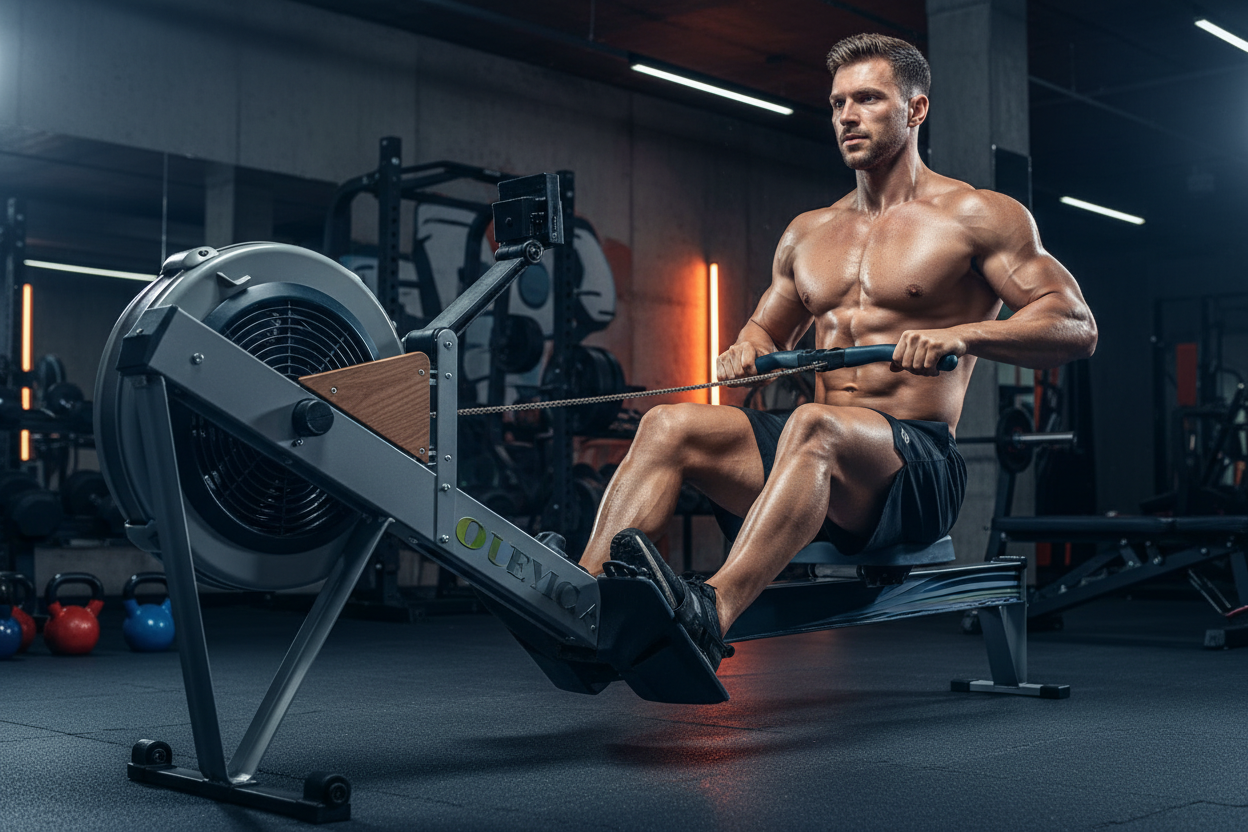
To master this tool, you need to understand the mechanics. A fan rowing machine operates on a simple principle of fluid dynamics. When you pull the handle, you spin a flywheel with fan blades. As the wheel spins, it displaces air.
The air pushes back against the blades, creating drag. This is why we call it an air resistance rowing machine. The faster you spin that wheel, the more air it runs into, and the harder it becomes to maintain that speed.
The Misunderstood Damper Setting
Most people sit down, crank the lever on the side of the rowing machine fan to 10, and assume they are getting the best workout. This is incorrect. That lever is the damper.
Think of the damper like bicycle gears. A setting of 10 allows maximum airflow into the cage, making the wheel slow down fast (like a heavy gear). A setting of 1 restricts air, making the wheel spin longer (like a light gear). For most metabolic conditioning, a setting between 3 and 5 is optimal for mimicking water resistance.
Air vs. Magnetic: Which is Superior?
You might encounter an air magnetic rowing machine (or hybrid) and wonder if it is a better investment. Here is the breakdown.
Pure Air Rowers
Air rowers provide a smooth, responsive feel. The resistance is dynamic. If you sprint, the resistance spikes instantly. This makes them ideal for HIIT (High-Intensity Interval Training) and testing athletic potential. However, they are loud. The noise level rises in correlation with your intensity.
Air and Magnetic Rowing Machine Hybrids
An air and magnetic rowing machine combines the fan with magnets. The magnets provide a baseline resistance that is quieter and constant, while the fan adds the dynamic top-end resistance. These are often quieter and can offer higher resistance at lower speeds, but they sometimes lack the "pure water" feel of a standard fan rower.
Technique: Mastering Air Rowing
Air rowing is 60% legs, 20% core, and 20% arms. If your biceps are burning but your quads aren't, your form is off.
The Drive
Initiate the movement by driving your heels into the footplates. Do not pull with your arms yet. Keep your arms straight and your core braced. The handle should only move because your seat is sliding back.
The Finish
Once your legs are extended, swing your torso back slightly (to about 11 o'clock) and pull the handle to your sternum. On air rowing machines, this sequence preserves momentum in the flywheel.
Choosing the Right Equipment
When shopping for air rowing machines, look at the monitor capabilities first. A robust monitor (like the PM5 found on Concept2s) is vital if you want to compare your times with other athletes. Cheaper models often calculate distance differently, making your data useless for competitive comparison.
Also, check the rail. A rowing machine with fan resistance usually has a long footprint. Ensure the rail is aluminum or stainless steel to prevent pitting and roughness over time.
My Training Log: Real Talk
I want to share something the product manuals never mention. I remember training for my first sub-7-minute 2k row. I was using a high-end fan rower in my garage.
Everyone talks about the leg burn, but nobody warned me about the "Concept cough." Because the fan circulates so much air, if you are in a dry room, that wind hits your throat constantly. By the last 500 meters, my throat felt like sandpaper. I learned the hard way to keep a bottle of water within arm's reach, not just for hydration, but to lubricate my throat between intervals.
Another unpolished reality? The "dust bunnies." The fan cage acts like a vacuum cleaner for your room. If you don't take a vacuum hose to the perforated metal mesh every few weeks, you'll see a ring of gray dust clogging the intake. This actually messes up the drag factor, making your "10" setting feel like a "6." Keeping that mesh clean is just as important as oiling the chain.
Conclusion
The air rower machine is an honest piece of equipment. It doesn't lie about your fitness level, and it doesn't do the work for you. Whether you choose a pure air model or an air magnetic rowing machine, the benefits to your posterior chain and cardiovascular system are undeniable. Fix your form, check your damper setting, and respect the machine.
Frequently Asked Questions
Is an air rower machine loud?
Yes, air rowers generate noise because of wind resistance. The harder you row, the louder the fan becomes. If you need a silent machine for an apartment with thin walls, a magnetic rower might be a better choice, though it sacrifices the dynamic resistance feel.
Can you lose belly fat on an air rowing machine?
Absolutely. Rowing is a full-body workout that burns a high number of calories. Because it engages the legs, core, and back simultaneously, it elevates your metabolic rate significantly, aiding in fat loss when combined with a proper diet.
What is the difference between air and water rowers?
Both offer dynamic resistance (harder pull = more resistance). However, air rowers allow for easier resistance adjustment via a damper and generally require less maintenance than water tanks, which can develop algae or leak over time.