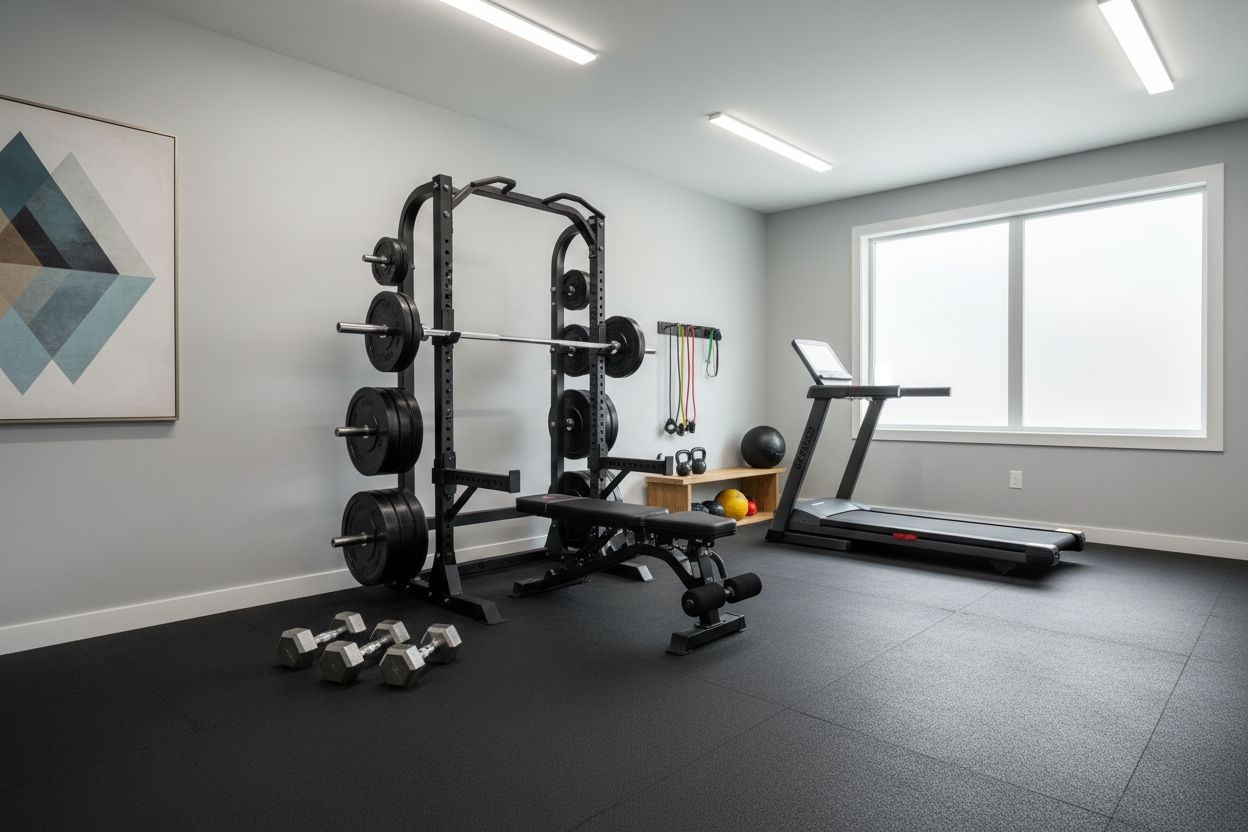
Adapting Popular Fitness Plans for Home
I remember standing in my cramped, unheated garage at 5 AM, staring at a PDF of a highly recommended workout split on my phone. The first three exercises called for a seated leg curl, a hack squat machine, and a cable crossover. I had a barbell, a flat bench, and a pair of 50-pound dumbbells. It was incredibly frustrating. If you train at home, you have probably faced this exact scenario. Most popular fitness plans are written by coaches who assume you have access to a fully stocked, 10,000-square-foot commercial facility.
You do not need a commercial gym membership to run the top exercise programs on the market. Over the last decade of building residential gyms for clients, I have learned that your muscles cannot tell the difference between a $4,000 selectorized machine and a $40 resistance band. They only understand tension, range of motion, and progressive overload. By learning how to swap exercises based on movement patterns rather than specific equipment, you can execute almost any mainstream routine in a 10x10 foot spare room.
Quick Takeaways
- Commercial routines rely heavily on isolation machines, but you can replicate 95% of them with free weights and bands.
- Focus on the underlying movement pattern (push, pull, hinge, squat) rather than the specific apparatus.
- Safety is paramount when training alone; always use safety pins for heavy barbell work or substitute with dumbbells.
- High-intensity and plyometric routines require adequate floor protection to save your joints and your foundation.
The Commercial Bias in Popular Fitness Plans
When you download a cookie-cutter workout template, you are almost always getting a commercial gym routine. Program designers include machines like the pec deck, leg press, and lat pulldown because they are universally available in big-box gyms and require very little technical skill to use. They are safe for beginners and easy to scale. However, this creates a massive barrier for the garage gym athlete.
This commercial bias makes many trainees feel like their home setup is inadequate. I have had clients tell me they cannot follow a hypertrophy block because they do not own a Smith machine or a reverse hyper. This is a fundamental misunderstanding of how resistance training works. The machine is just a tool to deliver a stimulus. The pec deck isolates the chest by dragging the arms across the midline of the body under tension. A pair of dumbbells, or even a set of heavy resistance bands anchored to a door frame, can achieve the exact same mechanical tension.
The problem is not your equipment; the problem is literal translation. Trying to follow a machine-heavy program line by line in a basement gym will only lead to skipped workouts and frustration. You have to stop looking at the name of the exercise and start looking at the target muscle group and the joint action. Once you make that mental shift, every commercial program becomes adaptable.
The Equipment Substitution Matrix
To successfully run mainstream routines at home, you need to use what I call the Equipment Substitution Matrix. This is a mental framework that categorizes exercises by their core movement pattern rather than their required hardware. Every exercise falls into one of a few categories: horizontal push, vertical push, horizontal pull, vertical pull, squat, hinge, or isolation.
If a program calls for a seated machine chest press, you identify it as a horizontal push. Your home gym swaps are the barbell bench press, dumbbell floor press, or weighted push-ups. If a routine lists a lying leg curl, you identify it as a knee flexion isolation movement. Your swaps are sliding leg curls using furniture sliders on carpet, or clamping a light dumbbell between your feet on a flat bench. When adapting fitness programs gym plans to your garage, this matrix is your best friend.
I recommend writing out the commercial routine on the left side of a notebook page. On the right side, write down the target muscle and the movement pattern. Then, fill in your available home gym equivalent. For example, a cable triceps pushdown becomes an overhead dumbbell triceps extension. A machine lateral raise becomes a strict dumbbell lateral raise. This process guarantees you hit the intended muscle groups with the appropriate volume, even if the tools look completely different.
Modifying the Classic 5x5 Strength Protocol
Heavy 5x5 barbell programs are the gold standard for building foundational strength. They focus heavily on the squat, bench press, deadlift, and overhead press. On paper, these are perfect for a home gym because they require minimal equipment. In reality, running a heavy strength block alone in your basement presents serious safety and logistical challenges.
First, you cannot push to true failure on a barbell bench press without a spotter unless you have a power rack with safety pins. I once tested a budget half-rack that lacked proper spotter arms. During a heavy 5x5 bench session, I failed on the fourth rep of 225 lbs. I had to do the 'roll of shame' down my torso, leaving a massive bruise on my hip. That taught me to never compromise on safety gear. If you do not have a rack with tested safety pins, you must swap the barbell bench press for heavy dumbbell presses. You can drop dumbbells safely to the floor if you fail.
Second, heavy deadlifts and barbell rows require serious floor protection. Pulling 400 lbs off a bare concrete floor will eventually crack your foundation, and cheap foam puzzle mats will compress to nothing under that kind of localized pressure. Investing in a large exercise mat is mandatory to protect your foundation and your plates. I recommend high-density rubber or specialized shock-absorbing mats that are at least 7mm thick. This allows you to perform your heavy 5x5 pulls aggressively without worrying about property damage.
Running a Push-Pull-Legs (PPL) Split at Home
The Push-Pull-Legs split is arguably the most popular hypertrophy program in the world. It is highly effective, but it is notorious for relying on cable towers and leg machines. Let us break down how to run it effectively using basic home equipment.
For your Push days, the biggest hurdle is usually the cable crossover. To replace that constant tension, I use resistance bands. You can loop a heavy band around a sturdy upright on your squat rack, or use a cheap door anchor. Step forward until the band is taut, and perform your flyes. If you prefer free weights, a slight incline dumbbell fly works perfectly. I often program 3 sets of 12-15 reps with 30-pound dumbbells to simulate the chest pump of a cable machine.
Pull days usually call for lat pulldowns and seated cable rows. If you have a pull-up bar, you are set. If you cannot do strict pull-ups, drape a heavy resistance band over the bar, step your foot into the loop, and do assisted pull-ups. For seated rows, the barbell Pendlay row or single-arm dumbbell rows leaning on a bench will build a massive back just as effectively. If you do want to buy a single piece of equipment, look into top rated exercise machines for home fitness like a compact functional trainer or a plate-loaded lat tower, which fit nicely in a corner and solve all your pulling limitations.
Leg days are where home gym owners struggle most. Missing the leg press and leg extension machine can feel limiting. To replace the heavy load of a leg press, switch to front squats or Bulgarian split squats. Holding a pair of 50-pound dumbbells for high-rep Bulgarian split squats will destroy your quads faster than any leg press. To replace leg extensions, try bodyweight sissy squats or reverse Nordic curls. They require zero equipment and provide brutal tension on the rectus femoris.
Translating High-Intensity & Cardio-Driven Routines
Many popular programs incorporate high-intensity interval training (HIIT), plyometrics, and fast-paced circuit work. Think of routines that feature burpees, box jumps, lateral bounds, and mountain climbers. These are incredible for fat loss and conditioning, but they pose a unique threat to home gym users: impact.
Doing jump squats or skater bounds on a hard concrete garage floor or a thin living room carpet is a recipe for shin splints, knee pain, and unhappy neighbors. Concrete has zero give, sending shockwaves straight up your tibia with every landing. You need a dedicated, shock-absorbing space. For dynamic movements, you need a surface that is at least extra wide 7 feet to safely perform lateral skater jumps without slipping onto the bare floor. A high-quality, dense mat will cushion your landings and significantly muffle the sound, dropping the noise level from a booming 85 decibels down to a manageable thud.
When modifying these fast-paced routines, you also need to consider equipment transitions. Commercial HIIT classes often have you sprint on a treadmill, jump off, and immediately grab kettlebells. At home, you might not have a treadmill. Swap the sprint for 60 seconds of high-knee rope skipping or kettlebell swings. Keep your dumbbells and bands organized in a tight circle around your mat so you can transition between exercises in under 10 seconds, maintaining your target heart rate.
Setting Up Your Space for Program Success
Ultimately, the success of any workout routine comes down to consistency, effort, and progressive overload. The specific brand of leg press or the exact angle of a cable tower matters very little in the grand scheme of your physical development.
Take the time to assess your home gym space and map out your exercise substitutions before you start week one of a new program. Write your swaps directly into your workout log. If you know exactly how you are going to replace a machine chest press with a floor press, you will not lose momentum during your session. Focus on pushing your available equipment to its limits, protecting your floors and joints, and tracking your progress. You will quickly find that your garage or spare bedroom can produce the exact same results as a premium commercial membership.
Frequently Asked Questions
Can I build muscle at home without machines?
Absolutely. Muscle hypertrophy requires mechanical tension, metabolic stress, and muscle damage. You can achieve all three using barbells, dumbbells, resistance bands, and bodyweight exercises. Your muscles do not know what equipment you are holding.
How do I replace a leg curl machine at home?
If you have a flat bench, you can lie face down and hold a dumbbell between your feet to perform lying leg curls. Alternatively, you can use furniture sliders on a carpeted floor, or a stability ball under your heels, to perform sliding hamstring curls.
What if I don't have heavy enough dumbbells for a strength program?
If you max out your dumbbells, you need to increase the difficulty without adding weight. You can do this by slowing down the eccentric (lowering) phase to 4 seconds, adding a 2-second pause at the bottom of the movement, or performing pre-exhaustion sets (like doing push-ups before your dumbbell bench press).