
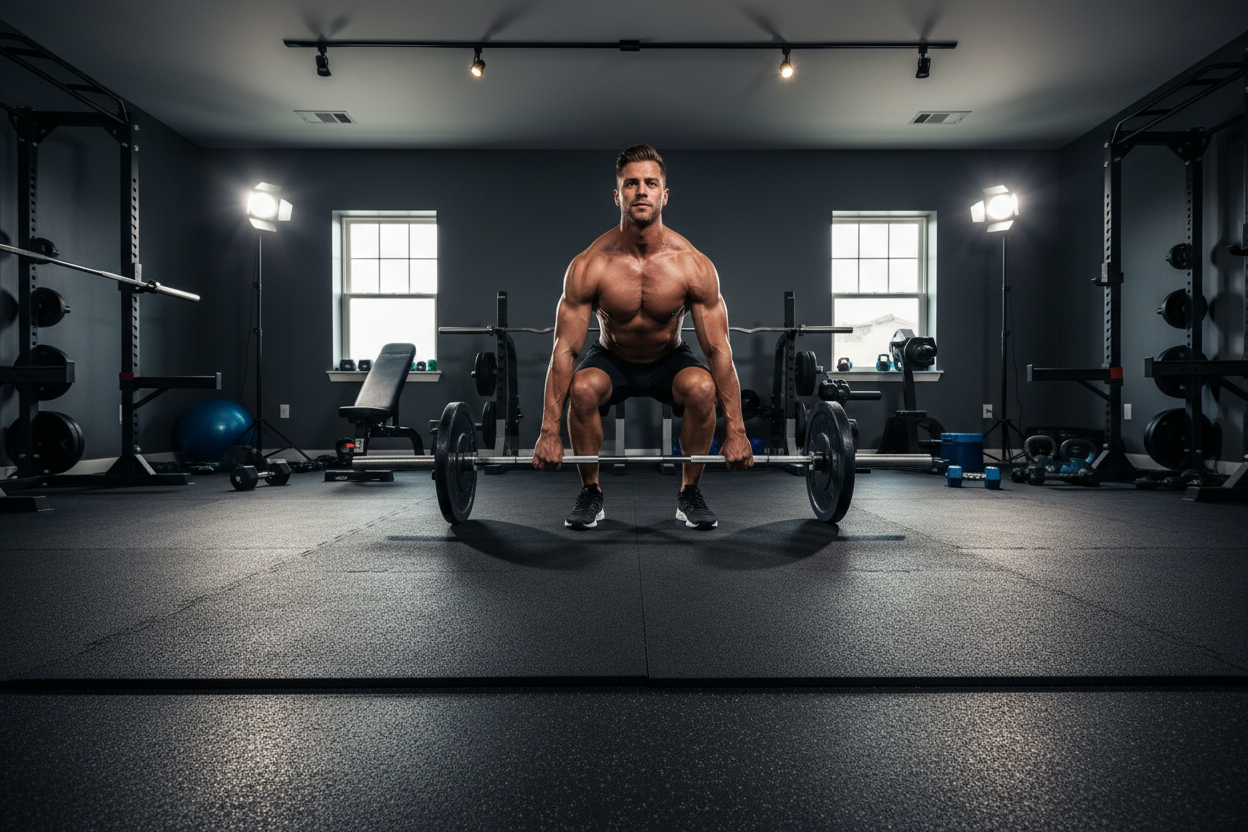
1/2 vs 3/4 gym flooring Explained: What to Know Before You Buy
Building a home gym is an exciting investment, but nothing kills that excitement faster than dropping a heavy barbell and hearing the terrifying crack of your concrete subfloor. Your flooring is the foundation of your entire training space, dictating everything from noise levels to equipment longevity. If you are stuck debating 1/2 vs 3/4 gym flooring, you are not alone. It is the most common crossroads for garage gym builders.
Choosing what thickness rubber flooring for home gym use ultimately comes down to your training style, the weight you lift, and what lies beneath the mats. In this guide, we will break down exactly which thickness is right for your space so you can lift heavy with total peace of mind.
Key Takeaways
- 1/2-inch flooring is ideal for general fitness, dumbbell workouts, and moderate strength training.
- 3/4-inch flooring is the gold standard for heavy powerlifting, Olympic weightlifting, and commercial settings.
- Your subfloor matters: concrete can handle thinner mats better than wood subfloors.
- Always calculate your square footage and add a 10% overage when figuring out how much gym flooring do i need.
Comparing Thickness: How Thick Rubber Mats for Gym Use Should Be?
When determining the best thickness for home gym rubber flooring, you have to look at your primary workout style. Over-buying wastes your budget, while under-buying puts your foundation at risk.
The Case for 1/2-Inch Flooring
For about 80% of home gym owners, 1/2-inch rubber flooring hits the sweet spot between price and performance. It provides excellent shock absorption for dropped dumbbells, kettlebell swings, and standard barbell work (like squats and bench presses). It is also significantly lighter and easier to cut when installing around tricky basement pillars or garage tracks. If you rarely drop loaded barbells from above the waist, 1/2-inch mats will serve you perfectly.
The Case for 3/4-Inch Flooring
If you are an Olympic lifter, a heavy powerlifter, or someone who frequently drops deadlifts from the lockout position, 3/4-inch flooring is non-negotiable. This thickness offers maximum impact resistance, drastically reducing the vibration and noise that travels through your home's foundation. It is the exact thickness used in most commercial facilities and CrossFit boxes.
Space Planning and Installation
Gym flooring usually comes in either interlocking tiles or heavy stall mats (typically 4x6 feet). Moving and cutting these mats is a workout in itself, especially the 3/4-inch variants which can weigh upwards of 100 pounds each.
Calculating Your Footprint
To calculate your needs, measure the length and width of your space to get your total square footage. If you are outfitting a standard one-car garage space (roughly 12x20 feet, or 240 square feet), you will need ten 4x6 mats. Always buy an extra 10% to account for cutting mistakes and edges when calculating how much gym flooring do i need.
From Our Gym: Honest Take
We have outfitted dozens of spaces over the years, and I have personally trained on both thicknesses in my own garage gym. When I first started, I used 1/2-inch interlocking tiles to save money. They were great for a while, but once my deadlift crossed the 400-pound mark, I noticed the tiles separating slightly after heavy drops, and the impact sent a jarring shockwave right into the concrete.
I eventually upgraded my primary lifting zone to 3/4-inch vulcanized rubber stall mats. The difference was night and day. The knurling on my plates no longer chewed up the floor, the mats stayed perfectly flush without tape, and the acoustic dampening kept my family from complaining about the noise upstairs. The only downside? Lugging those 100-pound mats up the driveway was a miserable experience. Bring a friend for installation.
Frequently Asked Questions
Can I put heavy equipment on 1/2-inch gym flooring?
Yes, 1/2-inch flooring easily supports heavy power racks, treadmills, and functional trainers without compressing permanently. The issue is not static weight, but the dynamic impact of dropping weights.
Do I need plywood under my rubber gym flooring?
If you are installing over concrete, plywood is usually unnecessary unless you are building a dedicated Olympic lifting platform. If you are installing over a hollow wooden subfloor (like a second-story bedroom), a layer of 3/4-inch plywood under your rubber mats is highly recommended to distribute the load.
Does 3/4-inch flooring smell worse than 1/2-inch?
Thickness does not dictate the smell; the manufacturing process does. Vulcanized rubber (often found in high-end 3/4-inch mats) tends to have a milder, less offensive odor than non-vulcanized or recycled tire mats. Either way, mopping with a mild degreaser and leaving the doors open for a few days will help off-gas the rubber.


