Why a 3 Exercise Workout Beats Your 60-Minute Routine
It is 6:30 PM, the kids are screaming, dinner isn't made, and your garage gym feels like a chore. The thought of a 60-minute session is paralyzing. So, you skip it. Again. Sound familiar?
As a personal trainer who has helped dozens of clients build functional home gyms in 6x6 foot spaces, I see this daily. The solution isn't more discipline; it is a structural shift. A hyper-condensed 3 exercise workout is the antidote to chronic inconsistency.
Quick Takeaways
- Consistency trumps volume: Doing three movements three times a week builds more muscle than skipping a six-movement routine.
- Focus on compound patterns: A push, a pull, and a squat cover every major muscle group.
- Progressive overload is still king: You can manipulate tempo and rest periods instead of adding new exercises.
- Core is built-in: Heavy compound bracing naturally trains the trunk.
The All-or-Nothing Trap in Home Fitness
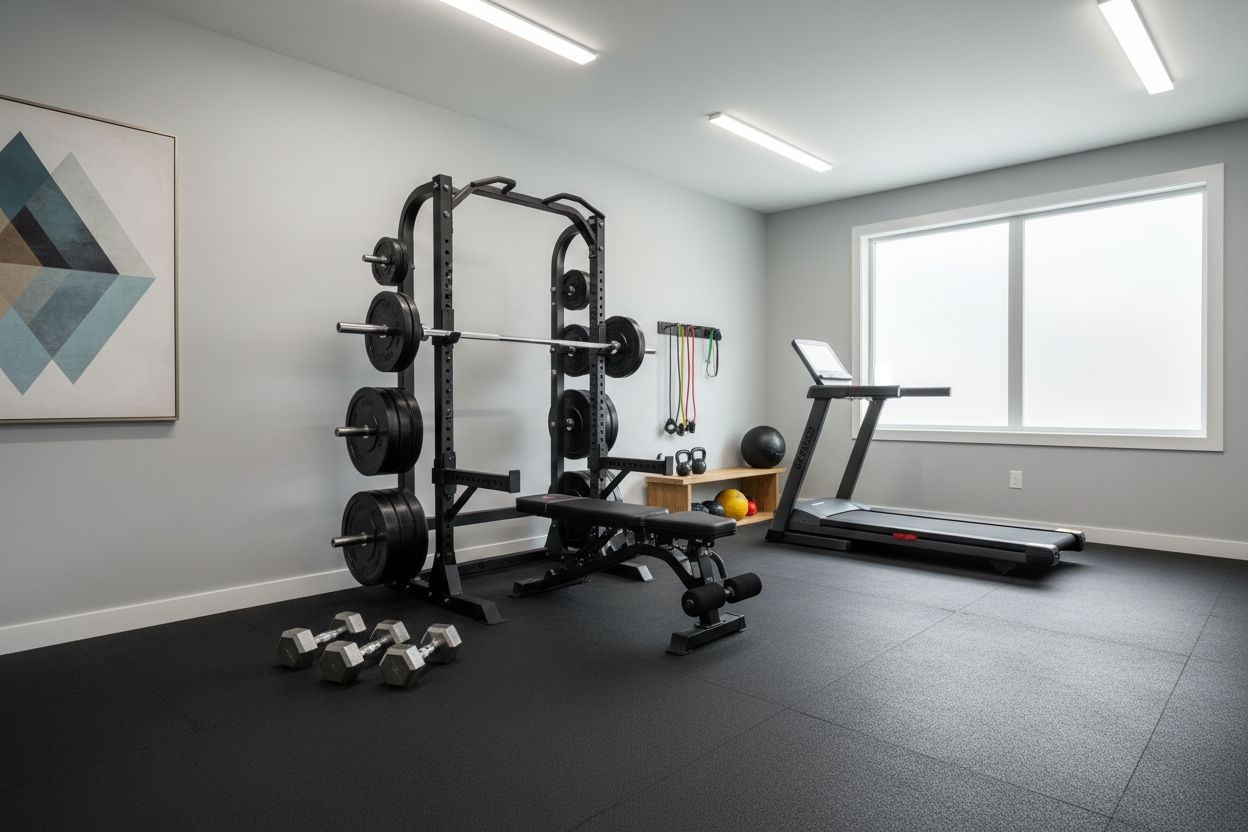
When I design garage setups for clients, they usually want the works: a rack, cables, 5-52.5 lb adjustable dumbbells, and a treadmill. But having the equipment doesn't guarantee the habit. The real killer is the belief that a workout must take an hour to be worth the effort.
This all-or-nothing mindset creates a massive barrier to entry. If you only have 20 minutes before a Zoom call, you write the day off. Weeks go by, and those expensive rubber hex dumbbells just gather dust.
By lowering the barrier to entry with a micro-workout, you trick your brain. Committing to just three movements feels manageable. Once you start moving, the friction disappears. You get the blood flowing, hit the muscles hard, and get out before mental fatigue sets in. This approach breaks the cycle of inconsistency, turning fitness into an automatic daily habit rather than a dreaded chore.
Understanding the Minimum Effective Dose
The minimum effective dose is the smallest amount of input required to produce a desired outcome. In fitness, this means finding the exact volume and intensity needed to trigger muscle protein synthesis without accumulating junk volume.
Most 60-minute routines are padded with redundant isolation exercises. Doing three variations of bicep curls might feel good, but it is highly inefficient for a home gym owner lacking commercial cable stacks. High intensity on a few heavy, multi-joint movements yields significantly better results.
When you strip away the fluff, you can push much closer to failure. If you only have three exercises on the docket, you can channel all your central nervous system energy into them. I have seen clients put an inch on their quads using nothing but heavy goblet squats and a pair of 50-pound dumbbells because they finally stopped pacing themselves for an hour-long marathon.
There is one honest downside to this approach: it can get boring. Doing the same three movement patterns requires mental focus and a willingness to embrace repetition. But if you can handle the lack of variety, the physiological payoff is massive.
The Only 3 Exercises You Need for a Complete Routine
If you strip human biomechanics down to the studs, you only need three fundamental movement patterns to stimulate every major muscle group. By combining a lower body push, an upper body push, and a posterior pull, you create a highly efficient, full-body stimulus. Honestly, these are the only 3 exercises you need to build a rugged, athletic physique in a garage or spare bedroom.
The Lower Body Push: Squat Variations
The squat is your primary driver for quad and glute development. Depending on your home setup, you can easily adapt this pattern. If you only have adjustable dumbbells, the goblet squat is fantastic. Keep the weight tucked under your chin to force your thoracic spine into extension.
If you have a half-rack and a barbell, a front squat or high-bar back squat works perfectly. For those dealing with limited weight, switch to a Bulgarian split squat. Elevating your rear foot on a bench shifts the entire load to one leg, doubling the relative intensity without requiring massive iron plates.
The Upper Body Push: Overhead or Horizontal
You need to push weight away from your center of mass. I usually have clients alternate between a horizontal push, like a flat dumbbell bench press, and a vertical push, like a strict overhead press.
If your basement ceiling height is under 7 feet, seated overhead presses or floor presses are your best friends. A weighted push-up using a 20-pound vest or a resistance band wrapped around your back is incredibly effective and requires zero heavy iron. It completely fries the pectorals and triceps while demanding intense core stabilization.
The Total Posterior Pull: Deadlifts or Rows
Most of us spend eight hours a day hunched over a keyboard. A heavy pulling motion is non-negotiable to counteract poor posture and strengthen the rhomboids, lats, hamstrings, and erector spinae.
If you have a barbell and rubber bumper plates, which keep the noise down on concrete floors, a conventional or Romanian deadlift is unmatched. If you are working with limited space and dumbbells, a heavy bent-over row is the perfect substitute. Pulling the weight toward your hip crease ensures you engage the lats rather than just shrugging with your upper traps.
Direct Core Work vs. Compound Bracing
A common question I get when prescribing these micro-routines is about abdominal training. The truth is, heavy compound movements inherently train the trunk. When you hold a 70-pound kettlebell in a goblet position or brace for a heavy Romanian deadlift, your transversus abdominis and obliques are working in overdrive to protect your spine.
For most beginners, this isometric bracing is more than enough stimulus for the core. However, if your goal is visible abdominal hypertrophy or you have specific weaknesses in your kinetic chain, adding direct isolation can be beneficial.
If you choose to add a fourth movement, keep it highly targeted. I recommend checking out specific strategies to build a bulletproof core at home. Just remember that isolation work should always happen at the very end of your session, never before your heavy compound lifts.
Programming Your Micro-Routine for Progression
Doing the same three exercises indefinitely will eventually lead to a plateau if you do not manipulate the variables. Progressive overload does not just mean adding more weight to the bar, which is crucial if your home gym maxes out at 100 pounds of total resistance.
First, play with tempo. A three-second eccentric lowering phase on a dumbbell row drastically increases time under tension. Suddenly, a 40-pound dumbbell feels like 80 pounds.
Next, manipulate your rest periods. If you normally rest 90 seconds between sets of squats, cut it down to 60 seconds. You are forcing your muscles to recover faster and perform under higher metabolic stress.
Finally, expand your rep ranges. If you stall out at 3 sets of 8 reps, push for 3 sets of 12 before you even think about buying heavier plates. This framework ensures you squeeze every drop of potential out of your existing equipment setup.
When to Expand Your Home Routine
The minimal effective dose is a tool to build consistency and baseline strength, but it isn't a life sentence. After 12 to 16 weeks of strict adherence, you might notice that your progress is stalling or you simply have more mental bandwidth to train longer.
Physiologically, if you are hitting your target rep ranges with perfect form and maximum available weight, and tempo tweaks no longer provide a challenge, it is time to expand. Psychologically, if you find yourself looking forward to workouts and craving more time under the bar, you have successfully beaten the all-or-nothing trap.
When that happens, you can graduate to a slightly larger program. A great next step is a 6 exercise workout for minimalist setups, which introduces secondary movement patterns like horizontal pulling and vertical pushing in the same session without overwhelming your schedule.
FAQ
Can I build muscle with only 3 exercises?
Yes. Muscle growth requires mechanical tension, metabolic stress, and muscle damage. As long as you push your sets close to failure and eat in a caloric surplus, a push, pull, and squat will trigger full-body hypertrophy.
How many days a week should I do this routine?
For a full-body micro-routine, 3 to 4 non-consecutive days per week is optimal. This allows for 48 hours of recovery between sessions, which is critical for muscle repair and central nervous system recovery.
Do I need a barbell for this to work?
Not at all. While a barbell allows for higher absolute loads, a pair of adjustable dumbbells or even heavy kettlebells are perfectly fine. Unilateral exercises like Bulgarian split squats make lighter weights feel incredibly heavy.