Top Home Workout Programs: A Trainer's Guide to True Progression
My phone buzzed at 6 AM last Tuesday. It was a new client, exhausted and frustrated. She had been strictly following random online HIIT videos in her living room for three months, sweating buckets every single morning, but her strength had completely plateaued. She asked me to recommend the top home workout programs to fix her routine. I had to break some hard news to her: sweating is just your body’s biological response to heat. It is not a metric of physical progression.
As a certified personal trainer who has designed and tested dozens of living room gym setups, I view digital fitness routines through a completely different lens than the average consumer. I do not care about flashy graphics, celebrity endorsements, or how sore a workout makes you the next day. I care about periodization.
If you want to actually change your body composition, build measurable strength, and avoid chronic joint pain, you need to ditch the randomized daily sweat sessions. Instead, we need to focus on structured, periodized programming that forces your body to adapt, recover, and grow.
Quick Takeaways for Evaluating Home Programs
- Look for Mesocycles: A solid program breaks training into 4-to-6-week blocks focusing on specific goals (hypertrophy, strength, peaking).
- Check for Progressive Overload: The routine should clearly explain how to increase reps, load, or time under tension week over week.
- Avoid Daily Randomness: Doing a completely different workout every day prevents your nervous system from mastering movement patterns.
- Mandatory Deloads: Quality programs schedule low-intensity recovery weeks to let your central nervous system repair.
- Floor Space Matters: You need at least a 6x6 foot clear area with dense flooring to safely execute compound lifts and plyometrics.
Why Most Digital Routines Fail the Trainer Test
Most digital fitness platforms are built on a fundamentally flawed business model: user retention through entertainment. They constantly feed you new, highly stimulating routines to keep you logging in. You get a chest-crushing pushup circuit on Monday, a brutal plyometric leg day on Tuesday, and a chaotic core-and-cardio mashup on Wednesday. You finish every session gasping for air on your living room floor, convinced you just got an incredible workout.
This is what trainers call 'exercising,' not 'training.' Exercising is just physical activity for the sake of burning calories right now. Training is a structured process designed to produce a specific physical adaptation over time. When you do random, highly fatiguing workouts every single day, you are constantly breaking down muscle tissue without giving your body a targeted reason to rebuild it stronger.
Your central nervous system (CNS) gets fried. Your joints take a beating from the repetitive impact of endless burpees and jump squats. Eventually, you hit a wall. I see this constantly with new clients who have been doing app-based WODs (Workouts of the Day) for months. They have great cardiovascular endurance, but they cannot perform a strict pushup or hold a heavy goblet squat with proper form. A program that just makes you tired is failing the basic physiological requirement of athletic programming: forced adaptation.
Defining True Progression in Top Home Workout Programs
When I evaluate the top at home workout programs, the very first thing I look for is a defined periodization structure. Periodization is simply the logical organization of training over time. It is how professional athletes train, and it is exactly how you should train in your living room.
A well-designed program will be broken down into mesocycles, typically lasting four to eight weeks. For example, Mesocycle 1 might focus on hypertrophy (building muscle size). You will be working in the 10-15 rep range, using moderate weights, and resting about 60 to 90 seconds between sets. Mesocycle 2 might shift to strength. Now, you are doing 5-8 reps with heavier loads and resting two to three minutes between sets.
Within these blocks, there must be a clear pathway for progressive overload. Progressive overload does not just mean grabbing a heavier dumbbell. It can mean adding one more rep to your floor press than you did last week. It can mean slowing down the eccentric (lowering) phase of your Bulgarian split squat to three seconds instead of dropping down quickly. It can mean reducing your rest time between circuits by 15 seconds.
The program should clearly dictate these variables. If an app just tells you to 'do as many reps as possible for 45 seconds' every single week without tracking your numbers, you have no baseline for progression. You are just guessing. Real progression requires tracking your data so you can explicitly beat your previous week's performance.
Red Flags to Avoid When Selecting a Plan
There are a few glaring warning signs that a digital routine was thrown together by a marketer rather than a strength coach. The first red flag is an infinite repetition scheme. If a program tells you to do 100 air squats or 50 pushups for time, without any instruction on form breakdown or tempo, run the other way. High-rep burnout sets usually lead to sloppy mechanics and overuse injuries, particularly in the knees and shoulders.
The second red flag is a lack of scaling options. Not everyone can jump straight into a pistol squat or a clapping pushup. The top rated at home workout programs will always provide a clear regression (an easier version) and progression (a harder version) for complex movements. If you cannot do a strict pushup, the program should guide you to incline pushups on a sturdy chair, not just tell you to drop to your knees, which alters the core mechanics of the movement.
Finally, the absence of scheduled recovery days is a massive issue. Muscle is not built during the workout; it is built during recovery. If a program demands high-intensity interval training six days a week, it is ignoring basic human physiology.
The Randomized Muscle Confusion Myth
We need to permanently retire the idea of 'muscle confusion.' Popularized by early 2000s DVD programs, this myth suggests that you need to constantly shock your muscles with new exercises so they do not adapt. Physiologically, this is nonsense.
Adaptation is exactly what we want. When you first try a new movement, like a single-leg Romanian deadlift, you will probably wobble and struggle with balance. This is because your neuromuscular system is still learning how to fire the correct motor units. It takes about three to four weeks of repeating that exact same movement for your brain to efficiently communicate with your muscles. Only after that neuromuscular adaptation occurs can you truly start loading the muscle to build strength. If you change your exercises every week to 'confuse' your body, you remain perpetually stuck in that awkward learning phase.
Foundational Gear Needed for Periodized Training
You absolutely do not need a $2,000 commercial cable machine to get strong at home. However, trying to run a structured, periodized program with just two 5-pound plastic dumbbells and a slippery yoga mat is an exercise in futility. You need a baseline of equipment that allows for scalable resistance.
For most of my clients, I recommend investing in a high-quality pair of adjustable dumbbells that range from at least 5 to 52.5 pounds. This allows you to smoothly transition from lighter isolation work (like lateral raises) to heavier compound lifts (like goblet squats and floor presses) without cluttering your room. Add a door-mounted pull-up bar and a set of variable resistance bands, and you have enough resistance to follow almost any advanced digital routine.
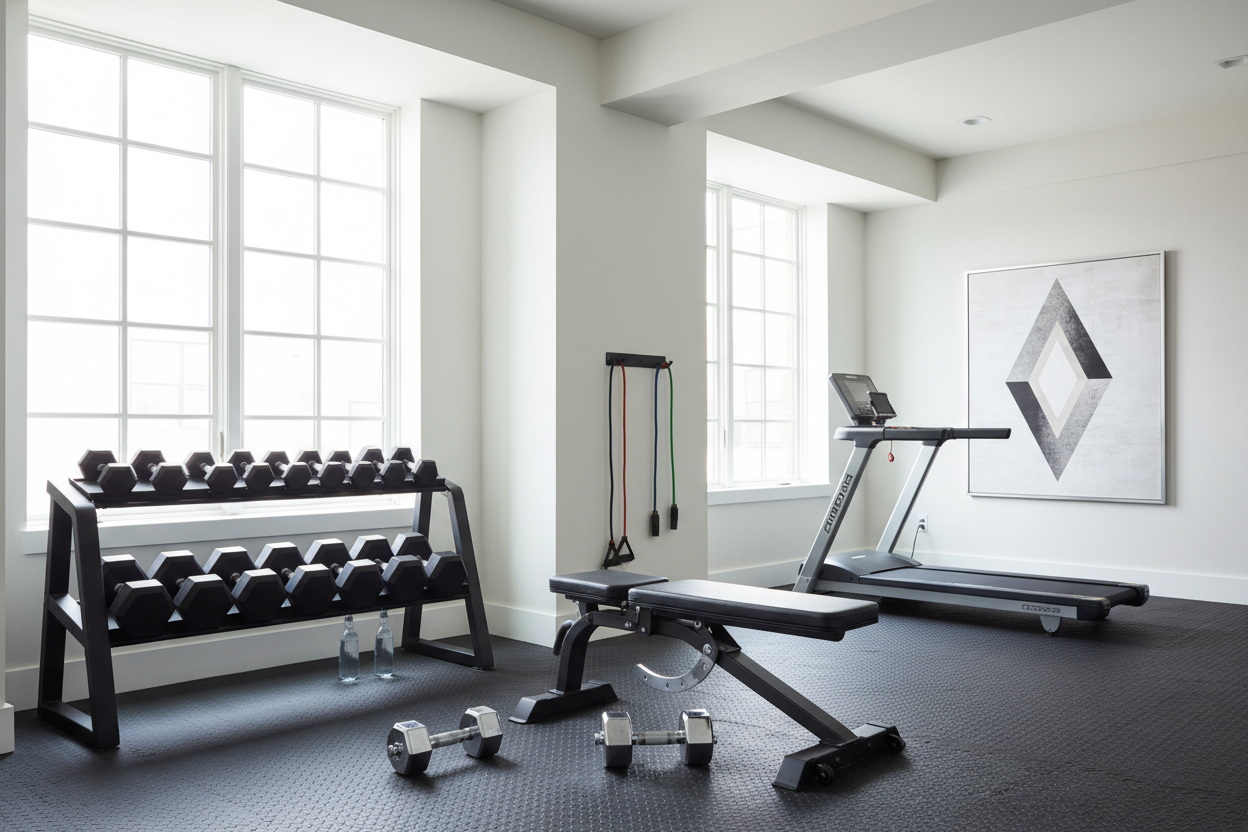
Just as important as the weights is the surface you are lifting on. Reviewing the top home workout equipment reveals that many people overlook their flooring. I once tried to test a heavy kettlebell swing routine on a standard, cheap foam mat. The mat stretched, my feet slid, and my lower back took the brunt of the instability. To safely execute heavy compound movements, you need a dense, large exercise mat for home gym use that grips the floor and provides joint protection without feeling squishy under heavy loads.
Scaling Your Environment for High-Performance Plans
As you progress through the mesocycles of a high-quality program, the demands on your body and your environment will escalate. You might move from static lunges in week one to dynamic lateral skater jumps in week eight. Your physical space needs to be able to handle that shift.
Clear a dedicated footprint. I have found that a 6x8 foot area is the absolute sweet spot for a home setup. It provides enough lateral space for agility work and enough length for walking lunges or burpees. Laying down a heavy-duty 6x8ft exercise mat over this area defines your workout zone and protects your subfloor from dropped dumbbells. It also drastically reduces noise transfer if you live in an upper-level apartment.
As your strength peaks, you will need to find creative ways to enhance your at home workout routine without buying an entire rack of heavier dumbbells. This is where you can start combining equipment. Looping a heavy resistance band over your shoulders while holding your adjustable dumbbells can add an extra 30 pounds of tension at the top of a squat, allowing you to continue progressive overload even when you have maxed out your free weights.
Commit to the Process, Not Just the Sweat
The hardest part of following a periodized home program is trusting the boring phases. The first two weeks of a new mesocycle might feel too easy. The deload week will definitely feel like you aren't doing enough. Resist the urge to go off-script and add random cardio circuits just to feel exhausted.
Pick one top rated program that aligns with your goals, gather your essential gear, set up a safe lifting space, and commit to the entire 8 to 12-week block. True physiological change happens slowly, quietly, and methodically. Track your reps, respect your rest days, and let the structured programming do its job.
Frequently Asked Questions
How long should a home workout program last?
A well-structured program should last between 8 to 12 weeks. This provides enough time to cycle through hypertrophy, strength, and peaking phases, allowing your body to properly adapt to the stimulus before you switch to a new routine.
Can I build muscle at home without heavy barbells?
Yes. Muscle growth (hypertrophy) is driven by mechanical tension, metabolic stress, and muscle damage. You can achieve this using adjustable dumbbells, resistance bands, and bodyweight exercises by manipulating tempo, increasing time under tension, and pushing sets close to muscular failure.
What if I miss a day in my structured program?
Do not panic and try to cram two workouts into one day. Simply pick up where you left off. If you miss a Tuesday lower-body session, do it on Wednesday. Structured periodization is about the cumulative volume over weeks and months, not a perfectly rigid 7-day calendar.