The Brutal Reality of Trying to Exercise From Home on Hard Floors
I remember the first time I tried a high-intensity session in my living room. I moved the coffee table, threw down a thin towel, and started banging out burpees on the oak hardwood. Within ten minutes, my shins were screaming and my downstairs neighbor was pounding on the ceiling with a broomstick. It was a disaster.
We have all been there—scrolling through equipment reviews at midnight, trying to figure out how to exercise from home without destroying our property or our patellar tendons. Most people focus on the weights or the bike, but they completely ignore the one thing they interact with every single second: the floor.
- Hardwood and tile offer zero shock absorption, leading to joint inflammation.
- Standard yoga mats are too thin for dynamic movements and high-impact loading.
- A dedicated 6x8ft footprint is the minimum space required for safe lateral movement.
- Permanent setups reduce the 'friction' of starting a workout, leading to better consistency.
The Hardwood Problem: Why Your Joints Hate Your Living Room
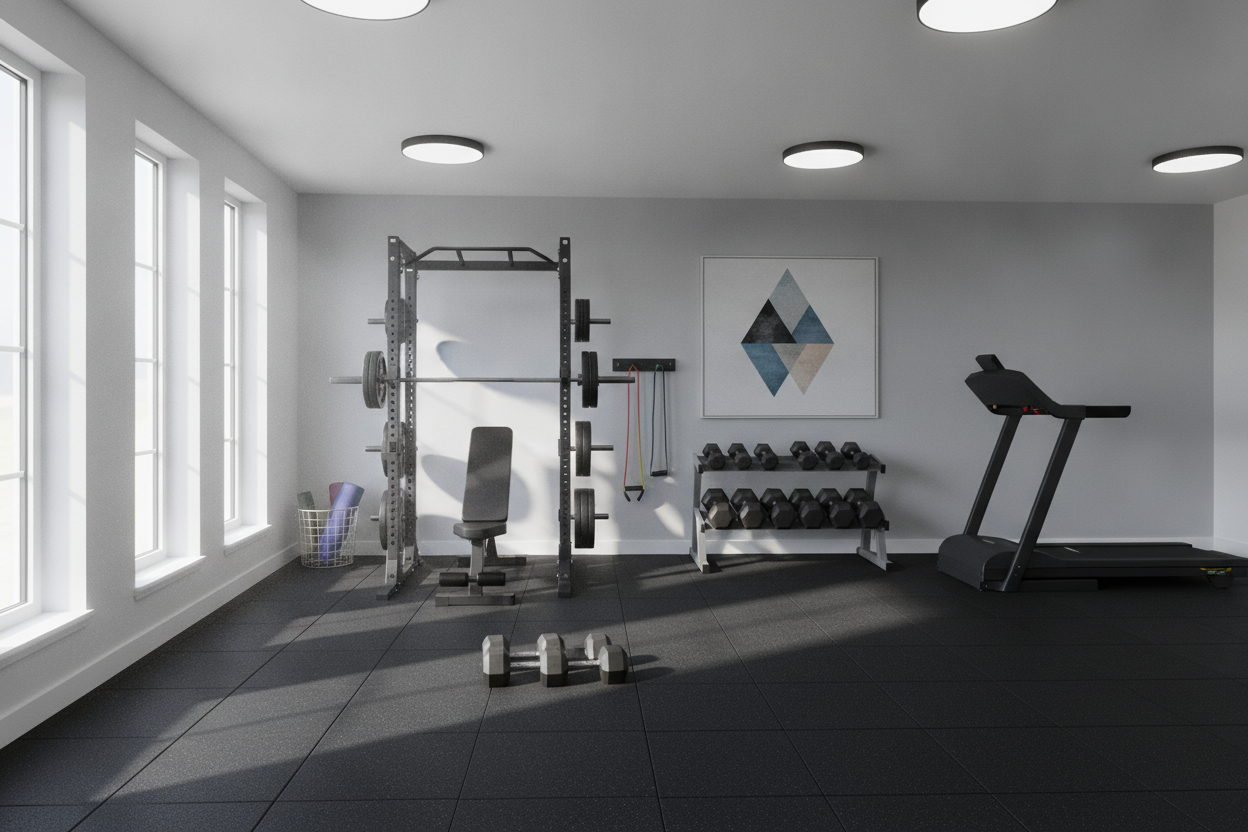
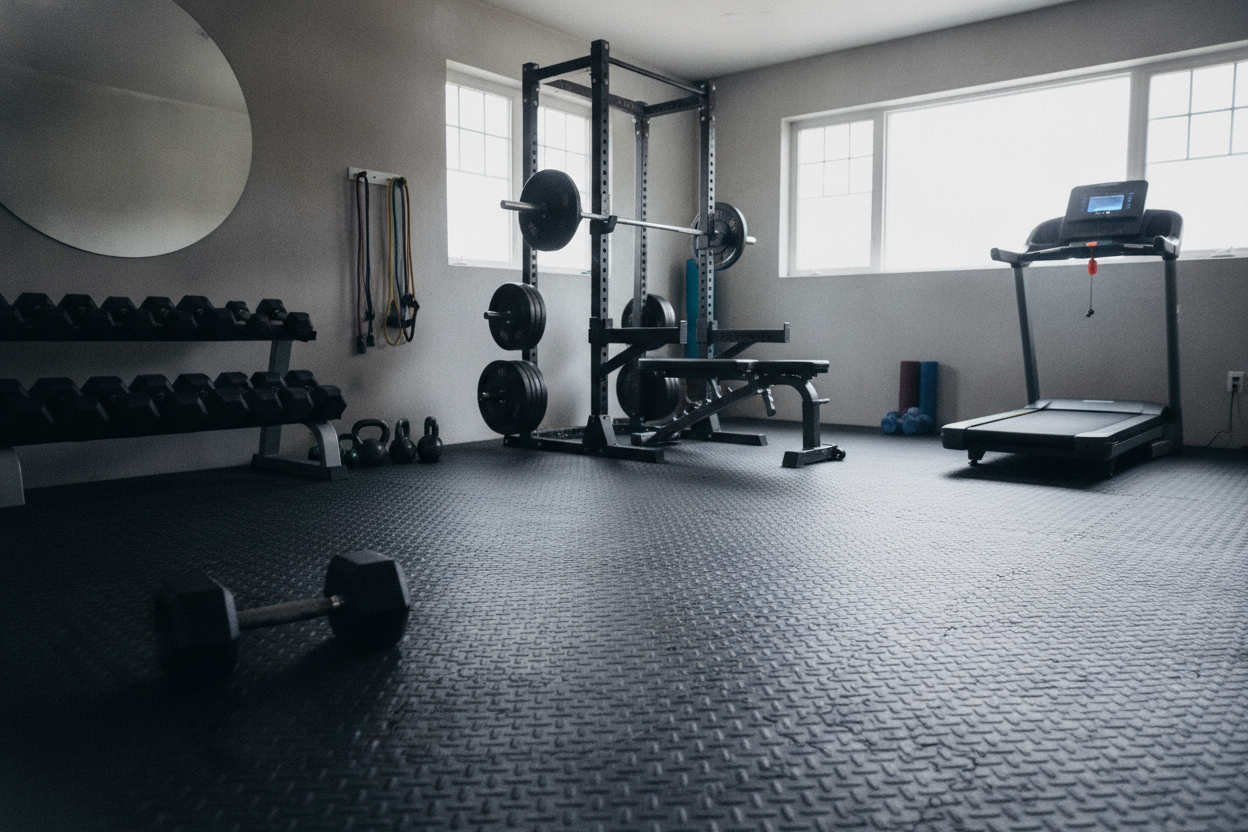
Commercial gyms are built like bunkers. Underneath that black rubber is usually a specialized sub-flooring system or high-density concrete designed to take a beating. Your living room? It is likely hardwood or laminate over plywood joists. There is a reason your knees feel like they are being hit with a hammer every time you land a jump.
When you perform high-impact movements on bare floors, the kinetic energy has nowhere to go but right back up into your ankles, knees, and lower back. Over a few weeks, this cumulative stress leads to 'mystery' aches that kill your motivation. If you want to exercise from home without wrecking your joints, you have to stop treating your residential floor like it has the structural integrity of a CrossFit box.
Why Flimsy Yoga Mats Fail for Fit Exercises at Home
I see this mistake constantly. Someone decides to get serious about their health, buys a pair of 25-lb dumbbells, and tries to use a 3mm yoga mat as their gym floor. It does not work. Yoga mats are designed for static grip and light stretching; they are not built for the shear force of a lateral lunge or the impact of a heavy kettlebell being set down.
If your mat is sliding across the floor while you are trying to do mountain climbers, you are asking for a groin strain. You need something with weight and a non-slip backing that stays put. When you transition from basic stretching to fit exercises at home, you need to look into a large exercise mat for home gym use. These are typically 7mm thick or more and made from high-density PVC that won't bottom out when you drop into a plank.
The 'Commercial Feel' Fix: Upgrading Your Footprint
If you are tired of feeling like you are exercising in a hallway, you need to claim a territory. A 'footprint' is your dedicated training zone. In my experience, a 4x6ft space is the absolute minimum, but it always feels cramped. You end up stepping off the mat mid-set, which is a great way to roll an ankle on the edge of the rubber.
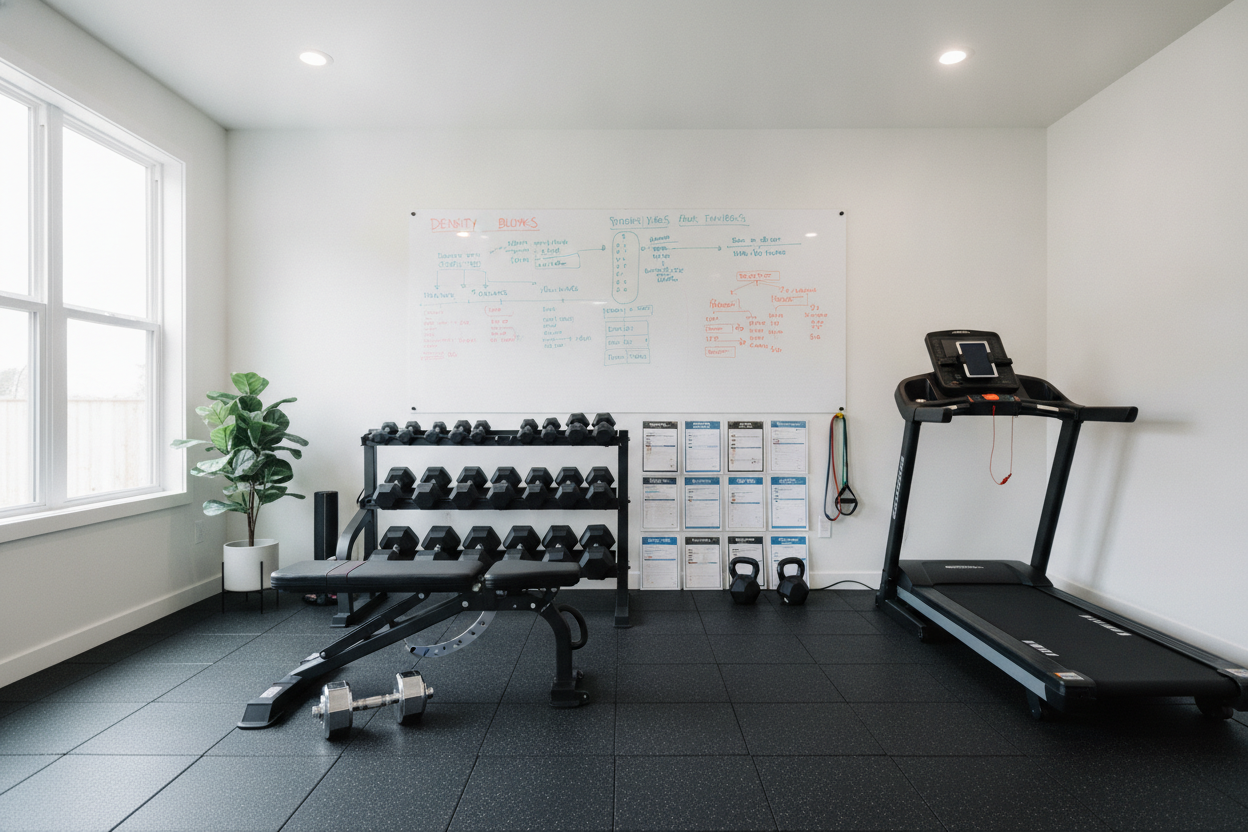
I personally recommend a 6x8ft exercise mat. This size gives you enough room to move laterally, sprawl out for burpees, and keep your weights on the protected surface. It creates a 'zone' that feels like a real gym. The density matters too—you want something that feels firm underfoot, not squishy like a marshmallow. If it is too soft, your balance will suffer during heavy overhead presses.
Mobility Without Misery: Fixing Your Pre-Workout Routine
Nobody likes doing mobility work. It is boring, it takes time, and if you are doing it on a hard floor, it is physically painful. I used to skip my hip openers because kneeling on my tile floor felt like kneeling on a pile of LEGOs. Once I put down a proper foundation, that excuse vanished.
When you have a surface that actually supports your body, you are much more likely to spend those ten minutes exercise in the home on the 'boring' stuff like foam rolling or a stretching workout at home. It turns the floor from an enemy into a tool. If your knees don't hurt, you will actually stay down there long enough to fix your tight hip flexors.
Stop Tearing Down Your Setup Every Single Day
The biggest killer of home workouts isn't a lack of equipment; it is friction. If you have to move the couch, unroll a mat, and hunt for your weights every single morning, you are going to quit. I spent years rolling and unrolling mats until I realized it was a psychological barrier.
If you can, leave your mat out. Make it a permanent fixture of the room. When the mat is already there, the mental hurdle of starting the workout is gone. You just step on and go. It signals to your brain that this space is for work, not just for watching Netflix. Consistency is built on making the right choices easy, and a permanent, high-quality floor setup is the easiest win you can get.
My Personal Experience: The Cracked Tile Incident
I learned the hard way about floor protection. I was doing 50-lb kettlebell swings in a rental apartment with a 'premium' thin yoga mat. I finished a set, set the bell down a little too hard, and heard a sickening 'crack.' I had shattered a ceramic tile right through the mat. It cost me my security deposit. Since then, I don't train on anything less than 7mm of high-density rubber or PVC. It is cheaper to buy a good mat than it is to replace a floor.
FAQ
Can I just use interlocking foam tiles?
You can, but I wouldn't. Those cheap 'puzzle' mats tend to pull apart during lateral movements like skaters or lunges. They also compress permanently under heavy weights. A single-piece solid mat is always the better investment for stability.
How do I stop my mat from sliding on hardwood?
Look for mats with a grooved or 'circle' grip pattern on the bottom. Weight also helps—a heavy 20-lb mat stays in place much better than a 3-lb foam mat. If it still moves, a small piece of rug tape in the corners works wonders.
Is 7mm thick enough for heavy weights?
For dumbbells and kettlebells up to about 50 lbs, 7mm of high-density material is usually the sweet spot. If you are doing heavy Olympic lifting with a barbell, you really need 3/4 inch stall mats, but those are overkill (and too smelly) for most living rooms.