The 3 Muscle Ratios You Actually Need for a Good Physique
I remember the morning I hit 225 pounds on the scale. I’d spent two years eating everything that wasn’t bolted down and chasing a 405-pound squat in my drafty garage. I thought I’d finally arrived. Then I saw a video my wife took of me doing rows from the side. I didn’t look like an athlete; I looked like a refrigerator with a beard. My waist was thick, my shoulders looked narrow by comparison, and my 'bulk' was just a blurry mess of mass.
Quick Takeaways
- Visual appeal is about the ratio of your shoulders to your waist, not your total body weight.
- Prioritizing the upper chest (the 'shelf') creates a better look in clothing than chasing a max flat bench.
- Building the 'quad sweep' provides a powerful lower body without thickening the midsection like heavy low-bar squats.
- Stable flooring is a non-negotiable for the heavy overhead and rowing movements that build these ratios.
The Difference Between Being Big and Looking Aesthetic
Most of us start our home gym journey with one goal: get big. We buy the 300-lb Olympic set, we start a linear progression program, and we drink a gallon of milk a day. But there is a massive difference between being a high-mass human and having a good physique. If you only focus on the big three lifts (squat, bench, deadlift), you risk developing a 'blocky' look. Powerlifting builds incredible strength, but it also thickens the obliques and the spinal erectors, which can actually make your waist look wider.
Building a great physique requires a shift in mindset from 'how much do I weigh?' to 'how do I look in a mirror?' This isn't vanity; it's geometry. You want to create an optical illusion. A 32-inch waist looks tiny if your shoulders are wide, but it looks average if your back is narrow. I’ve seen guys at 170 pounds who look more impressive than guys at 210 pounds simply because they understood how to get a good physique through proportion. Stop obsessing over the scale and start looking at the silhouette you're casting against your gym wall.
Ratio 1: The Shoulder-to-Waist Illusion
The single most important factor in how to get a great physique is the V-taper. This is the ratio between the width of your shoulders and the narrowness of your waist. To achieve this, you need to stop treating lateral raises like an afterthought. I used to do three sets of side raises at the end of my workout if I had time. Now, I prioritize them. Your lateral deltoids are the 'caps' that create width. If you want to know how to get a nice physique, you need to hammer the side delts and the lats.
Wide lats act like wings that pull the eyes upward and away from the midsection. This is why pull-ups and heavy rows are your best friends. The beauty of this ratio is that it makes you look leaner than you actually are. If you widen your frame by an inch on each side through delt and lat hypertrophy, your waist looks two inches smaller by comparison. This is the secret to building physiques that look 'superhero' rather than 'strongman.' I personally found that switching from a narrow grip to a slightly wider-than-shoulder grip on my pull-ups made a noticeable difference in my lat flare within six months.
Ratio 2: Building the 'Shelf' Up Top
We’ve all seen the guy with huge lower pecs that look like 'man boobs.' That happens when you spend years doing nothing but flat bench and dips. If you want to know how to have a good physique, you have to prioritize the clavicular head—the upper chest. This is the muscle that fills out the space just below your collarbone. It’s what creates that 'shelf' look that makes you look fit even in a loose-fitting t-shirt.
I stopped doing flat bench as my primary mover and switched to a 15-degree or 30-degree incline. There are proven ways to build a bigger upper chest, and almost all of them involve high-volume incline pressing and low-to-high cable flies. When you fill out the upper chest, it pulls the skin upward and creates a tighter, more athletic appearance. You should be looking for chest workouts to build a shredded physique that emphasize the incline over the decline. Trust me, nobody ever complained that their upper chest was 'too big,' but plenty of lifters regret the blocky, bottom-heavy chest look that comes from over-specializing in the flat press.
Ratio 3: The Leg Sweep Without the Blocky Hips
Leg day is usually a battle of wills, but how to build a physique that looks balanced requires some nuance in your leg training. Many home lifters stick to low-bar powerlifting squats because they can move the most weight that way. The problem? Low-bar squats are very hip-dominant. They build massive glutes and adductors, which can actually make your hips look wider and ruin your V-taper. If your goal is a good body physique, you want to focus on the 'quad sweep'—the vastus lateralis on the outside of the thigh.
To get that sweep, I started incorporating high-bar squats with a narrower stance and Bulgarian split squats. These movements put more tension on the quads and less on the hips and lower back. You want your legs to look like powerful pillars, not tree trunks that blend into your torso. By focusing on the outer quad, you create a shape that tapers down to the knee, which complements the taper of your upper body. It’s a subtle shift, but it’s the difference between looking like you have a nice physique and just looking like you have 'heavy legs.'
Why Your Floor Matters for Overhead Proportion Lifts
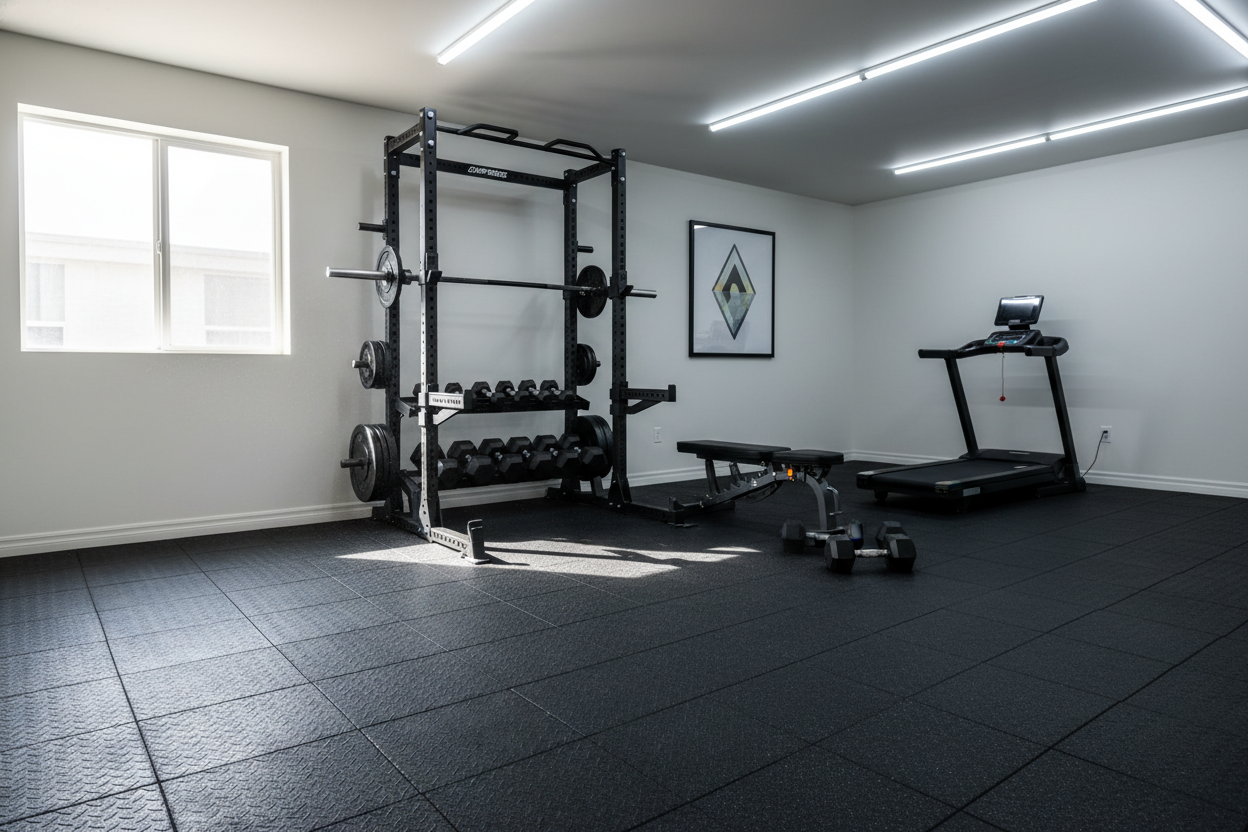
You can’t build a great physique if you’re constantly fighting for balance. To hit those lateral delts and lats, you’re going to be doing a lot of standing overhead presses and heavy bent-over rows. If you’re training on bare concrete or cheap, squishy foam tiles from a big-box store, you’re leaving gains on the table. When I’m pressing 155 pounds over my head, the last thing I want is my feet shifting. You need a large exercise mat for home gym use that provides a high-friction, high-density surface.
I learned this the hard way when I tried to do heavy rows on a cheap yoga mat and nearly blew out my back when the mat slid forward. For a proper setup, a 6x8ft exercise mat is the ideal size. It’s large enough to fit under a power rack or provide a dedicated 'landing zone' for your dumbbells. Having a stable, non-slip base allows you to actually focus on the mind-muscle connection—squeezing the lats or the delts—rather than just trying not to fall over. A solid floor is the foundation of how to build a good physique safely.
Stop Overthinking: How to Program for Proportions Today
If you want to know how to get a better physique, you need to audit your current program. Look at your volume. Are you doing 12 sets of flat bench and zero sets of incline? Are you doing 10 sets of squats and zero sets of lateral raises? To improve physique, you need to reallocate that 'junk volume' toward the muscles that actually change your shape.
Start by moving your incline press to the beginning of your chest day. Add three sets of lateral raises every single time you step into the gym—the delts can handle the frequency. Swap one of your heavy squat sessions for lunges or high-bar squats to target that quad sweep. Building a physique is a marathon, not a sprint, but you might as well run in the right direction. When someone eventually tells you, 'your physique is amazing,' it won’t be because you hit a specific number on the scale; it’ll be because you mastered the ratios.
Personal Experience: My 'Fridge' Phase
I spent an entire winter 'permabulking' to hit a 315-lb bench press. I got the number, but I also got a double chin and lost all my shoulder definition. I looked like a different person, and not in a good way. My 'gym physique' was just... thick. It took me six months of targeted cutting and a complete overhaul of my training—focusing on the upper chest and side delts—to actually look like I lifted weights again. Don't make my mistake. Don't sacrifice your shape for a number that only other gym nerds care about.
FAQ
What is a good physique?
A good physique is generally defined by symmetry and proportion, specifically a wide shoulder-to-waist ratio (the V-taper) and well-developed muscles that don't look 'blocky' or unbalanced.
How to build a great physique at home?
Focus on high-leverage movements: incline presses for the upper chest, lateral raises for shoulder width, pull-ups for lat flare, and high-bar squats or lunges for quad sweep. Ensure you have a stable floor and quality weights.
How to get good physique results quickly?
You can't rush muscle growth, but you can create the illusion of a better body quickly by losing body fat to narrow the waist and increasing the frequency of side delt and lat work to widen the upper body.