
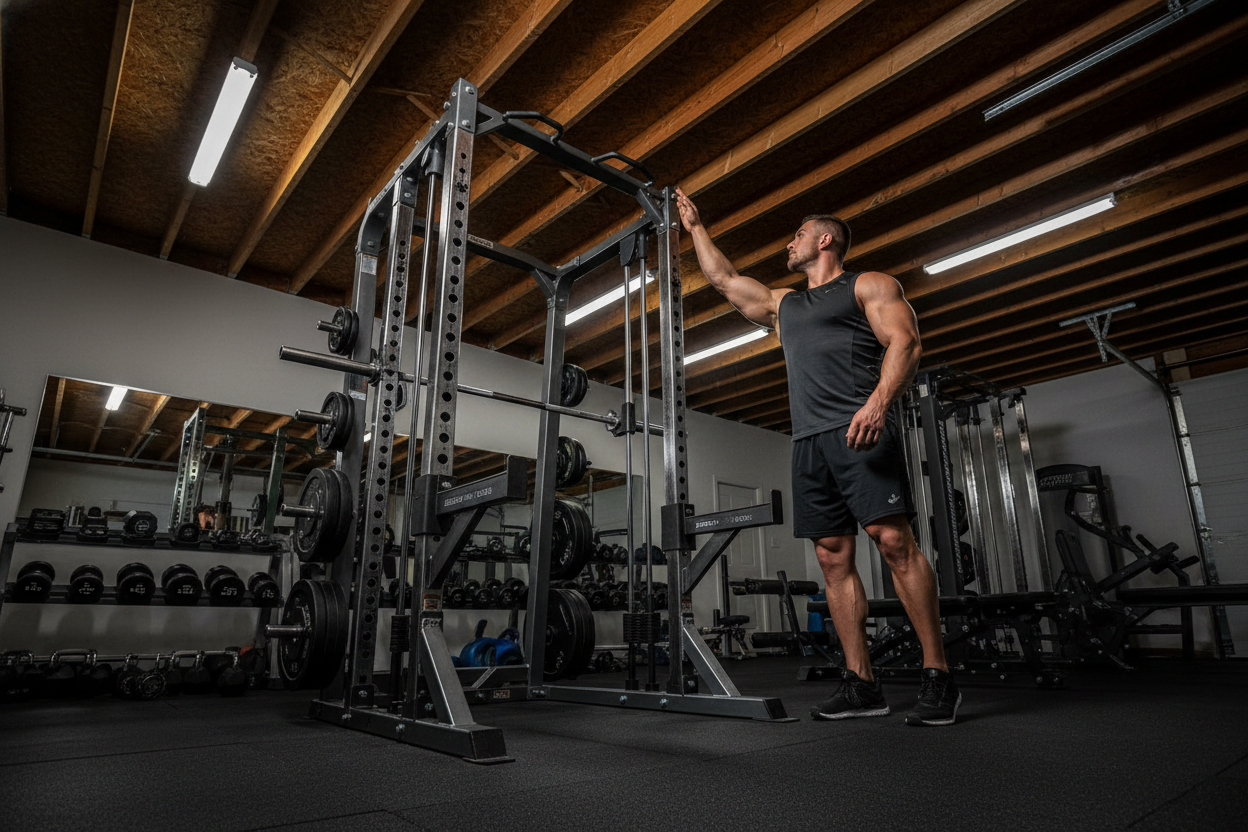
Smith Machine Height: The Definitive Home Gym Guide
You have measured your floor space twice. You have taped out the footprint on your garage mat. But have you seriously considered the vertical constraints? The smith machine height is often the single specification that forces home gym owners to return thousands of dollars in freight-delivered steel.
It is not just about whether the unit physically fits under your roof. It is about assembly clearance, pull-up bar functionality, and whether the guide rods will puncture your drywall when you try to tip the unit upright. If you are training in a basement or a garage with low rafters, verticality is your biggest adversary.
Quick Summary: Dimensions at a Glance
- Standard Height Range: Most Smith machines stand between 80 and 86 inches (approx. 6'8" to 7'2").
- Residential vs. Commercial: Home models are often shorter (around 80-83 inches) to fit standard 7-foot doors and ceilings.
- Clearance Rule: You need at least 2-4 inches of clearance above the machine for assembly and pull-up movements.
- The Tall User Problem: If the machine is under 80 inches, users over 6'0" may struggle to perform standing overhead presses inside the cage.
Understanding Standard Dimensions
When people ask, "how tall is a smith machine," the answer isn't a single number because manufacturers cater to different environments. However, the industry standard generally hovers around 84 inches (7 feet).
Why this specific height? It is a function of biomechanics and physics. The guide rods need enough length to allow for a full range of motion during a squat or an overhead press. If the rods are too short, the linear bearings or carriage will slam into the top frame before your arms are fully extended. Conversely, if they are too tall, the structural integrity can suffer without using thicker, more expensive steel gauges.
Residential vs. Commercial Height Profiles
There is a distinct split in the market that you need to be aware of before clicking "buy."
The Residential Profile (80" - 83")
Brands designing for home use (like Marcy or lower-tier Titan Fitness models) often cap their height at roughly 83 inches. They do this intentionally so the equipment can fit into a standard room with an 8-foot ceiling, leaving plenty of room for pull-ups.
The Commercial Profile (84" - 90"+)
Commercial units found in public gyms are beasts. They often exceed 90 inches, especially if they include a counter-balance system. Counter-balanced Smith machines have pulleys and weights hidden inside the uprights or behind the unit, requiring extra vertical housing. Do not buy a commercial-grade unit for a basement gym without measuring the absolute highest point of the pulley system.
The "Hidden" Height Factors
The spec sheet might say the machine is 84 inches tall, but that number can be deceiving. You need to look for protrusions that extend beyond the frame.
The Pull-Up Bar Arc: Many modern Smith machines are actually "functional trainers" or power rack hybrids. They often feature multi-grip pull-up bars that arch above the main frame. This can add 2 to 5 inches to the total height.
Guide Rod Clearance: On some older or specific heavy-duty models, the solid steel guide rods actually poke through the top of the frame. If you have a finished ceiling, you need to account for these metal spikes.
How to Measure Your Space Correctly
Don't just take a tape measure to the wall. Floors are rarely perfectly level, and ceilings often sag. Here is the protocol for ensuring a fit:
- Find the Lowest Point: Identify any ductwork, garage door openers, or light fixtures. If the Smith machine sits under a garage door rail, that is your hard limit, not the ceiling.
- The Assembly Buffer: This is where most people fail. Many machines require you to assemble the main uprights flat on the ground and then tip them up. The diagonal height of a rectangular frame is taller than its vertical height. If you have exactly 85 inches of ceiling for an 84-inch machine, you cannot tip it up. You will have to assemble it vertically, which is a two-person, ladder-balancing nightmare.
My Training Log: Real Talk
I learned the hard way about "functional height" when I installed a generic plate-loaded Smith machine in my previous garage gym. On paper, the machine was 83 inches. My rafters were at 86 inches. Perfect fit, right?
Wrong. I didn't account for the motion of my own body. The machine fit physically, but the pull-up bar was flush with the top crossbeam. Every time I went for a chin-up, my head was dangerously close to a rusty nail protruding from a rafter. I had to permanently shift my grip to a wide, uncomfortable angle just to avoid concussing myself on the ceiling joists.
Even worse was the overhead press. I'm 6'1". Inside the cage, with the bar unracked, a full lockout put the plates within an inch of the top frame. It created this psychological hesitation where I'd subconsciously soften my lockout because I was afraid of clanging the top. If you are tall, or have long arms, that 80-83 inch residential standard might actually hinder your gains simply because you run out of track.
Conclusion
The height of your Smith machine dictates more than just fit; it dictates function. If you are tight on space, look for residential models around the 80-inch mark, but verify that the internal working space allows for your full range of motion. Measure your lowest ceiling obstruction, subtract 4 inches for assembly clearance, and you will save yourself a massive headache on delivery day.
Frequently Asked Questions
What is the minimum ceiling height for a Smith machine?
Ideally, you want a ceiling height of at least 7 feet (84 inches) for compact residential models. For standard models, an 8-foot ceiling (96 inches) is recommended to allow clearance for pull-ups and assembly.
Can I cut down a Smith machine to fit my basement?
Technically yes, but it is highly inadvisable. Cutting the frame voids the warranty and compromises structural integrity. More importantly, you would have to cut the hardened steel guide rods perfectly straight; any burrs or unevenness will destroy the linear bearings, making the movement jagged and dangerous.
Does the height of the machine affect the weight capacity?
Generally, no. The weight capacity is determined by the gauge of the steel and the quality of the bearings or bushings. However, taller commercial machines often use heavier steel (11-gauge) to prevent wobbling at the top, which inherently gives them a higher load rating.


