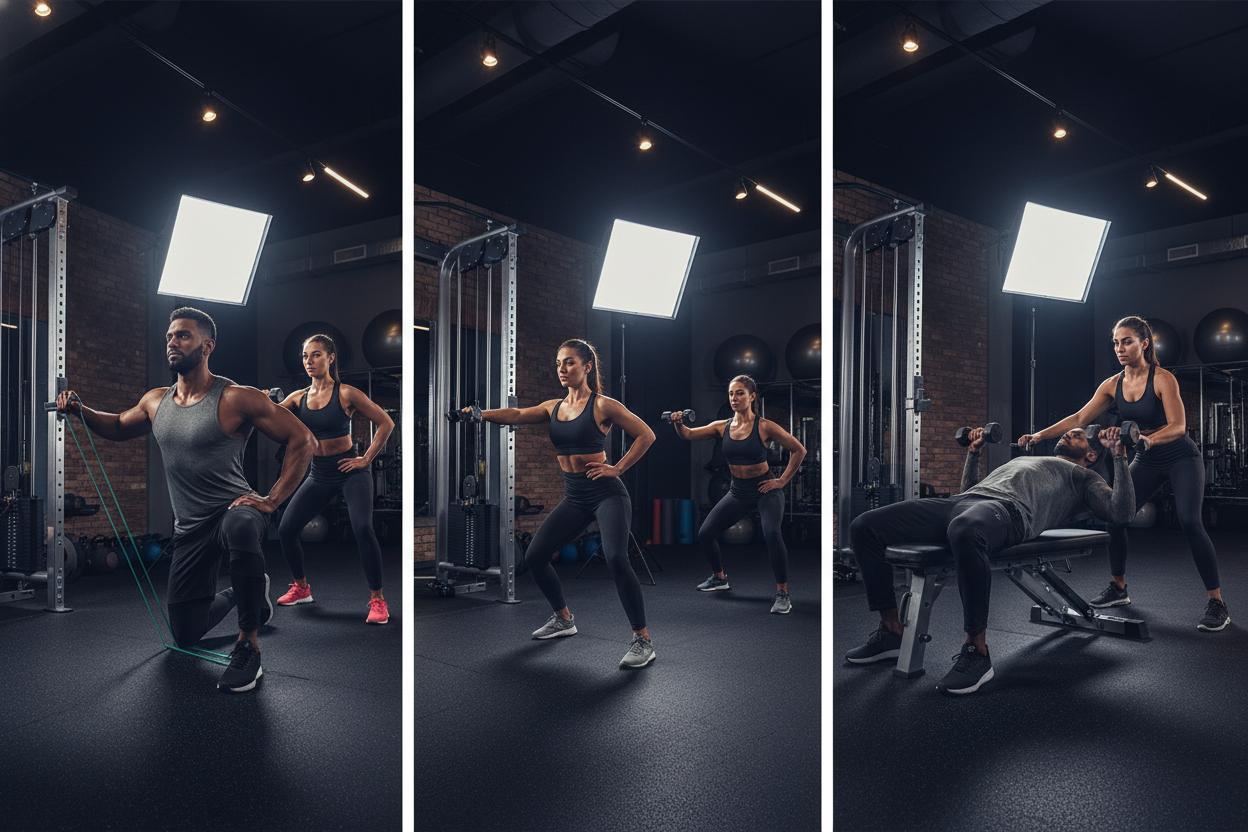
Rotator Cuff Exercises: The Visual Guide for Pain-Free Shoulders
Shoulder pain is a ghost that haunts the gym. One day you are pressing heavy, and the next, lifting a coffee cup feels like a chore. The problem often isn't lack of effort; it's lack of precision. When you look for pictures of rotator cuff exercises, you are usually trying to bridge the gap between a vague description and the exact biomechanics required to heal or strengthen the shoulder complex.
Understanding the visual nuance of these movements is critical. A shift of an inch in elbow position can move the load from the targeted stabilizer muscles to the dominant deltoids, rendering the rehab useless. This guide breaks down exactly what correct form looks and feels like.
Quick Summary: Visual Cues for Success
If you are skimming for the essentials, here are the core visual checkpoints you must hit during these movements:
- The Towel Trick: Always visualize (or use) a rolled-up towel between your elbow and ribcage to prevent arm flaring.
- Scapular Depression: Visually check in a mirror that your shoulders are not shrugging up toward your ears.
- Thumb Position: In lifting movements (scaption), keep thumbs pointing up to clear the subacromial space.
- The 30-Degree Plane: Never lift strictly to the side (90 degrees); move arms forward slightly into the scapular plane.
Why Static Images Aren't Enough
Searching for rotator cuff exercises images often yields 2D line drawings that miss the depth of the movement. The rotator cuff is a group of four small muscles (supraspinatus, infraspinatus, teres minor, subscapularis) that work to pull the head of the humerus into the socket.
When you look at a picture, you might see a person simply moving their arm out. What the picture misses is the tension. You need to visualize the shoulder blade acting as an anchor. If the anchor moves, the cannon (your arm) cannot fire accurately.
Visualizing the Essential Movements
Since we are focusing on form, let's break down the mental pictures you need to replicate perfect mechanics.
1. Side-Lying External Rotation
This is the gold standard for the infraspinatus. When analyzing rotator cuff exercises pictures for this movement, look at the elbow.
The Visual Cue: Lie on your side. Your elbow should be pinned to your side at a 90-degree angle. Imagine there is a rod running through your upper arm, pinning it to your torso. The only movement is the forearm rotating upward like a hinge.
Common Error: Lifting the elbow off the hip. This turns the move into a deltoid fly, which defeats the purpose.
2. The "Full Can" (Scaption)
Many old-school diagrams show the "Empty Can" (thumbs down) movement. Modern physical therapy largely rejects this as it increases impingement risk.
The Visual Cue: Stand with dumbbells. Raise your arms at a 45-degree angle (halfway between front and side). Thumbs must point to the ceiling. Visualizing holding a full can of soda that you don't want to spill keeps the shoulder joint open and safe.
3. Doorway Stretch and Isometric Press
Sometimes the best exercise is static. Isometrics build strength without grinding the joint.
The Visual Cue: Stand in a doorway. Bend your elbow 90 degrees. Press the back of your wrist into the door frame. Your body shouldn't move. You are visualizing pushing the wall down, engaging the muscles on the back of the shoulder blade without any actual motion occurring.
My Personal Experience with pictures of rotator cuff exercises
I have spent years navigating shoulder injuries, from impingement to partial tears. I remember vividly searching for diagrams online, trying to figure out why my external rotations hurt more after doing them.
The turning point wasn't finding a better diagram; it was realizing what the pictures didn't show. I recall using a yellow TheraBand tied to a squat rack. I felt a constant, annoying "click" in my front delt every time I pulled back. I realized that even though my form matched the pictures perfectly, my scapula was tilting forward.
I had to physically poke my own trap muscle with my free hand to ensure it was soft and relaxed. The grit of rehab isn't in the heavy lifting; it's in the boring, high-rep sets with a 2-pound pink dumbbell where your ego takes a hit, but your stabilizer muscles finally wake up. That specific burning sensation deep under the rear delt—not the superficial burn of a pump—is the only indicator that you're actually hitting the cuff.
Conclusion
Building a bulletproof shoulder isn't about heavy weight; it is about precise geometry. Use these descriptions to correct your form. If you look in the mirror and your form doesn't match the strict biomechanics described here, drop the weight and reset. Your shoulders will thank you for the precision.
Frequently Asked Questions
How often should I perform rotator cuff exercises?
Because these are endurance muscles, they respond well to frequency. You can perform these exercises 3 to 4 times a week. However, keep the volume manageable—usually 2 to 3 sets of 15 to 20 repetitions.
Should I feel pain during these exercises?
No. A muscle "burn" or fatigue is acceptable and expected. Sharp, shooting pain or a pinching sensation means you are likely impinging the tendon. Stop immediately, check your form against the visual cues above, or reduce the range of motion.
Why do most rotator cuff exercises pictures show light weights?
The rotator cuff muscles are small stabilizers, not power generators. If you use heavy weights, the larger muscles (deltoids, pecs, traps) take over to protect the joint. To isolate the cuff, you must use light resistance—often 2 to 5 pounds is sufficient for most adults.