Life Fitness Cable Machine Exercises Most Lifters Ignore
If you have hit a wall in your strength training or find that free weights are aggravating old joint injuries, you are not alone. Many home gym owners eventually seek out equipment that offers smoother resistance and endless versatility without taking up the entire garage. Enter the dual adjustable pulley system.
Mastering the right life fitness cable machine exercises can completely redefine how you train at home. Unlike dumbbells or barbells, cables provide constant tension throughout the entire range of motion, forcing your muscles to work harder while sparing your joints. In this guide, we will break down the mechanics, setups, and specific movements you need to maximize your investment.
Key Takeaways
- Cables provide continuous time-under-tension, optimizing hypertrophy and joint health.
- A single dual-pulley system replaces dozens of single-station machines, saving valuable floor space.
- Proper pulley height and attachment selection dictate the exact muscle fibers targeted.
- Integrating compound and isolation cable movements prevents training plateaus.
Designing Your Training Protocol
Why Constant Tension Matters
When you perform standard free weight movements, gravity dictates the resistance curve. There are resting phases at the top and bottom of most lifts. Cable systems eliminate this. By keeping the weight stack suspended, your muscles endure mechanical tension from the first inch of the pull to the very end. This makes targeted life fitness cable machine workouts incredibly efficient for both muscle growth and mind-muscle connection.
Adapting for Space and Flow
If you are setting this equipment up in a basement or garage, space is a premium. Life Fitness models typically require a footprint of about 44 by 62 inches, but you need an additional 3 to 4 feet of clearance in front for lunges, walkouts, and chest presses. Plan your floor layout so you can easily transition between high-pulley and low-pulley exercises without moving other benches or racks out of the way.
Essential Movements for Full-Body Development
Upper Body: Chest, Back, and Arms
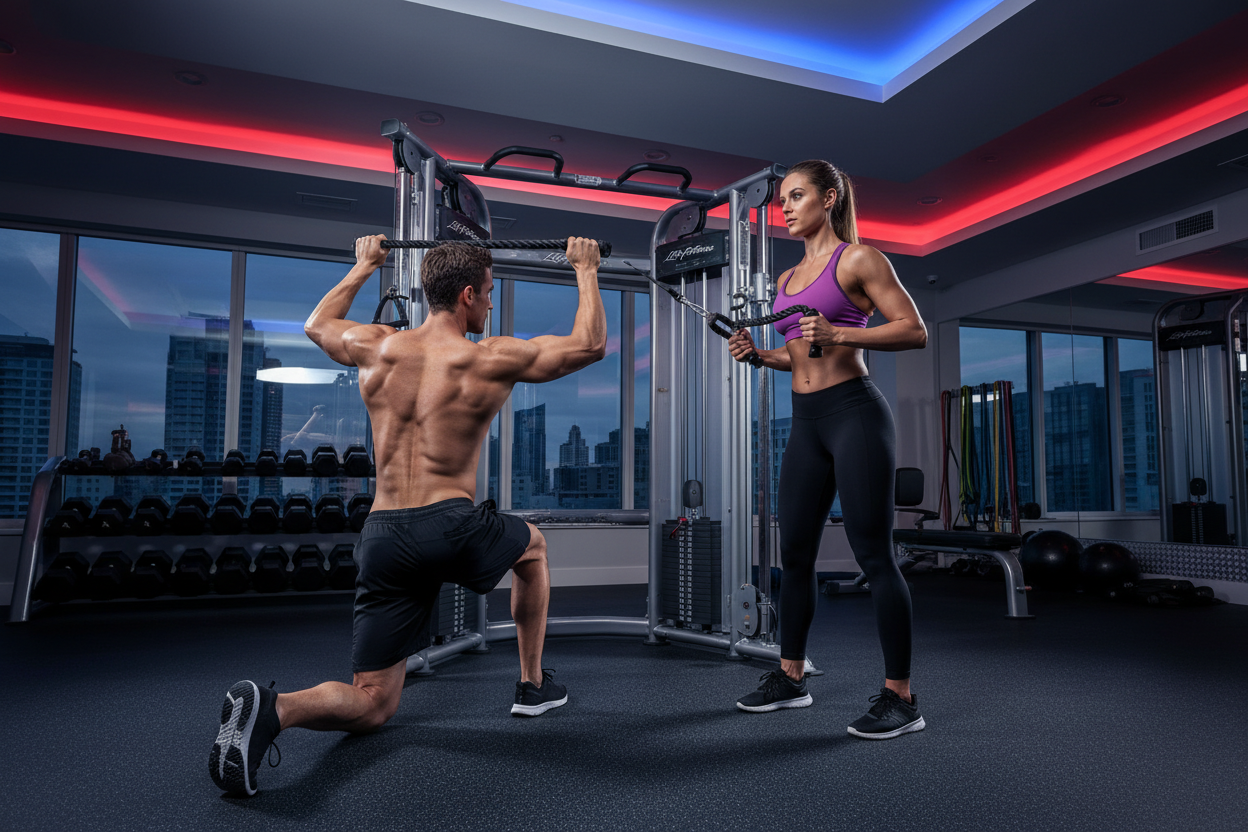
For the chest, the standing cable crossover is unmatched. Set the pulleys to shoulder height, step forward to engage the weight, and focus on the squeeze at the center of your chest. For the back, seated low rows and single-arm lat pulldowns offer incredible stretch and contraction. Do not forget isolation work: triceps pushdowns with a rope attachment and overhead biceps curls utilize the swivel pulleys perfectly to match your natural biomechanics.
Lower Body and Core Integration
Cables are not just for the upper body. By attaching an ankle strap, you can perform glute kickbacks, lateral leg raises, and hip adductions. These movements isolate the lower body in ways barbells simply cannot. For the core, high-pulley woodchoppers and kneeling cable crunches force your abdominals to stabilize against off-center loads, building functional, rotational strength.
From Our Gym: Honest Take
We have had a Life Fitness G7 Dual Adjustable Pulley in our main testing garage for over two years now. I can honestly say it gets more daily use than our power rack. The 1:2 resistance ratio means the weight increments are incredibly smooth, which is perfect for my shoulder rehab exercises. The aluminum pulleys glide without that annoying catch you feel on cheaper home gym units.
However, I will note one caveat: at 6'2", when I do standing overhead triceps extensions, the cable travel is just barely long enough before the weight stack tops out. If you are exceptionally tall, you might need to perform certain overhead movements from a seated or kneeling position. Aside from that, the powder-coated frame has survived two humid, un-air-conditioned summers with zero signs of rust.
Frequently Asked Questions
Are cable machines better than free weights?
They are not necessarily better, but they are highly complementary. Free weights are excellent for absolute strength and central nervous system adaptation, while cable machines excel at hypertrophy, isolation, and joint-friendly continuous tension.
How much space do I need for a Life Fitness cable machine?
While the machine itself may only take up roughly a 4x5 foot square, you should allocate a functional space of at least 7x7 feet. This ensures you have room to step away from the pulleys for walking lunges or cable crossovers.
Can I build muscle using only cables?
Absolutely. Muscle growth relies on mechanical tension, metabolic stress, and progressive overload. A high-quality cable machine allows you to achieve all three safely, making it entirely possible to build an impressive physique without ever touching a barbell.