I Stopped Trying to Replicate Every Gym Exercise in Home Workouts
I remember the night I hit a breaking point. I was at my workbench at 2 AM, trying to rig a boat winch to a pull-up bar because I thought I couldn't grow my lats without a commercial cable stack. It was dangerous, stupid, and completely unnecessary. I realized then that trying to force a gym exercise in home settings to look exactly like a machine-based movement is a recipe for injury and mediocre results. You don't need a $3,000 selectorized leg press to build wheels; you need to stop fighting your environment and start working with it.
Quick Takeaways
- Machines provide artificial stability; home workouts require you to build it yourself.
- Unilateral (single-leg/arm) movements are the secret to heavy loading with limited weight.
- Floor grip is the most underrated factor in home training safety.
- Ditch the 'cable clone' attachments that wobble under more than 50 lbs.
The 'Replicate Everything' Trap
The biggest mistake I see people make when building a home workout list is buying 'all-in-one' gadgets. You’ve seen them: the folding benches with flimsy leg extension attachments or the $40 door-frame cable pulleys. They promise to bring every gym exercises home, but they lack the mass and stability to actually work. If the equipment moves more than you do during a set, you aren't building muscle; you're just practicing a balancing act.
Instead of asking 'what are exercises you can do at home' that look like the ones in a commercial gym, ask what movements target the same muscle groups using gravity and leverage. A sissy squat might look nothing like a leg extension machine, but your quads won't know the difference when they're screaming at rep fifteen.
Why Your Living Room Just Doesn't Feel Like the Weight Room
There is a psychological and physical shift when you move from a commercial floor to a residential one. In a gym, the floor is usually bolted-down rubber or concrete, and the machines are heavy enough to stay put. At home, you’re often fighting the floor as much as the weight. This is why exercise in a gym feels different—you lose that 'ground reaction force' when your feet are sliding on laminate or sinking into carpet.
Biometrically, machines guide your path. At home, usually with dumbbells or bands, you have to stabilize the load in three dimensions. This makes home exercise moves feel harder at lower weights, which is actually a benefit if you're working with a limited dumbbell set. You don't need 100-lb bells if a 60-lb Bulgarian split squat leaves you gassed because you're actually using your stabilizer muscles.
The 'Do Not Attempt' List of Exercises at Home
I’ve learned the hard way that some things just don't belong in a house. Heavy barbell hip thrusts are a staple in my list of workouts at home, but only if you have a wall-mounted rack or a heavy sandbag. Doing them against a couch that slides backward is a great way to put a hole in your drywall.
Similarly, skip the makeshift pull-up stations. If you’re over 180 lbs, those 'no-screw' door frame bars are a gamble I wouldn't take. I’ve seen enough bruised tailbones to know that if the anchor point isn't solid steel bolted to a stud, it's not a reliable fitness exercise in home option.
The Blueprint: A Reliable At Home Exercise List
A real at home exercise list shouldn't be forty items long. It should be five or six heavy hitters that you can progressively overload. We’re looking for high-tension, high-stability movements. My training workouts at home revolve around the 'Big Five' adaptations: the squat, the hinge, the push, the pull, and the carry.
Lower Body Grinders That Don't Need Machines
If you want to blow up your legs without a leg press, you need to fall in love with the Bulgarian Split Squat. It is the king of the home exercise list. By putting one foot back on a chair or bench, you double the load on the front leg. Pair these with Romanian Deadlifts (RDLs) using whatever heavy object you have—a pair of 50-lb dumbbells is plenty to wreck your hamstrings if your form is locked in.
Upper Body Pulls When You Don't Have a Cable Stack
The best gym exercise at home for a wide back is the heavy single-arm row. You can use a bench, the edge of a sturdy table, or even your own knee for support. If you miss the constant tension of a cable lat pulldown, loop a heavy resistance band over a rafters or a high doorway. Banded pullovers provide that 'long lever' tension that simple rows sometimes miss.
Your Floor is the Ultimate Limiting Factor
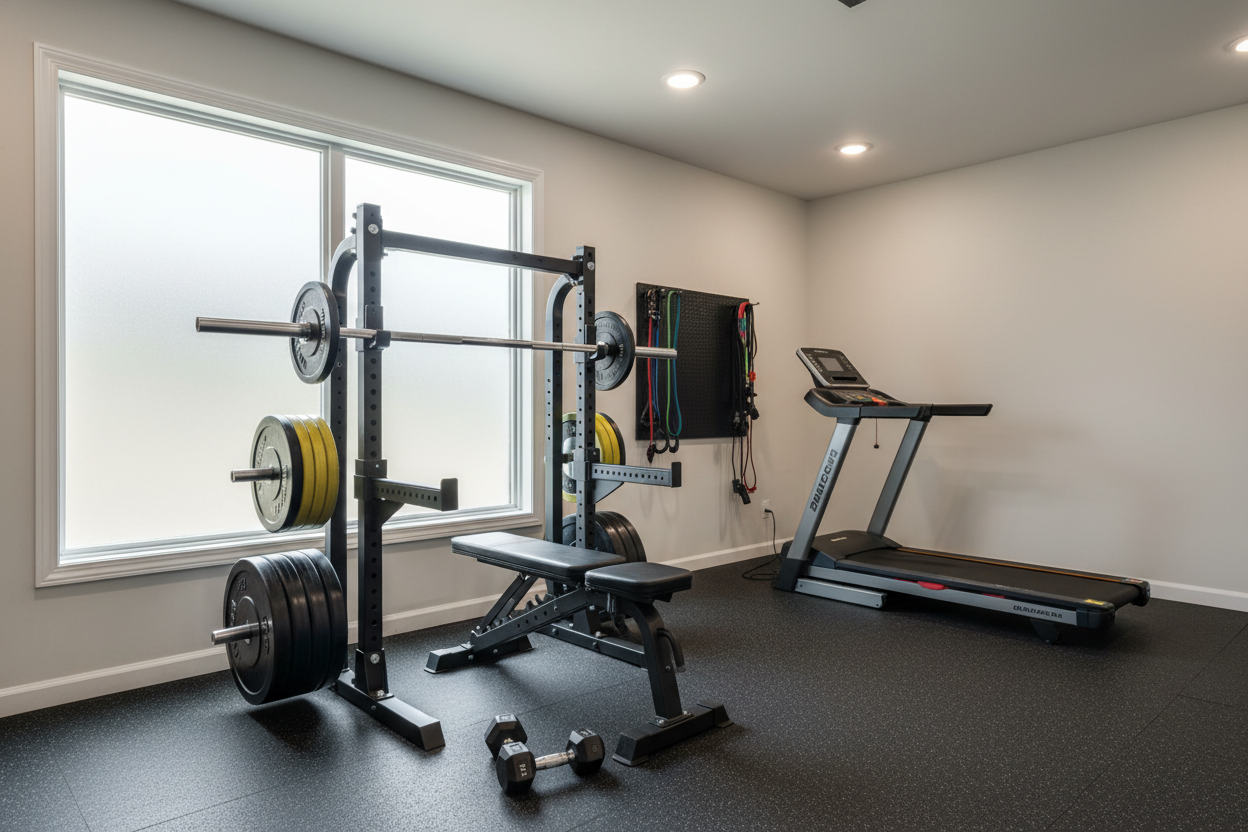
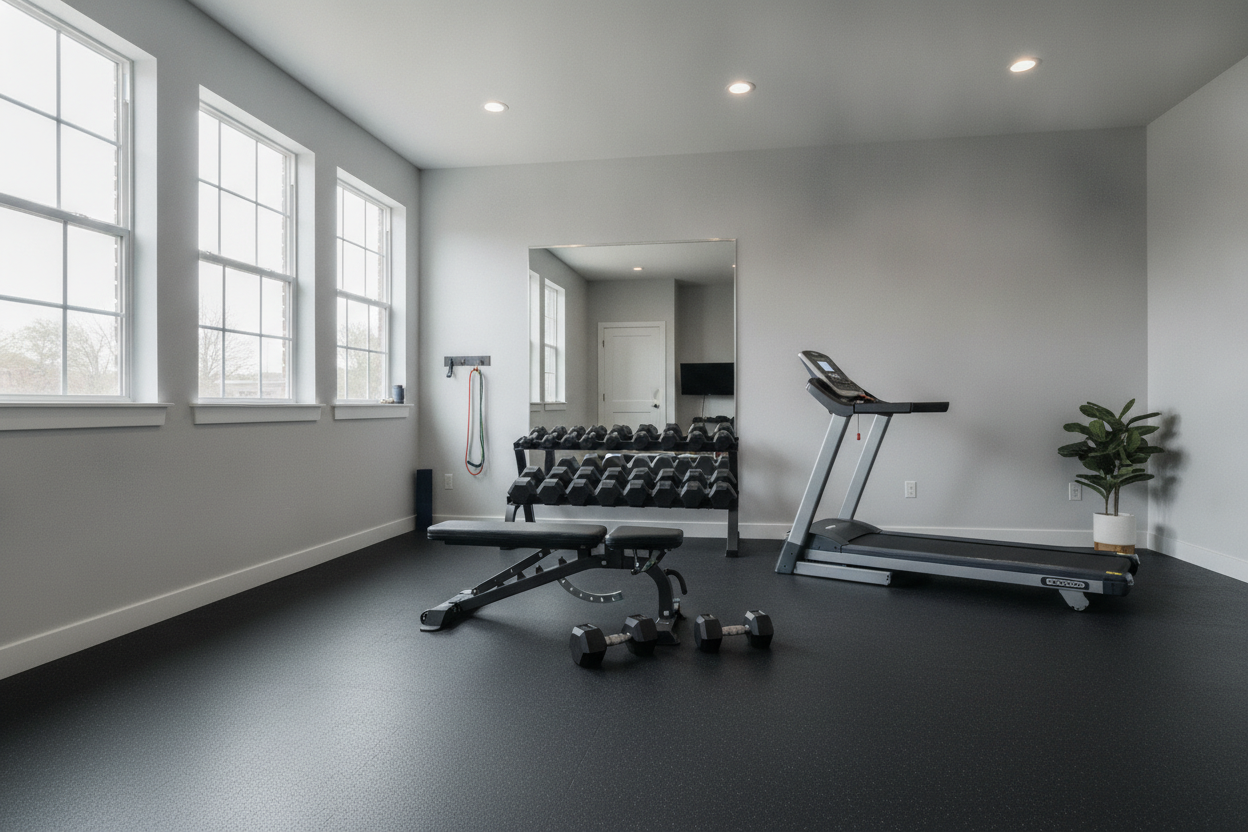
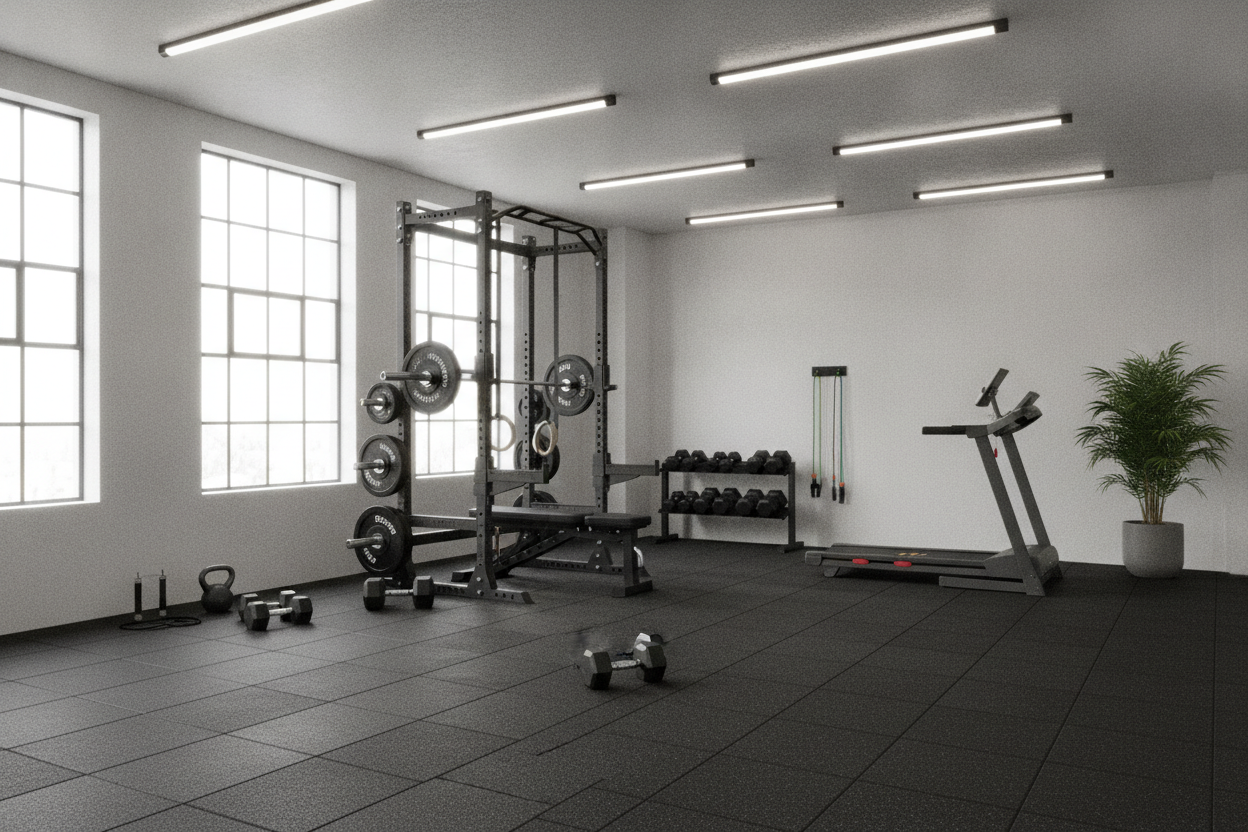
You can have the best dumbbells in the world, but if your feet are sliding during a lunge, your brain will 'throttle' your strength to keep you from falling. I spent years training on a thin yoga mat before I realized it was killing my progress. You need real estate and friction. Upgrading to large exercise mats for home gyms is the single best investment I made for my garage setup.
Specifically, if you're doing any explosive home workout moves or heavy deadlifts, a heavy-duty 6x8 exercise mat gives you enough room to move without resetting your feet every five seconds. It protects your subfloor from dropped weights and, more importantly, gives you the confidence to push through a heavy rep without your feet flaring out.
How to String These Together Into a Real Routine
To make this a legitimate exercise routines you can do at home, I recommend a Push/Pull/Legs split. Don't overcomplicate the simple exercise name; just focus on the movement. On Push days, do floor presses and overhead presses. On Pull days, do rows and pull-ups. On Leg days, do split squats and RDLs. Aim for 3 sets of 8-12 reps, and once that gets easy, slow down the tempo. A 4-second descent on a dumbbell squat will make 30 lbs feel like 80 lbs.
Personal Experience: My $200 Mistake
I once bought a 'tower' that promised dips, pull-ups, and leg raises. It was so light that it tipped over every time I tried to do a real pull-up. I ended up using it as a clothes rack for six months before selling it for twenty bucks. The lesson? Buy one solid piece of equipment (like a great mat or a pair of adjustable dumbbells) rather than a multi-tool that does five things poorly. Quality over variety every single time.
FAQ
What are some cool exercises to do at home with no equipment?
Focus on 'mechanical disadvantage' moves like Archer Pushups or Nordic Curls. These use your body's leverage to make standard bodyweight moves significantly harder without needing extra plates.
What is a good list of workout exercises at home for beginners?
Start with the basics: Goblet squats, push-ups, planks, and door-frame rows. Master the form before you worry about adding heavy external resistance.
Can I really build muscle with a list of workouts to do at home?
Yes, provided you follow the principle of progressive overload. If you don't have heavier weights, increase the reps, decrease the rest time, or slow down the eccentric (lowering) phase of the lift.