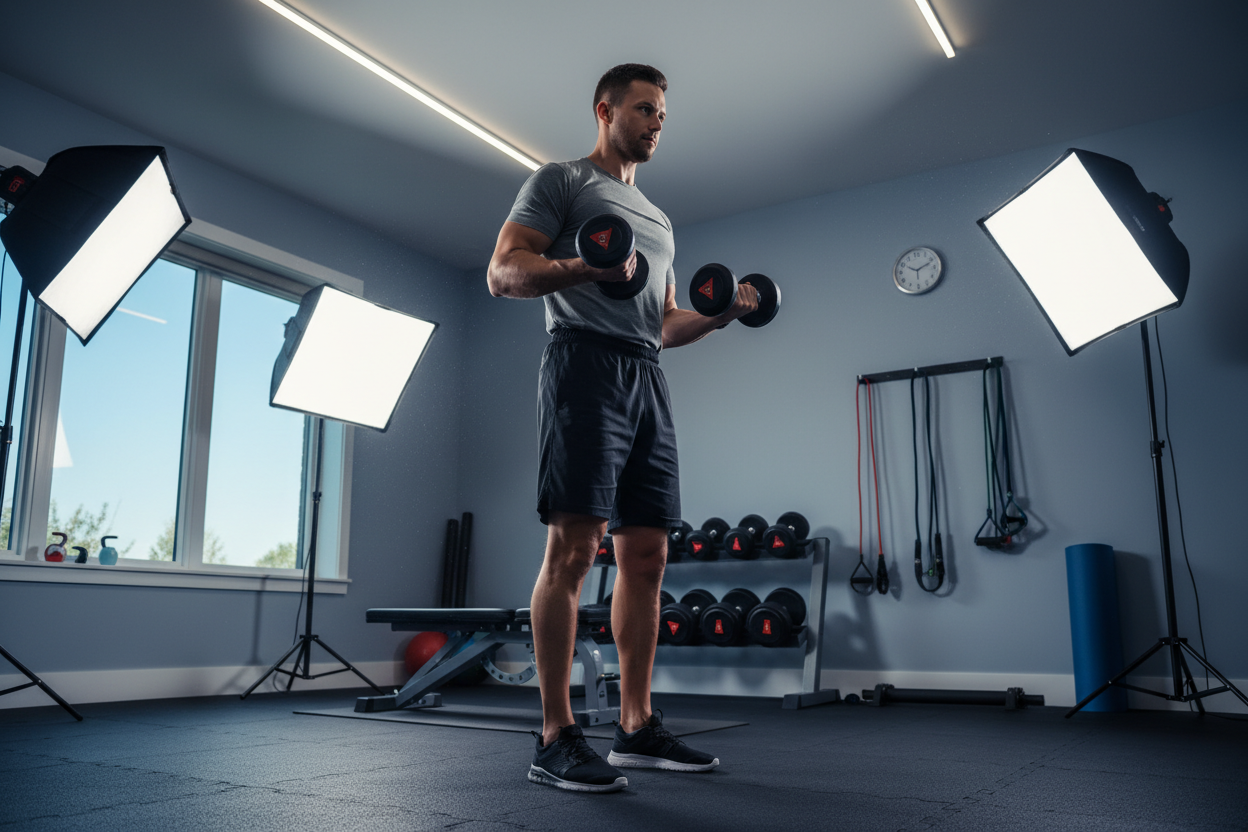
Full Body Workout Images: Visualizing Your Home Gym Routine
Ever walked into your garage gym, stared at your power rack, and completely blanked on your routine? You are not alone. Whether you are dealing with limited floor space or hitting a frustrating training plateau, relying purely on memory often leads to skipped sets and sloppy mechanics. That is exactly why utilizing full body workout images has become a staple strategy for serious home gym owners.
Having a precise visual reference does more than just remind you of your next exercise; it acts as a silent, on-demand coach. In this guide, we will explore how to effectively integrate visual workout plans into your home gym setup to maximize your space, perfect your biomechanics, and get the absolute most out of your equipment investment.
Key Takeaways
- Form Correction: Visual cues help align your posture and mechanics during complex compound lifts, reducing injury risk.
- Space Optimization: Following a visual guide allows you to stage your equipment (like dumbbells and benches) in advance for efficient supersets.
- Pacing and Flow: A clear visual roadmap eliminates the 'what next' downtime, keeping your heart rate elevated.
- Equipment Adaptability: High-quality images can help you find alternative movements if you lack specific commercial gym machines.
Integrating Visual Guides into Your Home Setup
Using a full body workout with pictures requires a bit of logistical planning. You do not want to be squinting at a tiny phone screen while holding a loaded barbell. Setting up your training environment to accommodate visual aids is crucial for a seamless session.
Screen Placement vs. Old-School Printouts
If you are training in a standard North American garage or basement, consider your sightlines. Wall-mounting a cheap smart TV or tablet at eye level (around 5 to 6 feet high) keeps your neck in a neutral position while checking your next movement. Alternatively, if you prefer a tech-free zone, laminating your routines ensures they survive the sweat and humidity of a non-climate-controlled space.
Matching Exercises to Your Equipment
Not all full body workout photos will perfectly align with your specific home gym loadout. The key is understanding movement patterns rather than getting fixated on specific machines.
Adapting Commercial Movements for Home Gyms
If an image shows a cable crossover but you only have an adjustable bench and free weights, you need to pivot to dumbbell flyes. Look for visual guides that categorize exercises by movement pattern (push, pull, hinge, squat) rather than specific apparatuses. This makes it infinitely easier to adapt a visual routine to a minimalist squat stand and barbell setup.
From Our Gym: Honest Take
When I first built my basement gym, I thought I could just memorize my programming or wing it. Six months in, my deadlift form was slipping, and my lower back was paying the price. I decided to print out high-resolution full body workout pictures detailing the exact hinge mechanics and taped them right next to my power rack. Seeing that visual cue of a neutral spine before every heavy pull completely rewired my setup. The only downside? Paper curls and fades fast in a damp basement. I eventually upgraded to a cheap, wall-mounted monitor protected by an acrylic shield, which I highly recommend if you have the clearance and budget.
Frequently Asked Questions
How do I best display workout images in a garage gym?
For budget setups, use a magnetic clipboard attached directly to your power rack uprights. If you have the budget, a wall-mounted tablet or TV on a swivel arm allows you to change the viewing angle depending on where you are lifting in the room.
Can I build an effective routine just using photos?
Absolutely. As long as the images clearly demonstrate the starting position, the midpoint of muscle contraction, and the finishing posture, you can build a highly effective and safe routine without needing lengthy video tutorials.
What equipment is essential for a standard full-body visual guide?
Most comprehensive visual routines can be completed with a flat or adjustable bench, a set of adjustable dumbbells, and resistance bands. If you want to tackle advanced heavy routines, a power rack and a standard 45lb barbell are highly recommended.