Chest Press Machine Muscles Worked: The Ultimate Anatomy Guide
You walk into the gym, and the bench press stations are taken. Again. You look over at the seated press station, wondering if it can actually deliver the same growth. Here is the honest truth: the machine isn’t just a backup plan for when the barbells are busy. It is a precision tool for hypertrophy.
Understanding the specific chest press machine muscles worked allows you to isolate fibers that free weights sometimes miss due to stability demands. Whether you are a bodybuilder looking to bring up a lagging body part or a beginner learning motor patterns, this machine has a distinct role in your programming.
Key Takeaways: Quick Anatomy Breakdown
- Primary Mover: Pectoralis Major (specifically the sternal head/mid-chest).
- Secondary Movers: Anterior Deltoids (front shoulders) and Triceps Brachii.
- Stabilizers: Serratus Anterior and Biceps (short head).
- The Verdict: The seated chest press machine muscles worked are nearly identical to the bench press, but with greater isolation and reduced stabilizer fatigue.
The Primary Movers: What You Are Actually Building
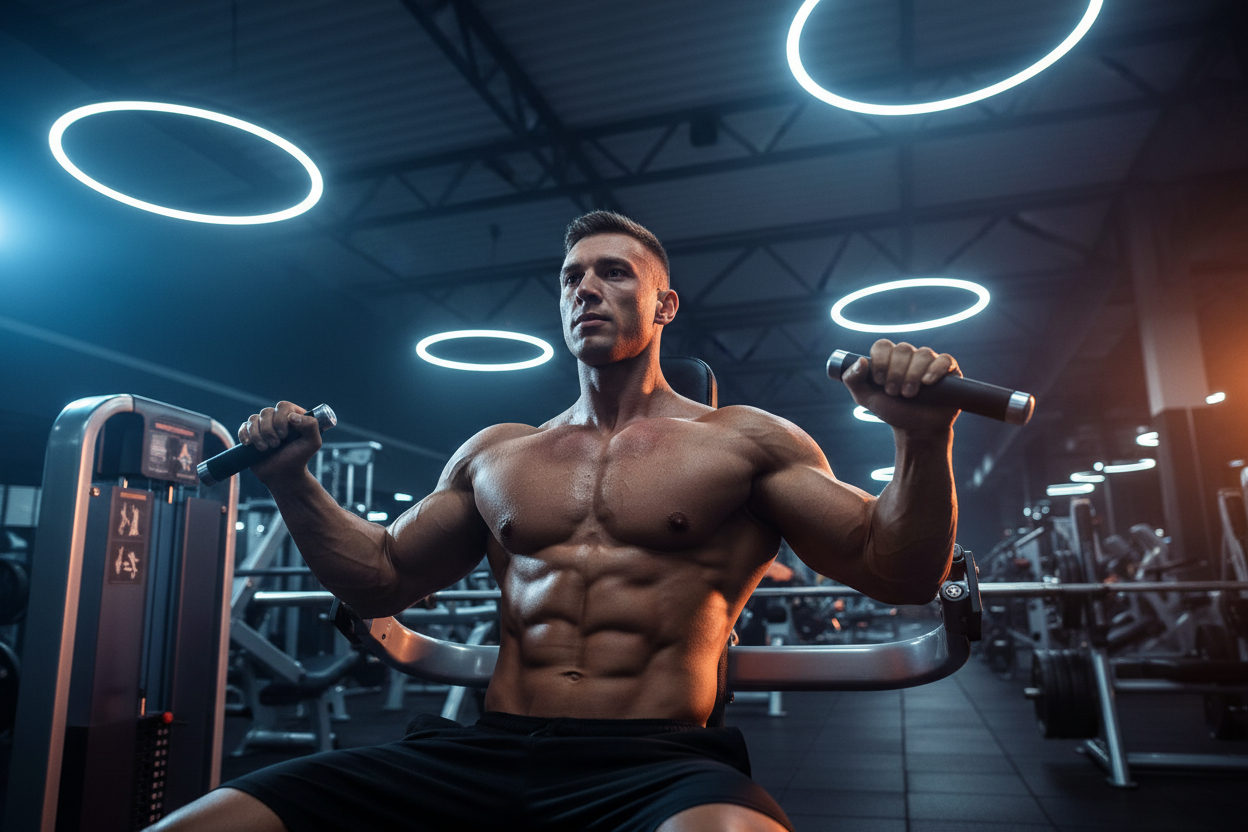
When you sit down and push those handles, you aren't just "working chest." You are engaging a specific kinetic chain. Let's break down the machine press muscles worked with some biomechanical nuance.
1. Pectoralis Major (The Engine)
This is the obvious one. The chest press machine primarily targets the sternal head of the pecs. Because the machine follows a fixed path, you can maintain constant tension on these fibers without worrying about balancing a bar. This creates a high stimulus for the mid-chest region.
2. Anterior Deltoids (The Helper)
Your front delts are heavily involved in any pressing movement. However, one of the seated chest press machine muscles worked nuances is that you can often adjust the seat height. If you sit too low (handles high), you shift more load onto the anterior delts. If you sit correctly, they act as a strong secondary mover rather than taking over the lift.
3. Triceps Brachii (The Lockout)
The triceps are responsible for extending the elbow. During the final third of the movement—the lockout—your triceps take a beating. This makes the machine bench press muscles worked profile excellent for developing arm thickness alongside chest width.
Benefits of Chest Press Machine Over Free Weights
Why choose the machine? The machine bench press benefits go beyond just convenience. It comes down to the tension curve.
With a dumbbell press, tension drops off at the top of the movement (when your arms are stacked). With most modern machines, the resistance remains constant throughout the entire range of motion. This leads to greater metabolic stress on the muscle, which is a key driver for growth.
Additionally, the chest press machine benefits include safety. You can train to absolute failure without a spotter. There is no fear of getting pinned under a bar, allowing you to push that extra rep that actually triggers adaptation.
Does Chest Press Machine Work Upper Chest?
This is a common question. The standard flat press machine targets the mid-chest. However, the answer depends on the machine's mechanics and your setup.
If you use a specific "incline" lever machine, absolutely. But on a standard flat seated press, you can slightly emphasize the upper fibers (clavicular head) by lowering the seat. This places the handles higher relative to your shoulder joint, mimicking a slight incline press path. Just be careful not to go so high that your shoulders take over completely.
Variations: MTS, Converging, and Standard
Not all machines are built the same. The chest press machine variations you choose will alter the stimulus slightly.
MTS and Iso-Lateral Machines
The MTS chest press muscles worked are the same as the standard version, but with one key difference: independence. MTS (Motion Technology Selectorized) machines usually allow you to move each arm independently. This prevents your dominant side from compensating for your weaker side, ensuring balanced development.
Converging vs. Fixed Path
Old-school machines push straight out. Newer, converging machines bring your hands together at the peak of the movement. The converging style is superior for peak contraction of the inner chest fibers.
My Training Log: Real Talk
I want to step away from the textbook anatomy for a second and talk about what this actually feels like in the gym.
I remember specifically using an older model Life Fitness chest press at a hotel gym in Chicago. It was one of those units where the weight stack feels "sticky"—you know that friction/grit feeling on the eccentric phase? I hated it at first, but I realized something mid-set.
That friction forced me to control the negative way harder than I do on a smooth barbell. I couldn't just drop the weight and bounce it off my chest. I had to grind through the grit. My triceps were screaming in a way they rarely do on free weights because the machine locked me into a path I couldn't cheat. Now, when I use machines, I intentionally look for that "locked-in" feeling where my lower back is jammed against the pad so hard it leaves a mark. If you aren't bracing your feet and driving your back into the pad, you're missing half the leverage.
Bottom Line
The seated chest press isn't "cheating." It's a tool for high-intensity output with low injury risk. By understanding exactly what muscles does the chest press machine work, you can slot it into your workout—preferably after your heavy compounds or as a burnout finisher—to maximize hypertrophy.
Frequently Asked Questions
Can the chest press machine replace the barbell bench press?
It can replace it for hypertrophy (muscle growth) purposes, yes. However, for pure strength and stabilizer development, the barbell bench press is superior. A balanced program often uses both.
Why do I feel the chest press in my shoulders?
This usually happens if your seat is too low (handles are too high) or if your elbows are flared out too wide. Raise the seat so the handles align with your mid-chest and tuck your elbows slightly to engage the pecs.
Is the machine press better for beginners?
Yes. It teaches the horizontal pushing motor pattern without the stability demands of free weights. This allows beginners to build the requisite muscle mass before moving to more complex stabilization movements.