
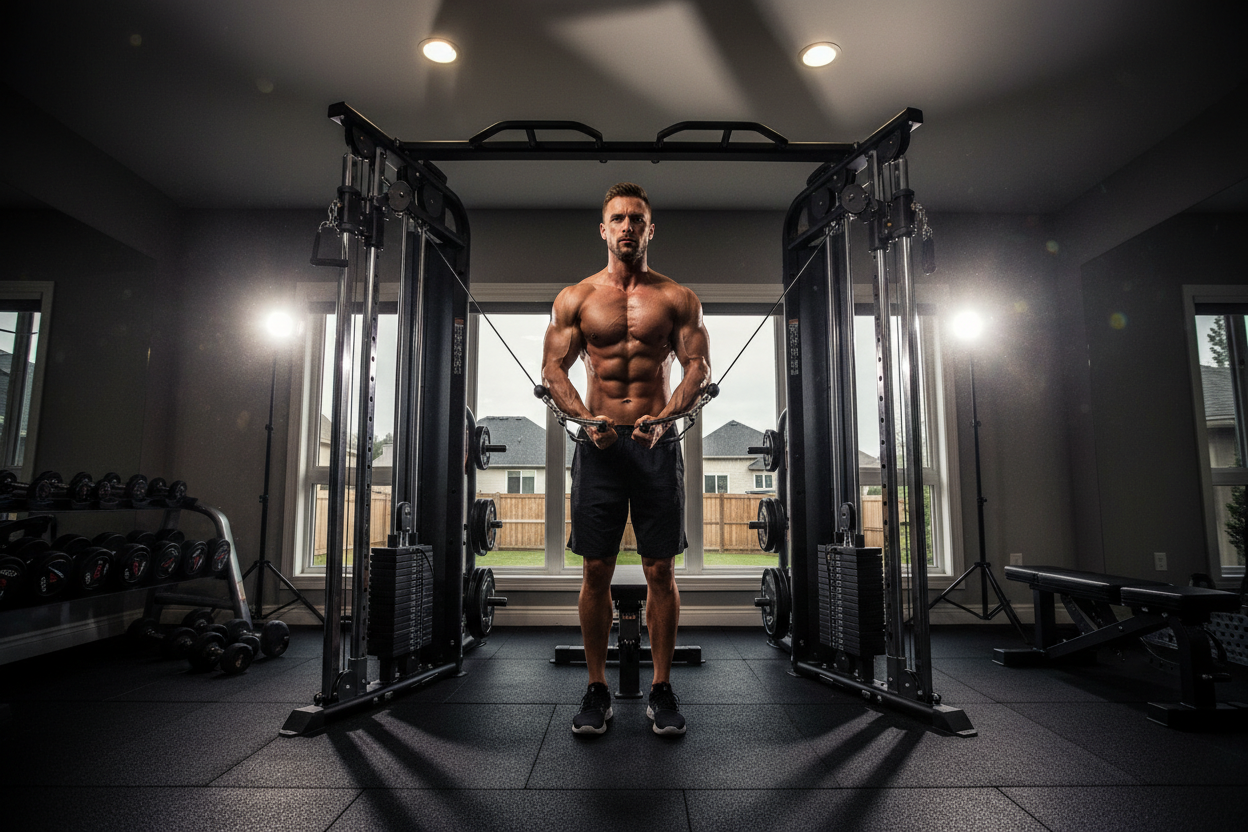
Cable Crossover Machine Home Gym Truths: Read Before Buying
If you have hit a plateau with free weights, you are probably missing the constant tension that only cables can provide. Building a dedicated cable crossover machine home gym setup is often the turning point where a basic garage gym transforms into a comprehensive training facility.
But let us be realistic: these machines are massive, expensive, and require careful planning. Before you dedicate half of your floor space to dual weight stacks, you need to know if the investment matches your training style and physical space.
Key Takeaways
- Space Requirements: Expect to need at least 10 feet of width and 8 feet of ceiling clearance for a full-sized unit.
- Pulley Ratios: Most functional trainers use a 2:1 ratio, meaning a 100-pound stack provides 50 pounds of actual resistance.
- Plate-Loaded vs. Selectorized: Plate-loaded models save money, but selectorized weight stacks offer faster drop sets and convenience.
- Versatility: A crossover setup replaces dozens of single-use machines, making it the ultimate tool for isolation work and functional training.
Sizing Up Your Space
Footprint & Ceiling Clearance
The biggest hurdle when planning a cable crossover for home gym use is the sheer footprint. Unlike a power rack that sits neatly in a corner, a true crossover machine dominates the room. You need a minimum of 10 feet in width just to house the frame, plus an extra 2 to 3 feet of clearance on either side for your arms to extend fully during chest flyes.
Ceiling height is another trap. Standard basement ceilings in North America hover around 84 inches. Since many commercial-grade cable towers stand at 82 to 90 inches tall, you must measure your vertical clearance—including any low-hanging ductwork—before hitting the checkout button.
Key Specs to Compare
Weight Stacks vs. Plate-Loaded
When choosing a cable crossover home gym system, your budget will largely dictate the resistance type. Plate-loaded machines utilize your existing Olympic plates. They are highly cost-effective but can be tedious if you frequently perform supersets or drop sets. Selectorized machines (with built-in weight stacks) offer a premium, commercial feel with pin-select convenience, though they cost significantly more and complicate the shipping process.
Pulley Ratios Explained
Do not be fooled by a 200-pound weight stack until you check the pulley ratio. A 2:1 ratio is standard for functional trainers, meaning you are moving half the selected weight. This allows for faster cable travel (ideal for athletic movements) but means strong lifters might max out the stack on heavy lat pulldowns or low rows. If you want raw, heavy resistance, look for a 1:1 ratio machine.
From Our Gym: Honest Take
After running a commercial-grade dual cable setup in our testing garage for the last 14 months, I can confidently say it completely changed my programming. The constant tension on tricep pushdowns and lateral raises is something dumbbells simply cannot replicate.
However, it was not all smooth sailing. At 6 foot 2, I found that the 82-inch uprights on our mid-tier model did not allow for a full stretch on lat pulldowns from a seated position. I have to perform them kneeling. Also, the assembly process took two of us nearly six hours. If you are buying a selectorized model, grease the guide rods with silicone spray on day one—it makes a massive difference in the smoothness of the aluminum pulleys. The nylon pulleys we tested on a cheaper model felt jarring by comparison.
Frequently Asked Questions
Is a cable crossover machine worth it for a home gym?
Yes, if you prioritize hypertrophy and isolation movements. It offers constant tension through the entire range of motion, which is difficult to achieve with barbells and dumbbells alone. However, powerlifters or those strictly focused on the big three lifts may find it unnecessary.
Can I build a full physique using only cables?
Absolutely. While free weights are excellent for foundational strength, a cable machine allows you to hit every major muscle group from multiple angles. You can perform squats, deadlift variations, chest presses, and endless accessory work.
How do I maintain the cables and pulleys?
Maintenance is surprisingly simple. Wipe down the guide rods with a dry cloth weekly to prevent dust buildup. Every few months, apply a light coat of 100% silicone lubricant to the rods. Inspect the cable coating for fraying annually, as a snapped cable under heavy load can be dangerous.


