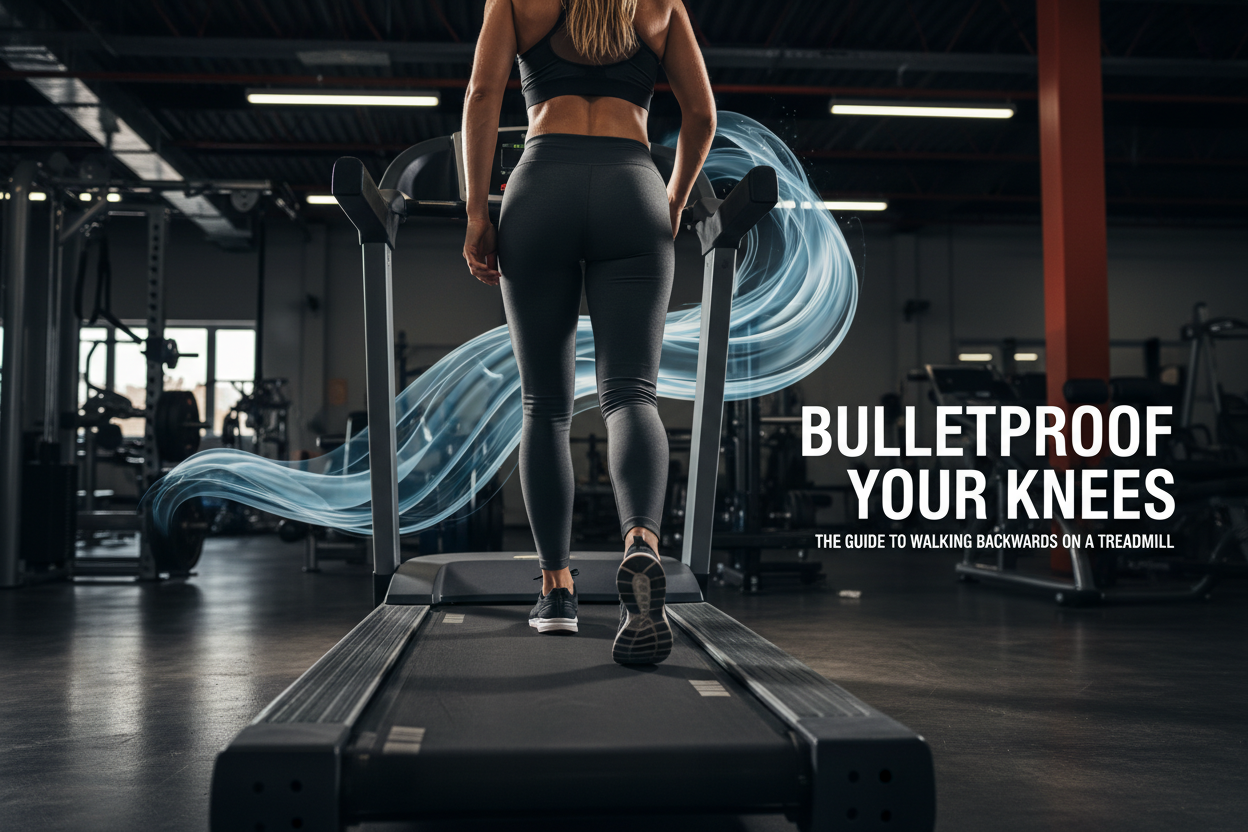
Bulletproof Your Knees: The Guide to Walking Backwards on a Treadmill
Most gym-goers stare straight ahead, counting down the minutes until their cardio session ends. But if you have spent any time on the fitness side of the internet recently, specifically following the "Knees Over Toes" philosophy, you have likely seen people doing the exact opposite. Walking backwards on a treadmill—also known as retro walking—has shifted from an obscure physical therapy drill to a mainstream staple for athletic durability.
It looks unusual, but the mechanism behind it is solid. Whether you are recovering from a tweak or trying to increase your vertical jump, reversing your direction changes how your biomechanics load your joints. This isn't just about burning calories; it is about structural integrity.
Key Takeaways
- VMO Activation: Walking backwards specifically targets the Vastus Medialis Oblique (the teardrop muscle above the knee), which is crucial for knee stability.
- Reduced Joint Impact: Retro walking creates less compressive force on the patellofemoral joint compared to forward running, making it ideal for rehab.
- Deadmill vs. Powered: You can use a standard treadmill turned on for cardio, or turned off (resisted) for strength training.
- Shin Splint Relief: It strengthens the tibialis anterior, helping to balance leg muscles and prevent common runner's injuries.
Why Walk Backwards? The Science of Reverse Treadmill Walking
Why do people walk backwards on treadmill belts when forward motion is so much more natural? The answer lies in the posterior chain and the knees.
When you walk forward, you heel strike. When you engage in backward treadmill walking, you strike with your toe first. This reversal forces your quadriceps to contract eccentrically to control the knee extension. A study published in the Journal of Biomechanics suggests that retro walking reduces the compressive force on the knee joint while still providing a high level of muscle activation.
Targeting the VMO
The primary benefit of walking backwards on a treadmill is the isolation of the VMO. This is the muscle responsible for tracking your kneecap properly. Most people are quad-dominant but have weak VMOs, leading to "runner's knee." Walking backwards on treadmill muscles worked primarily includes the quads, calves, and shins, but that VMO burn is what you are chasing.
The "Knees Over Toes" Connection
You cannot discuss this topic without mentioning Ben Patrick, the Knees Over Toes Guy. He popularized the concept of "ROKP" (Reverse Out Knee Pain). The philosophy is simple: to bulletproof your knees, you must train them through a full range of motion and strengthen the muscles that support the joint in reverse.
While Patrick often uses a specific ATG treadmill (a manual, resisted treadmill designed for this), you don't need specialized ATG equipment to get started. A standard commercial treadmill works fine if you know how to manipulate the settings.
How to Walk Backwards on a Treadmill Safely
If you have never done this, do not just hop on and hit "start." Your coordination needs to adjust.
1. The Powered Method (Cardio & Endurance)
Start the machine at a very low speed (1.0 – 1.5 mph). Turn around, holding the handrails firmly. Focus on reaching back with your toe, rolling through to the heel, and extending the knee. As you get comfortable, you can let go of the handrails to engage your core, but keep your hands ready.
2. The Deadmill Method (Strength & Hypertrophy)
This is often called the reverse treadmill knees over toes method. With the machine turned off, lean your back against the console (or hold the rails) and use your legs to push the belt backward. This creates significant resistance. It mimics pushing a sled and is incredible for strength.
Incline vs. Flat: Dialing Up the Intensity
Once you master the flat surface, you might ask: what does walking backwards on an incline do?
Walking backwards on treadmill incline settings significantly increases the demand on your quads. Because you are fighting gravity, the burn in the VMO happens much faster. However, range of motion is king. If the incline forces you to shorten your stride too much, lower it. You want a full extension of the knee with every step.
My Training Log: Real Talk
I want to share my personal experience with walking backwards on a treadmill, specifically the "deadmill" variation, because the tutorials often skip the gritty details.
The first time I tried this at my local commercial gym, I realized not all treadmills are created equal. I hopped on an older model to try the "turned off" push method. The belt had so much friction that I could barely get it moving, and when I did, the movement was jerky. I felt a distinct strain in my lower back because I was fighting the machine's mechanics rather than my own muscles.
I switched to a newer model with a smoother belt. The game-changer for me wasn't the leg burn—I expected that. It was the grip. Holding the rubberized handrails while sweating caused my hands to slide, breaking my rhythm. I actually started bringing a small towel to drape over the sensor bar so I could push hard without slipping. Also, nobody warns you about the "sea legs" sensation. When I stepped off after 10 minutes of reverse walking, my brain felt like it was still moving backward. I nearly stumbled into the water fountain. That neurological reset is real, so take a second before walking away.
Conclusion
Is walking backwards on a treadmill good for you? Absolutely. It is a low-impact, high-reward tool for anyone looking to improve knee health, coordination, and leg strength. Whether you are using a fancy backward treadmill for sale or just the standard cardio equipment at your local gym, the key is consistency. Start with 5 minutes before your leg day, and your knees will thank you.